
A Pilgrim’s Record of Gupta-period Bharat
What kind of civilizational world had to exist for a Chinese monk to travel thousands of kilometres, cross mountains and deserts, spend years in India, find teachers and manuscripts, and return home carrying knowledge that had not been available to him in his own land?
A Short Biography
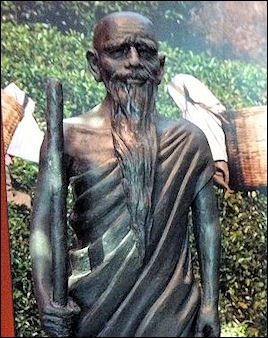
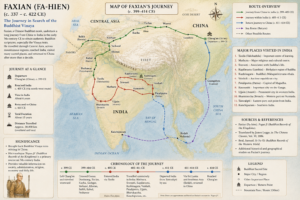
Faxian (Fa-Hien) was a Chinese Buddhist monk who travelled from China to India between 399 and 414 CE, primarily in search of complete copies of the Vinaya, the disciplinary texts of the Buddhist monastic order. Unlike many later travellers who came as diplomats, merchants or court observers, Faxian travelled principally as a pilgrim and seeker of knowledge, moving through Central Asia, Gandhāra, North India, the Gangetic plain, Pāṭaliputra, Bodh Gayā and the eastern coast before continuing to Sri Lanka and returning to China by sea. His journey is recorded in the Fo-guo-ji, generally translated as A Record of Buddhist Kingdoms, translated into English by James Legge in 1886. The surviving account is particularly valuable because Faxian records not merely Buddhist monuments, but also observations concerning political administration, social customs, punishment, taxation, charitable institutions, education, monasteries, pilgrimage, urban life and the condition of places associated with India’s religious past.
What makes Faxian especially valuable for Civilizational Studies is the purpose of his journey. He was not travelling to write a political history of India; he was looking for knowledge that was considered incomplete in his own country, and his journey therefore reveals the intellectual networks through which India functioned as a source of learning for Buddhist Asia. His account also gives us an unusual glimpse into the Gupta-period social world, particularly in what he calls the “Middle Kingdom”, where he observed political authority, economic life, social customs, charity and religious institutions together. At the same time, Faxian must be read as a Buddhist pilgrim: his attention is naturally concentrated upon monasteries, relics, sacred places and Buddhist communities, and his account should not be mistaken for a comprehensive description of all Indian society.
Major Work
- Fo-guo-ji (佛國記) — A Record of Buddhist Kingdoms
- English translation: James Legge, A Record of Buddhistic Kingdoms (1886). The complete translated text and Chinese text are available in the Project Gutenberg edition.
Some Important Insights
1. A Society That He Described as Prosperous
One of Faxian’s most striking observations occurs when he reaches what he calls the Middle Kingdom, referring to the central regions of northern India:
“The people are numerous and happy.”
He continues by observing that they did not have to register their households or regularly appear before magistrates, and that those cultivating royal land paid a portion of the produce. He adds:
“The king governs without decapitation or (other) corporal punishments.”
— Faxian, A Record of Buddhist Kingdoms, Chapter XVI, “On to Mathurā or Muttra.”
This is one of the most frequently cited passages from Faxian, but its importance goes beyond the question of whether Gupta India had a “mild” penal system. Faxian is describing a society in which political authority appears relatively light in the everyday life of ordinary cultivators, at least from the perspective of this particular traveller. He continues that criminals were generally fined according to circumstances and notes that even repeated rebellion was punished by cutting off the right hand rather than execution.
2. A Society Organised Around Non-Violence
Faxian gives another remarkable observation:
“Throughout the whole country the people do not kill any living creature, nor drink intoxicating liquor, nor eat onions or garlic.”
— A Record of Buddhist Kingdoms, Chapter XVI.
He immediately qualifies this observation by discussing the Chaṇḍālas, whom he describes as living separately and being required to announce their presence when entering cities or markets; he also says that they were associated with hunting, fishing and the sale of meat.
This is particularly valuable because Faxian’s account simultaneously records a strong ideal of non-violence and a significant form of social exclusion.
3. Charity Was Institutionalised
Perhaps Faxian’s most important observation for the study of social institutions comes from Pāṭaliputra:
“The Heads of the Vaiśya families in them establish in the cities houses for dispensing charity and medicines.”
He then describes who could use them:
“All the poor and destitute in the country, orphans, widowers, and childless men, maimed people and cripples, and all who are diseased, go to those houses.”
And he adds that they were provided with:
“every kind of help”
including food and medicines, after which physicians examined their illnesses. — A Record of Buddhist Kingdoms, Chapter XXVII, “Pāṭaliputtra or Patna.”
This passage deserves much more attention than it usually receives because Faxian is not describing charity as an occasional act of individual generosity. He is describing institutionalised philanthropy, supported by wealthy Vaiśya families and organised through establishments within cities. That opens an important civilizational question: what happens to a society when care for the vulnerable is distributed through community institutions rather than being understood exclusively as a function of the state? It certainly gives us evidence of a form of organised social responsibility in Gupta-period Pāṭaliputra.
4. The King Bowed Before the Scholar
Faxian also records something particularly interesting about the relationship between political authority and knowledge. At Pāṭaliputra, he describes a Brahmin named Rādhasāmi, whom he identifies as a learned teacher associated with the Mahāyāna. Faxian writes:
“The king of the country honoured and reverenced him, and served him as his teacher.”
He then adds:
“If he went to inquire for and greet him, the king did not presume to sit down alongside of him.”
— A Record of Buddhist Kingdoms, Chapter XXVII.
Whatever the precise historical circumstances, the scene is conceptually significant. Faxian presents political authority standing in a relationship of reverence towards intellectual authority. The king possesses power, but the scholar possesses a different kind of authority. For Civilizational Studies, this is an invitation to investigate a much larger question: how did different forms of authority—political, intellectual, religious and social—interact in Indian institutions?
 5. Pāṭaliputra as a Centre of Intellectual Life
Faxian’s description of the monasteries at Pāṭaliputra is also revealing:
“Shamans of the highest virtue from all quarters, and students, inquirers wishing to find out truth and the grounds of it, all resort to these monasteries.”
— A Record of Buddhist Kingdoms, Chapter XXVII.
This is an extraordinarily useful line for the history of knowledge. Faxian does not describe the monastery merely as a place where monks performed rituals. He describes it as a place where students and seekers came to investigate truth and its grounds. This is exactly the sort of evidence that allows us to move beyond the simplistic idea that ancient educational institutions were merely “religious centres”. They could simultaneously function as spaces of residence, learning, debate, textual preservation and intellectual exchange.
6. Knowledge Was Being Preserved Through Institutions
Faxian’s own journey provides perhaps the strongest evidence of this. He spent years in India copying manuscripts and studying Buddhist texts. The contents of his account show that monasteries across different regions possessed distinct textual traditions and disciplinary practices, while his stated purpose from the beginning was to obtain complete copies of the Vinaya that were unavailable to him in China.
His journey is therefore itself evidence of a trans-Asian knowledge network. India was not simply the place from which a religion had historically spread; it remained, centuries later, a destination to which foreign scholars travelled because texts, teachers, institutions and traditions were still available there. That is a civilizational fact worth studying in its own right.
7. The Past Was Still Present
One of the most fascinating aspects of Faxian’s account is his repeated encounter with layers of historical memory. He visits places associated with the Buddha, but often finds that the original cities have changed dramatically. At Kapilavastu, for example, he writes:
“There was neither king nor people. All was mound and desolation.”
Yet the sacred locations associated with the Buddha were still identified, marked and venerated. This gives us an important civilizational insight: political and urban decline does not necessarily erase cultural memory. A city may disappear while its sacred geography remains intelligible. A political centre may become ruins while pilgrimage continues. The physical settlement may decline while memory gives the place another form of life.
This is an important dimension of Civilizational Studies because it reminds us that historical continuity can operate through memory and sacred geography even when political continuity has been broken.
Reading Fa-xian
Faxian is a remarkably valuable source, but he is not a neutral census-taker of Gupta India. His primary purpose was Buddhist pilgrimage and textual recovery, and consequently Buddhist institutions, monasteries, relics and sacred places occupy a disproportionate place in his account. He gives us something inscriptions cannot easily provide: the texture of lived society as encountered by a traveller. He tells us about the road, the monastery, the city, the physician, the poor person seeking help, the king approaching a scholar, the pilgrim being received by strangers, the rituals of ordinary communities and the ruins of once-great cities. And perhaps his greatest contribution to Civilizational Studies is that he allows us to see Gupta-period Bharat not simply as the age of an emperor or a dynasty, but as a network of communities, institutions, sacred places, intellectual centres and social practices.
Faxian came to Bharat looking for books. What he left behind was something much larger: a record of a society in which knowledge travelled, pilgrims travelled, institutions travelled, and memory itself travelled across generations and across borders.
For the researcher, therefore, the most interesting question is not simply “What did Faxian say about India?”
It is: What kind of civilizational world had to exist for a Chinese monk to travel thousands of kilometres, cross mountains and deserts, spend years in India, find teachers and manuscripts, and return home carrying knowledge that had not been available to him in his own land?
That question takes us beyond Faxian the traveller—and towards Bharat as a civilizational knowledge network.
