
An Outsider Looking at Mauryan Bharat
A Short Biography
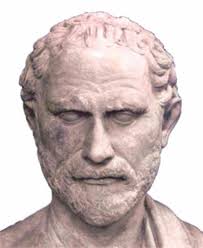
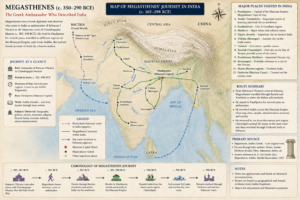
Megasthenes was a Greek diplomat associated with Seleucus I Nicator and was sent as an ambassador to the court of Chandragupta Maurya at Pāṭaliputra, probably in the early third century BCE. Very little is known about his personal life, but his importance is enormous because his Indica became the most substantial Greek account of India based upon direct observation available to the ancient Mediterranean world. He described India’s geography, peoples, political organisation, cities, occupations, customs, religious specialists and social institutions, drawing both upon his own observations and information received from people in India. His work was subsequently used extensively by Diodorus, Strabo, Arrian and Pliny, although the original text itself has not survived.
This makes Megasthenes an unusual source for the study of Bharat. He was neither an Indian court chronicler nor a later European colonial observer; he was an outsider who encountered the Mauryan world at a moment when a large imperial formation had em
erged in northern India. His account therefore allows us to ask a fascinating question: what did Bharat look like to an educated foreign observer who had actually entered its political and social world? At the same time, he must be read carefully, because some of his descriptions contain errors, exaggerations and material that he appears to have received as local reports or legends.
Major Work
- Indica — the principal work through which Megasthenes described India.
- The original text is lost; surviving fragments occur principally in Diodorus Siculus, Strabo, Arrian and Pliny the Elder.
What Did Megasthenes See in Bharat?
1. A Society Without Slavery?
One of Megasthenes’ most striking observations concerns slavery. Through Arrian’s preservation of his account, we read:
“All the Indians are free, and not one of them is a slave.”
— Megasthenes, preserved in Arrian, Indica, 10.
This is an extraordinary statement, and precisely because it is extraordinary, it must not be turned into a simplistic claim that ancient India had no forms of servitude whatsoever. Megasthenes was describing what he observed or was told within the social order he encountered, and his terminology must be understood within the Greek conceptual world from which he came. Nevertheless, the observation is historically important because he explicitly compares Indian society with the Greek world and finds the absence of slavery remarkable. Arrian preserves his comparison with Sparta, noting that while the Lacedaemonians possessed Helots, “the Indians have no slaves at all.”
For Civilizational Studies, the more useful question is therefore not simply whether Megasthenes was technically correct, but what social arrangements he encountered that led him to make such a striking comparison.
2. The Farmer Was Protected Even During War
Perhaps one of the most interesting passages in the entire surviving Indica concerns agriculture and warfare. Megasthenes observed that Indian farmers were treated differently from combatants:
“husbandmen are regarded as a class that is sacred and inviolable”
and even while battles were being fought around them, the cultivators continued working their land without being attacked.
Megasthenes goes further, explaining that opposing armies could fight one another while leaving the cultivators unharmed, and that combatants did not normally burn agricultural land or destroy trees. He connects this practice directly with food security, observing that because the land was not devastated, it continued to produce abundant crops.
Whether this represented an absolute rule across ancient India is another question, but the observation is enormously valuable. Megasthenes was not simply describing agriculture; he was noticing a relationship between warfare, food production and social norms.
That is exactly the kind of relationship that Civilizational Analytics should investigate.
3. Knowledge Had a Public Function
Megasthenes gives us another fascinating picture when he describes the philosophers of India and what he calls the Great Synod. According to Strabo’s preservation of Megasthenes:
“The philosophers are first in rank, but form the smallest class in point of number.”
At the beginning of the new year, the philosophers assembled before the king, and those who had recorded useful observations concerning crops, cattle or public affairs could present them publicly. The most striking part comes next. Megasthenes says that a philosopher who was repeatedly found to have given false information could be compelled to remain silent for life, whereas one who gave sound advice received exemption from taxes and contributions.
Even allowing for the limitations of Megasthenes’ terminology, this is a fascinating description of knowledge being connected to public responsibility. The philosopher is not presented merely as someone engaged in private metaphysical speculation. Knowledge about crops, cattle and public affairs enters the political sphere.
For researchers today, this raises a question worth pursuing: What happens when knowledge is treated as a public responsibility rather than merely as an academic speciality?
4. Pāṭaliputra Was a Major Urban Centre
Megasthenes’ description of Pāṭaliputra gives us an unusually concrete picture of the Mauryan capital. He describes the city as approximately 80 stadia in length and 15 stadia in breadth, protected by a wooden wall and surrounded by a defensive ditch.
In another surviving passage, he describes the city as having 570 towers and 64 gates, presenting Pāṭaliputra as an enormous and heavily organised urban centre. This matters because the city emerges not simply as the residence of a king but as an enormous administrative and urban system. Megasthenes’ account therefore becomes useful for studying urbanisation, infrastructure, political centralisation and environmental adaptation. His observation that riverside and coastal cities were often built with timber because of heavy rains and flooding is particularly interesting: construction itself appears in his account as an adaptation to ecological conditions.
5. The Ganges and the Geography of Bharat
Megasthenes also devoted considerable attention to India’s geography. He described the Ganges as an enormous river and recorded numerous tributaries, while attempting to estimate the dimensions of the Indian subcontinent. Later classical writers preserved his measurements and descriptions of India’s boundaries and river systems.
This is important because Megasthenes did not encounter India simply as a political kingdom. He attempted to map it as a geographical and ecological world. His description of India as an enormous landmass bounded by mountains, rivers and seas shows an early foreign attempt to understand the subcontinent as a connected geographical space.
6. Social Organisation
Megasthenes famously described Indian society as divided into seven groups or “castes”, placing philosophers first in honour, followed by cultivators, herders, artisans, soldiers, inspectors and councillors. His description should not simply be equated with the later four-varṇa framework found in Sanskrit texts. Indeed, the very difference between Megasthenes’ sevenfold classification and the four-varṇa scheme gives researchers something important to investigate.
Perhaps Megasthenes was observing functional social divisions rather than reproducing an Indian textual classification. That distinction matters. Instead of asking immediately, “Was Megasthenes correct about the caste system?”, we can ask: What kind of social differentiation was visible to a foreign observer in Mauryan India, and why did he organise what he saw into occupational and functional categories?
7. The Village, the Farmer and the Larger Political Order
His account of cultivators is particularly revealing because Megasthenes places them within a larger political and economic system. He describes farmers as extremely numerous, exempt from military service and protected from the violence of war, while also reporting that they paid a land tax to the king.
Whatever the precise historical accuracy of his formulation, this gives us an important picture of interdependence between agriculture and the state: the farmer produces, the state protects, taxation sustains political authority and the preservation of agriculture becomes a matter of public interest. This is precisely the sort of relationship that disappears when ancient history is reduced to a list of kings.
8. The Indians and Public Morality
Megasthenes also gives a remarkably favourable description of Indian social behaviour. Later summaries of his account report his observations concerning honesty, moderation, courage, limited litigation and the absence of locks on houses.
It gives us another question: What kind of society did Megasthenes perceive when he looked at everyday Indian social behaviour, and why did he find it sufficiently different from his own world to record it?
Reading Megasthenes
Megasthenes should never be treated as an infallible witness. His Indica contains descriptions of extraordinary animals, geographical marvels and stories that later writers themselves sometimes regarded as fabulous. Modern scholarship therefore distinguishes between material that appears to derive from direct observation, information obtained from Indian informants, and inherited Greek or local traditions.
But there is another reason to read him carefully: we do not possess Megasthenes directly. What we possess is Megasthenes through other writers.
Strabo selected and transmitted portions of his work; Diodorus preserved others; Arrian used him extensively; Pliny drew upon him. The original Indica disappeared. This means that every quotation from Megasthenes should ideally carry a double reference:
Megasthenes, Indica, fragment preserved in Strabo XV.1.39 or Megasthenes, Indica, fragment preserved in Arrian, Indica 10.
The surviving fragments were collected and translated systematically by J. W. McCrindle in Ancient India as Described by Megasthenes and Arrian (1877), which remains a convenient gateway to the fragments. The Library of Congress preserves the complete 1877 edition.
Why Megasthenes Matters Today
Perhaps the greatest value of Megasthenes is not that he tells us what “ancient India was really like”—no single traveller can do that. His value lies in the questions his observations allow us to ask.
He saw agriculture and warfare as connected. He saw knowledge and governance as connected. He noticed the relationship between geography and political organisation. He described urban infrastructure, occupational groups, philosophers, farmers, soldiers and administrators. He noticed social practices that appeared unusual from a Greek perspective. In other words, Megasthenes did something that is extremely useful for Civilizational Studies: he observed relationships rather than merely collecting curiosities.
And perhaps that is why his account remains so valuable. He came to Bharat as an outsider. But in trying to explain what he saw, he inadvertently left us one of the earliest external mirrors of Mauryan society.
The task before us is not simply to look into that mirror and ask, “What did Megasthenes say about India?”
It is to ask something much more interesting: What did Megasthenes notice about Bharat that his own civilization had not prepared him to expect—and what did he fail to see because he was looking through Greek eyes?
That is where the study of the traveller becomes the study of civilizational दृष्टि itself.
