
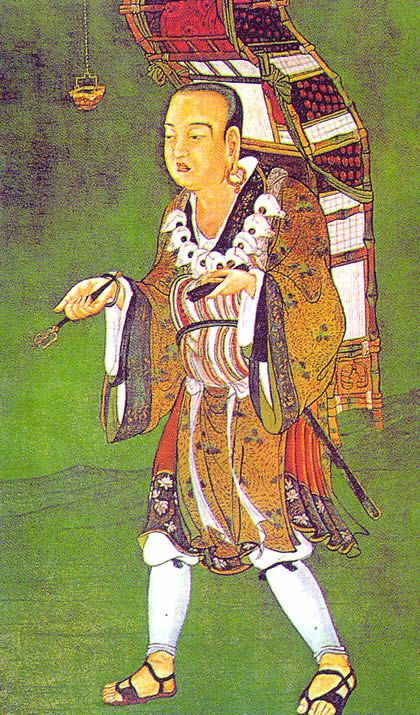
The Intellectual Pilgrim and the World He Found in Bharat
Xuanzang (玄奘, c. 602–664 CE) belongs to a very different category of traveller from the ordinary visitor. He did not come to Bharat merely to see its sacred places. He came because the intellectual material available to him in China did not, in his judgement, adequately resolve the questions he was trying to answer. He crossed Central Asia, entered the Indian subcontinent, studied with teachers, learned Sanskrit, spent years at Nālandā, travelled through different regions, encountered Buddhist and Brahmanical scholars, observed kingdoms and cities and eventually returned to China with a large body of texts. His Da Tang Xiyu Ji became one of the most important external records for reconstructing the geography, society and intellectual life of seventh-century India. The standard English translation by Samuel Beal appeared in 1884.
But there is something more interesting here than the familiar story of “Xuanzang visits Nālandā.” His own account repeatedly moves between the intellectual and the ordinary. He describes scholars and debates, but he also describes agriculture, climate, manners, roads, cities, political authority, religious institutions and local customs. He can describe a ruined city and, in the same passage, tell us whether its fields were productive and whether its inhabitants were devoted to learning. This is what makes him particularly useful for a civilizational study: he does not encounter an abstract “India”. He encounters places inhabited by people, organised by institutions and shaped by particular intellectual and moral practices.
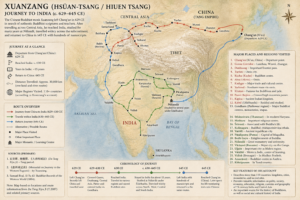 He Came Because Knowledge Was Incomplete
The reason for Xuanzang’s journey is preserved more explicitly in the later Life of Hiuen-Tsiang than in the geographical Da Tang Xiyu Ji. The biography records his dissatisfaction with the condition of Buddhist learning in China:
「去聖日遠,教旨漸昏,聞義不能明,疑心無所決。」
A literal rendering is: “As the time from the Sage became distant, the meaning of the teaching gradually became obscure; hearing the doctrines, I could not understand them clearly, and my doubts had nowhere to be resolved.”
The biographical tradition then describes his determination to go west in search of the sources and teachers that might resolve those doubts. This is consistent with the account preserved in the English translation used in the present draft, where Xuanzang says that he had become dissatisfied with the condition of the sacred texts and wished to “find out the truth for myself.”
This distinction matters. Xuanzang’s journey was not simply a pilgrimage in the modern sense of visiting a sacred destination. The journey itself was part of his method of knowing. If the texts available in China appeared inconsistent, the solution was not simply to speculate from a distance. He went to the places where the traditions were being studied, sought teachers who had access to other textual lineages and learned the language in which those traditions were preserved.
His own memorial presented to the Tang court also describes the journey in the language of seeking the Dharma:
「冥心梵境,敢符好事……飘身迈迹,求自遐迩。」
He describes turning his mind toward the Indian realm, setting out physically and seeking knowledge across distant lands. That is a much richer way of understanding the journey than simply saying that “Xuanzang travelled to India.” He travelled because distance had become a method of inquiry.
The India He Entered Was Not One Intellectual Centre
By the time Xuanzang reached the great centres of northern India, he was entering an intellectual world that was already old and institutionally differentiated. Nālandā was important, but it was not the only place where serious learning occurred.
His account of Magadha gives us a sense of the scale of the religious and intellectual environment. He describes the region as having fertile land and a large number of monasteries:
「地沃壤滋稼穑……风俗淳质,气序温暑,崇重志学,尊敬佛法。伽蓝五十馀所,僧徒万有馀人。」
In translation:
“The land is fertile and productive; … the customs are simple and sincere; the climate is warm; they esteem learning and respect the Buddha’s Dharma. There are more than fifty monasteries, with more than ten thousand monks.” (Wikisource)
Even if we treat the numbers cautiously, the description is historically significant. Xuanzang is not describing a single monastery standing alone in an empty landscape. He describes a region containing numerous institutions and a very substantial monastic population.
This changes the question we should ask of Nālandā. Instead of beginning with “How large was Nālandā?”, we should ask: what kind of society could sustain several large centres of learning, teachers, students and religious institutions at the same time?
That question takes us beyond the monument and into the social history of knowledge.
Nālandā: Learning as a Living Community
The story of Nālandā becomes particularly interesting when we read the Chinese text rather than relying on the modern shorthand of calling it an “ancient university”.
The Da Tang Xiyu Ji describes the lineage of Nālandā and its scholars, including Śīlabhadra, whom the Chinese text calls 尸罗跋陀罗, and the earlier intellectual figures associated with the institution. It records that Śīlabhadra had travelled in search of learned teachers and eventually came to Nālandā.
One passage describes the kind of intellectual contest in which these scholars participated:
「逮乎集论之日,远近相趋,少长咸萃。外道弘阐大猷,尽其幽致;戒贤循理责实,深极幽玄。外道辞穷,蒙耻而退。」
A close translation would be:
“When the day of the debate arrived, people from near and far gathered, young and old alike. The non-Buddhist scholar expounded his doctrine, bringing out its deepest meanings; Śīlabhadra examined the arguments according to reason and pressed them to their profoundest points. The opponent’s arguments were exhausted, and he withdrew in defeat.”
Whether we accept the narrative of victory literally or read it as part of the Buddhist intellectual biography surrounding Śīlabhadra, the important historical evidence is the form of intellectual life being described. Doctrines were not merely possessed. They were articulated, challenged and defended. And that is important because a tradition becomes intellectually alive not merely when it produces texts, but when those texts enter into argument.
The same passage contains an even more revealing description of Śīlabhadra’s attitude toward wealth and institutional patronage. After the ruler offers him a city as a reward for his intellectual victory, Śīlabhadra refuses:
「染衣之士,事资知足,清净自守,何以邑为?」
Literally:
“For one who wears the dyed robe, contentment is his wealth; maintaining purity and self-restraint, what need have I of a city?”
The king nevertheless persuades him to accept the grant for the sake of supporting the Dharma, and Śīlabhadra uses it to establish a monastery and provide for religious learning.
Here, within a few lines, we see something that is often lost in modern descriptions of ancient institutions: knowledge, renunciation and patronage existed together. The scholar could reject wealth personally while the institution still required resources. The ruler could patronise intellectual life without necessarily making the scholar a court official. The scholar’s authority could rest on learning and discipline rather than possession.
That is a much more interesting social history than simply saying that “kings supported universities.”
A Student Was Expected to Become a Scholar
The intellectual culture Xuanzang encountered was also competitive. The traditions associated with Nālandā describe students and scholars debating, questioning and testing one another. The later account of Xuanzang’s own education records the range of subjects he studied: Buddhist philosophical works, logic, grammar and Sanskrit linguistic science, alongside texts of different schools.
This is important because Xuanzang himself was not simply an observer of this system. He became one of its students.
He had arrived from China, but once he entered this world he had to acquire the intellectual tools required to participate in it. His journey therefore became a transformation from traveller into scholar. The biography of his Nālandā years records that he studied the Yogācārabhūmi, Nyāyānusāra, Mahāyāna-saṃgraha, works of logic and Sanskrit grammar, among others.
This is where the history of Xuanzang becomes particularly important for the history of Indic knowledge. He did not simply take Indian ideas and carry them to China. He entered an Indian system of learning sufficiently deeply to become capable of translating and transmitting its literature. Translation was therefore the final stage of the journey, not the beginning.
He Did Not See a Uniform Bharat
One of the strongest features of the Da Tang Xiyu Ji is the variety of societies Xuanzang describes. His India is not a single social type. Cities differ. Religious communities differ. Political systems differ. Some places are prosperous; others are in decline. Some have flourishing monasteries; others have ruins.
His account of Śrāvastī is particularly revealing:
「都城荒颓,疆埸无纪。宫城故基周二十馀里,虽多荒圮,尚有居人。谷稼丰,气序和。风俗淳质,笃学好福。」
Xuanzang describes the city as largely ruined, but then immediately adds that people still live there, agriculture is abundant, the climate is agreeable, the people are simple in their customs, and they are devoted to learning and religious merit.
This is a small passage, but it tells us a great deal about the way Xuanzang observed society. He does not assume that the condition of the monument tells him everything about the condition of the society. A city can be politically diminished while its fields remain productive. Its monumental past can be in ruins while people continue to live there. Its political importance can decline while learning and religious practices continue.
That is a much more sophisticated historical observation than the modern habit of dividing civilisations into “golden ages” and “decline”.
Xuanzang’s Bharat Was Religiously Plural
Another important feature of his descriptions is that he repeatedly records Buddhist institutions alongside Brahmanical temples and other religious communities.
He does not describe every region as uniformly Buddhist. In some places Buddhist monasteries are numerous; in others Brahmanical institutions dominate. Some regions contain both. Some rulers patronise one tradition while respecting scholars belonging to another.
This becomes particularly visible in his description of the intellectual world around Nālandā, where debates could involve Buddhist and non-Buddhist scholars. The passage concerning Śīlabhadra explicitly describes an intellectual contest with a scholar from South India identified as an “external” or non-Buddhist thinker.
The significance is not that Xuanzang provides a perfect census of religious affiliation. He does not. His perspective remains that of a Buddhist monk.
What matters is that the social world he records was not intellectually homogeneous. There were competing traditions, competing institutions and competing claims to knowledge. And those traditions sometimes met precisely through debate.
The Political World Was Also Part of the Intellectual World
Xuanzang’s encounter with Harṣavardhana gives us another dimension of this society. When Xuanzang is brought before Harṣa, the ruler is already familiar with the reputation of the Chinese empire. The conversation recorded in the Da Tang Xiyu Ji is revealing:
「自何国来,将何所欲?」
Xuanzang replies:
「从大唐国来,请求佛法。」
The king asks:
“From what country have you come, and what do you seek?”
Xuanzang answers:
“I have come from the Great Tang country, seeking the Buddha’s Dharma.”
It is a very small exchange, but historically it is wonderful because it captures the meeting of two worlds. Xuanzang is not merely a wandering monk. He is a Chinese intellectual entering the court of a powerful Indian ruler. Harṣa, in turn, knows of the Tang emperor and recognises the prestige of the land from which this scholar has travelled.
The exchange shows that the movement of knowledge existed alongside diplomacy, political power and long-distance cultural awareness. The intellectual world was not separate from the political world.
Harṣa and the Idea of Kingship
The account of Harṣa also provides an important insight into how kingship could be represented through generosity and moral conduct.
The Da Tang Xiyu Ji describes Harṣa’s great religious assembly at Prayāga. Xuanzang records that the king accumulated wealth for five years and then distributed it at the great assembly. The order of distribution is striking:
「初第一日,置大佛像,众宝庄严,即持上妙奇珍而以奉施;次常住僧,次现前众,次高才硕学、博物多能,次外道学徒、隐沦肥遁,次鳏寡孤独、贫穷乞人。」
In translation:
“On the first day a great image of the Buddha was installed and adorned with treasures, and the finest precious things were offered. Next came the resident monks, then the assembled community, then those of high talent and broad learning, then the students of other teachings and recluses, and finally widows, widowers, orphans, the solitary, the poor and beggars.”
The sequence is fascinating. It does not fit neatly into any modern category. It is simultaneously religious, intellectual, political and charitable.
The learned receive patronage. Other religious traditions are included. The vulnerable are included. And the entire act is performed publicly.
This is why we should resist translating such an institution too quickly into modern language such as “welfare state” or “secular philanthropy”. The categories are different. The important historical fact is that royal wealth was being converted into an act of religious merit, intellectual patronage and public generosity within a highly ceremonial political order.
Xuanzang then gives us one of the most memorable lines in the account. After giving away his treasures, Harṣa says:
「乐哉!凡吾所有,已入金刚坚固藏矣。」
A close translation is:
“Joyful indeed! Everything that I possessed has now entered the treasury that is firm as a diamond.”
The metaphor is important. Wealth is not considered truly secure when it remains in the royal treasury. It becomes secure when it has been given away in the right manner. That is a very different conception of wealth from simple accumulation.
A Society Cannot Be Understood Only Through Its Monuments
Perhaps the most useful quality of Xuanzang’s writing is that he repeatedly brings us back from monuments to ordinary society.
In Śrāvastī he notices agriculture. In Magadha he notices the fertility of the land and the number of monasteries. In other regions he describes crops, climate, roads, temples, monasteries, political authority and local customs.
This is why his record is valuable beyond Buddhist history. Even where his religious interests determine what he notices, the geographical structure of his account allows us to reconstruct aspects of settlement, economy and social organisation.
He is not writing sociology in the modern sense. But his observations become sociologically valuable because he records how people actually inhabited places.
That is why his description of Śrāvastī is so useful. The city is “荒颓”—fallen into ruin—yet agriculture remains productive and people continue to study. There is a lesson here for civilizational history. Decline is rarely total.
A civilisation does not simply move from “great” to “collapsed”. Different institutions decline at different speeds. Political power may weaken while agricultural systems continue. Cities may shrink while religious institutions survive. Old monuments may become ruins while intellectual traditions continue elsewhere.
Xuanzang’s geography repeatedly gives us these uneven landscapes.
The Most Important Thing About Xuanzang May Be That He Was Himself Transformed
The deeper significance of Xuanzang’s journey is ultimately not what he saw but what happened to him as a result of what he saw.
He began as a Chinese monk dissatisfied with the knowledge available to him. He travelled across Asia, learned from Indian teachers, studied Sanskrit and entered debates that were taking place within the Indian intellectual world. His return to China was therefore not the return of a tourist carrying souvenirs.
He returned as a translator and intellectual mediator.
The later tradition records that he brought back hundreds of texts, and his translation work in China became one of the major channels through which Indian Buddhist philosophical literature entered the Chinese intellectual world.
This makes his journey a particularly powerful example of civilizational transmission.
Knowledge did not move because “India influenced China” in some vague sense.
A person travelled. He found teachers. He learned their language. He studied their texts. He copied or acquired manuscripts. He returned. He translated. Other people then studied those translations. That is how civilizations actually transmit knowledge.
It is much less abstract—and much more human—than the phrase “cultural influence” suggests.
But We Should Not Make Xuanzang Say More Than He Says
This is where a serious Indic civilizational reading must also remain critical.
Xuanzang was a Buddhist monk. His attention naturally falls upon Buddhist sacred geography, monasteries, teachers and doctrinal questions. His account also contains stories, miracles and religious traditions that cannot be treated in exactly the same way as his descriptions of roads, crops or political institutions.
There is another important textual issue. The Da Tang Xiyu Ji is not a modern travel diary written directly in the form in which we possess it. The Chinese textual tradition identifies it as 玄奘译、辩机撰—Xuanzang’s account/translation and Bianji’s composition or compilation. So we should not casually say, “Xuanzang wrote every sentence exactly as we read it.” The safer historical formulation is that the work preserves Xuanzang’s account of the regions he visited, organised into the finished text by Bianji.
This distinction actually makes the source more interesting, not less. We are looking at the interaction of memory, travel experience, oral testimony, translation and textual compilation.
And then there is the question of translation. The Chinese terms in the original are sometimes compressed in ways that do not map neatly onto English categories. Even apparently simple words such as 外道, 伽蓝, 法, 学 and 德 carry historical meanings that cannot always be reproduced by a single English word.
That is precisely why I think the original Chinese should appear alongside the translation in our articles. Otherwise, we risk studying the nineteenth-century translator’s Xuanzang rather than Xuanzang’s Chinese text.
What Kind of Bharat Did Xuanzang Actually Encounter?
Taken together, his descriptions reveal something considerably more complex than the usual picture of “ancient India as a land of temples and universities.”
He encountered fertile agricultural regions and ruined cities, powerful kings and local communities, Buddhist monasteries and Brahmanical institutions, teachers and students, scholars who debated one another, rulers who patronised learning, and networks through which people and texts moved across enormous distances.
The India of Xuanzang was not uniform. It was not intellectually silent. It was not institutionally simple. And it was not isolated from the rest of Asia.
At Nālandā, scholars argued over difficult doctrines. At royal courts, Indian rulers interacted with a scholar who had travelled from Tang China. At Prayāga, royal wealth was redistributed among religious communities, scholars and the poor. In Śrāvastī, a city whose monuments had fallen into ruin, agriculture and learning continued.
These details are more historically valuable than the grand claim that “India had a great civilisation,” because they show how a civilisation functioned at ground level.
Xuanzang as a Source for Indic Cultural and Social Studies
This is where I would place Xuanzang within our larger framework. He is not simply a “foreign traveller”. He is a source for studying the social life of knowledge. His account allows us to see teachers and students, intellectual competition, patronage, institutions, religious plurality, political authority, agriculture, urban decline and long-distance mobility within the same historical frame.
That is precisely why we should read him differently from a conventional history of Buddhism. His account does not merely tell us what Buddhists believed. It tells us something about the social world in which intellectual traditions lived.
And this is where the comparison with Yijing becomes particularly useful. Yijing takes us closer to the daily discipline of learning—grammar, teacher–pupil relations, food, medicine and institutional routines. Xuanzang gives us a wider geographical and civilizational landscape—kingdoms, cities, intellectual centres, religious communities and political patrons.
Together they allow us to move from the institution to the civilization around the institution. That is much more valuable than treating either traveller as a collection of quotations about India’s greatness.
The Traveller Was Also a Participant
There is perhaps one final point that deserves emphasis. Xuanzang was not standing outside the Indian intellectual world taking notes. He became part of it. He learned its language. He studied with its teachers. He entered its debates. He acquired its texts. And then he carried what he had learned back into another civilization.
That makes his journey something more than a travel narrative. It becomes a history of intellectual transmission through human movement.
The most interesting question, therefore, is not simply, What did Xuanzang say about India?
It is: What kind of intellectual world could make a scholar from China cross deserts, mountains and political frontiers, learn another language, spend years studying with Indian teachers and then carry hundreds of texts back across Asia?
The answer cannot be reduced to Nālandā.
It lies in the wider ecosystem that Xuanzang encountered: teachers who possessed intellectual authority, institutions that sustained learning, rulers who patronised scholarship, traditions that argued with one another, students who travelled in search of knowledge, and texts that were valuable enough for people to cross continents to obtain them. That is the historical Xuanzang. Not merely the pilgrim who came to Bharat. Not merely the witness who praised Nālandā.
But a student who entered an existing knowledge system deeply enough to become one of the principal agents through whom that system travelled beyond Bharat.
And perhaps this is the question that should remain with us when we study him:
If Xuanzang came because the knowledge available to him was incomplete, what did he believe he could find in Bharat that he could not find elsewhere?
That question takes us beyond the traveller.
It takes us into the intellectual history of Bharat itself.
Primary textual basis
The Sources are – 玄奘译、辩机撰,《大唐西域记》 (Da Tang Xiyu Ji), Tang period. The Chinese textual tradition explicitly identifies Xuanzang as the translator and Bianji as the compiler/writer.
For Xuanzang’s own first-person statement concerning his journey, 《进西域记表》 is also valuable and should be kept separate from the later biography.
For the English reader, Samuel Beal’s 1884 Si-Yu-Ki: Buddhist Records of the Western World remains useful.
