
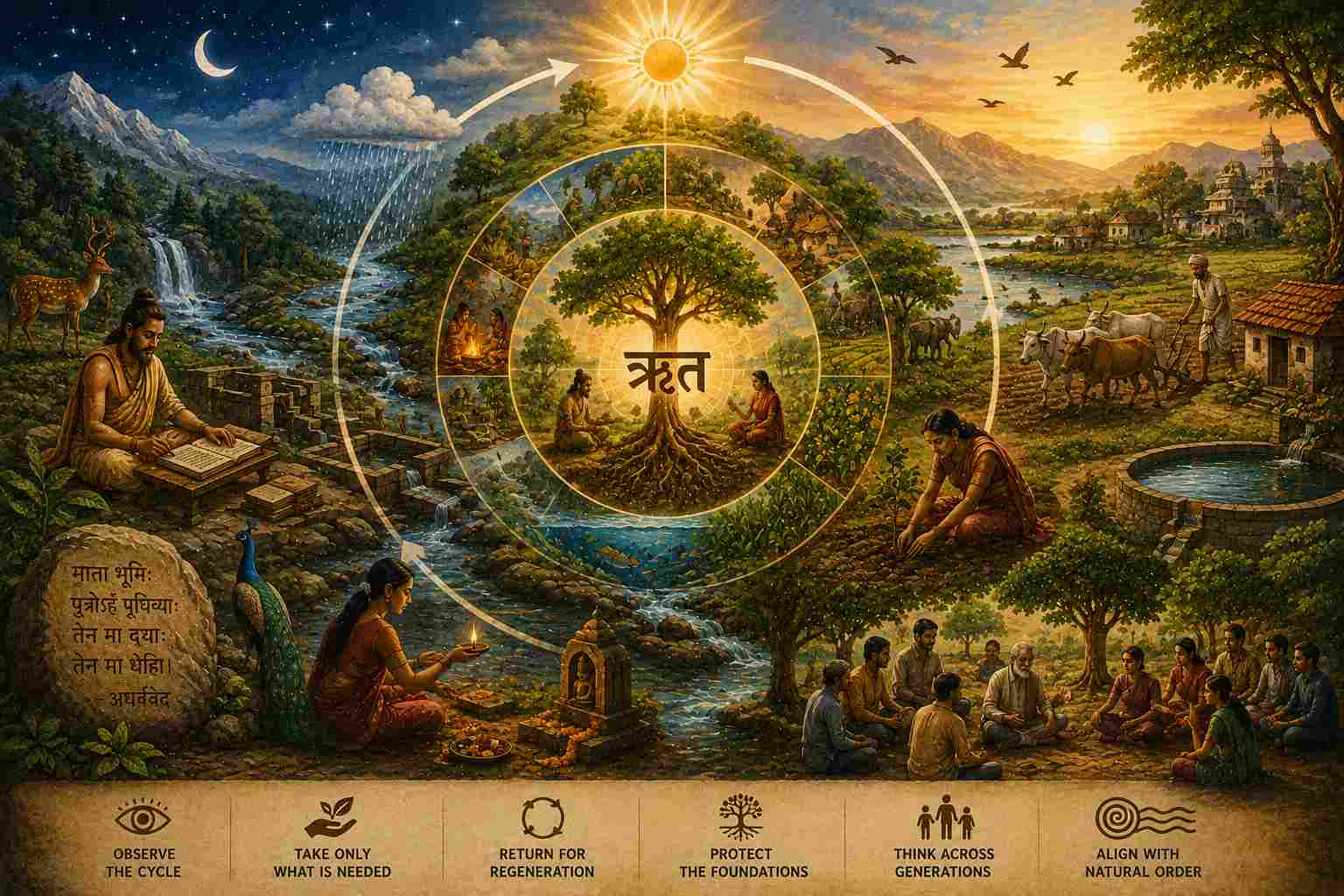
Ecology, Reciprocity and Balance
What if ecology is not merely the study of nature, but the study of the order that makes life possible?
Modern environmental studies usually begins with ecosystems, biodiversity, food chains, carrying capacity, climate systems and resource management. These are essential scientific categories. Yet they often leave one deeper question to the side: what kind of human conduct allows these systems to continue?
The Indic idea of Rta offers a powerful starting point. Rta is among the oldest and most foundational concepts of the Vedic worldview. It refers to the cosmic order through which natural, moral and social processes remain intelligible and interconnected. The movement of seasons, the regularity of the sun, rainfall, rivers, agricultural cycles and the conduct of human beings are not imagined as completely unrelated domains. They participate in a larger order.
This gives ecology a different starting point. Nature is not simply an external object that humans manage.
Human beings are participants within an order they did not create.
That distinction is crucial.
Modern development often begins with the question: How much can we produce?
Rta asks another question: Can what we produce continue without disturbing the conditions that make production possible?
A farmer depends upon soil, rainfall, seeds, animals, microorganisms and seasons. A city depends upon rivers, groundwater, forests, food-producing regions and climate stability. Industry depends upon minerals, energy, water and ecological systems. Human prosperity is therefore never independent of nature. We may temporarily hide these dependencies through technology and markets, but we cannot eliminate them.
This is where Rta becomes an ecological principle rather than merely an ancient philosophical concept.
From Extraction to Reciprocity
The modern environmental vocabulary frequently speaks about resource management. The Indic vocabulary can add the idea of reciprocity.
- If the Earth provides food, what do human beings return?
- If a river provides water, how is the river protected?
- If a forest provides livelihood, what prevents its destruction?
- If soil produces food year after year, what practices maintain its fertility?
The question is no longer simply: “What can nature give us?”
It becomes: “What must we do so that nature can continue to give?”
This is a practical ecological shift.
Consider agriculture. A system that maximises yield by exhausting soil fertility may appear economically successful for a decade. But if soil organic matter declines, groundwater falls and biodiversity disappears, the system has consumed its own ecological foundation. From an Rta-based perspective, this is not merely an environmental “externality”. The productive system has violated the conditions of its own continuity.
The same principle applies to water. A river can be treated as a pipeline carrying water to cities, or as a living hydrological system involving rainfall, forests, wetlands, groundwater, agriculture and settlements. The second understanding is closer to an ecological Drishti: protect the system, not merely the resource extracted from it.
The Practical Ecological Drishti
Rta can therefore become a practical framework for environmental policy:
- Observe the cycle before extracting from it.
- Take only within regenerative capacity. Return what the system requires for renewal.
- Protect the ecological foundations of production.
- Design settlements according to water, soil and climate rather than forcing nature to accommodate unlimited expansion.
- Measure ecological health alongside economic output. Think across generations rather than electoral or financial cycles.
This changes the meaning of sustainability. Sustainability is not simply reducing environmental damage while continuing the same model of consumption. It means asking whether our economic and social systems are aligned with the regenerative rhythms of the ecosystems on which they depend.
The Vedic idea of Rta also prevents us from imagining that humans must either dominate nature or completely withdraw from it. Agriculture itself is an intervention in nature. Cities are interventions. Irrigation is an intervention. Technology is an intervention. The question is therefore not intervention versus non-intervention.
It is: Does our intervention cooperate with ecological processes or systematically undermine them?
That is a much more useful environmental question. And perhaps this is the deepest contribution of Rta to contemporary ecological thinking. It does not tell us to abandon science, technology or development. It asks us to place them within a larger understanding of order. Science can measure the decline of groundwater. Economics can calculate its cost. Technology can develop alternatives.
But Rta asks the civilizational question: Why did we allow the system that sustains us to decline in the first place?
The ecological crisis, then, is not only a crisis of resources. It is a crisis of relationship and restraint. Human prosperity cannot exist outside the order that sustains life. We do not inherit an unlimited Earth. We inherit a living order—and our prosperity depends upon not breaking it.
