
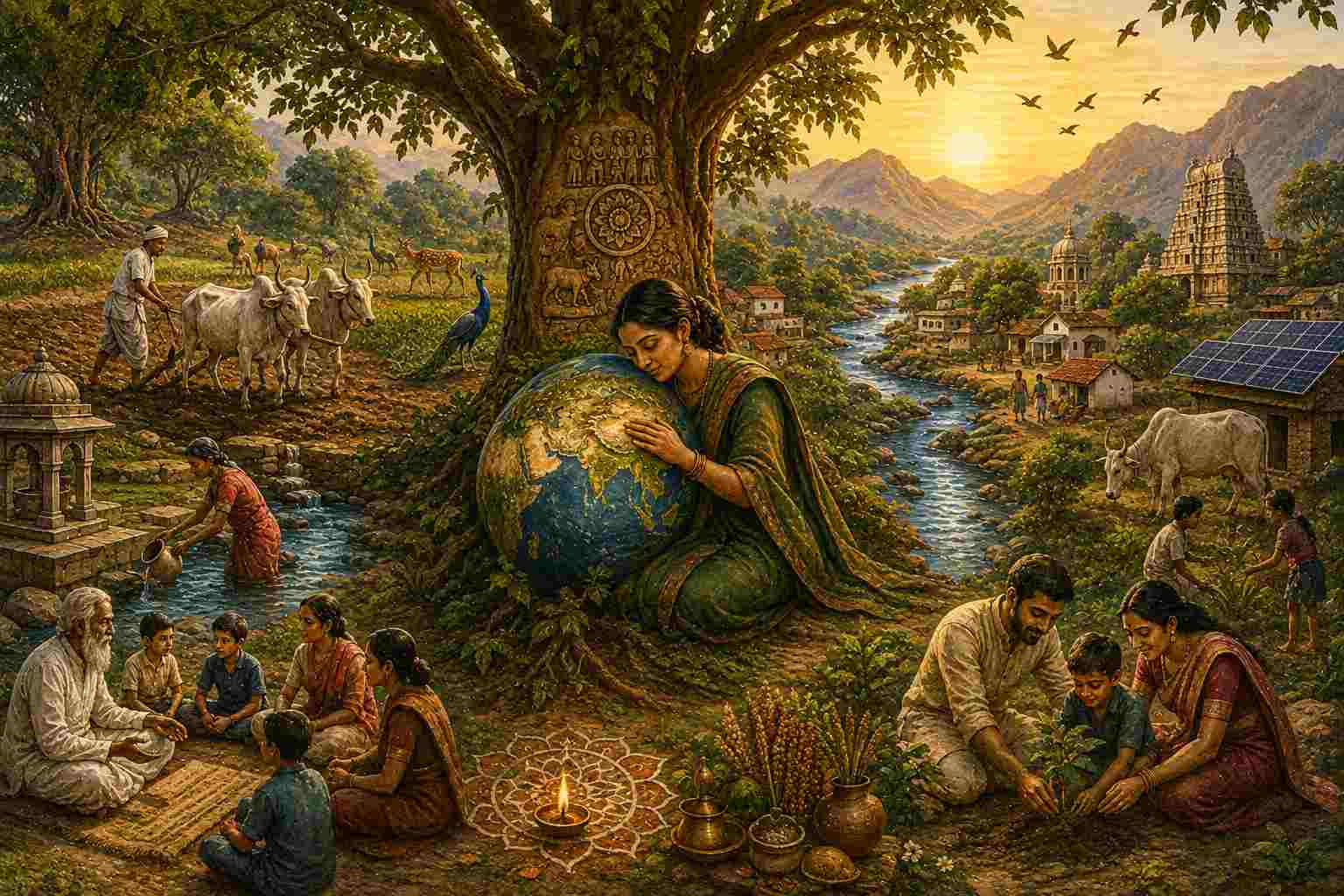
From Ownership to Stewardship
What does it mean to live on the Earth?
Modern environmental studies often begins with a crisis: climate change, deforestation, biodiversity loss, pollution, resource depletion and ecological collapse. We are then given scientific indicators, environmental laws, sustainability frameworks and technological solutions. All of these are necessary. But there is a question that usually comes much earlier than environmental science itself: what is our relationship with the Earth?
For a large part of modern Western economic and political thought, land eventually became something that could be owned, divided, transferred, exploited and valued. The transformation of land into property was central to the development of modern capitalism. Locke’s theory of property connected ownership with labour and improvement; later industrial capitalism turned land, forests, minerals and water increasingly into economic resources. The modern state then converted territory into administratively measurable property and resources. None of this makes every Western thinker anti-ecological, and the West itself later produced powerful ecological critiques. But it is impossible to ignore the historical contradiction: the civilization that developed the most powerful industrial system of extraction also produced much of the intellectual machinery through which nature was increasingly treated as an economic resource.
The ecological crisis is therefore not simply a technological problem. It is also a civilizational problem of relationship. And this is where Bhoomi offers a different starting point.
Bhoomi is not merely “land”. Land is soil, habitat, food, livelihood, memory, settlement, sacred geography and the material foundation of collective life. The question is therefore not simply “Who owns this piece of land?” but “What relationship do human beings have with the land that sustains them?”
This distinction is fundamental. If land is primarily an asset, its value can be calculated through price, productivity, rent and capital appreciation. If land is Bhoomi, economics becomes only one dimension of the relationship. The soil has ecological value. The river has cultural value. The forest has livelihood value. The mountain has civilizational memory. The agricultural landscape has knowledge embedded within it.
A village is not merely a settlement occupying geographical space; it is a historical relationship between people, water, soil, animals, occupations and institutions. This does not mean that Indic traditions developed a modern theory of environmental science. They did not. Nor should every traditional practice be romanticised as ecological. The stronger argument is that the normative relationship between humans and nature was often framed differently.
The Atharvaveda’s famous Bhumi Sukta addresses Earth as mother:
“माता भूमिः पुत्रोऽहं पृथिव्याः” — “Earth is my mother; I am her son.”
This is not an environmental policy document. It is something more foundational: a statement about relationship. The Earth is not merely an inert object standing outside human existence.
The distinction can be expressed simply:
| Extractive modern paradigm | Indic ecological possibility |
|---|---|
| Land as property | Land as Bhoomi |
| Nature as resource | Nature as life-supporting relationship |
| Ownership | Stewardship |
| Extraction | Use with responsibility |
| Present productivity | Continuity across generations |
| Forest as timber | Forest as ecological and cultural system |
| River as water resource | River as ecological, social and sacred system |
| Land value = market value | Land has material + ecological + cultural value |
| Human vs nature | Human embedded within nature |
The importance of this distinction becomes clearer when we examine agriculture. The Arthashastra does not treat agriculture simply as a private economic activity. It pays attention to land, irrigation, rainfall, cultivation, agricultural administration and the productive capacity of the territory. Economic prosperity depends upon maintaining the foundations of production.
The logic is therefore not merely extract → consume → profit, but produce → protect → reproduce productive capacity.
This is particularly important today. A farm can generate higher output while losing soil fertility. A forest can generate timber revenue while losing biodiversity. A city can expand its built environment while destroying water systems. GDP can rise while ecological capital declines.
So what exactly has grown? This is where modern environmental economics itself has begun to recognise the limits of treating nature as an externality. Natural-capital accounting, ecosystem services and sustainability indicators are attempts to bring ecological foundations back into economic reasoning. The intellectual movement is valuable. But an Indic ecological framework asks a prior question: why did nature have to be rediscovered as valuable only after its destruction became measurable?
There is an even deeper issue.
The modern ecological crisis cannot be separated entirely from the colonial experience. Colonial extraction reorganised forests, minerals, agriculture and land around imperial economic interests. Forests became timber reserves. Land became revenue. Traditional institutions were weakened or displaced. Local communities frequently lost authority over ecological resources that had previously been governed through customary arrangements.
Thus ecological destruction and cultural destruction were often interconnected. When a forest is transformed only into timber, something more than trees is lost. The knowledge of the forest can disappear. The rituals associated with it can weaken. The occupations dependent upon it can disappear. The community’s relationship with the landscape can fracture. The ecological crisis can therefore become a cultural crisis. And this is where an important correction to the environmental curriculum is necessary.
Students are often taught environmental history through a largely Western intellectual sequence: industrialisation creates environmental consequences; modern environmentalism responds; sustainability becomes a policy objective. But this risks making the rest of the world appear as if it has only recently discovered ecology.
That is historically inadequate.
Indic traditions contain ideas concerning Rta, Dharma, Bhoomi, Vanaspati, sacred groves, rivers, agricultural rhythms, non-excess, interdependence and duties towards future generations. Chinese traditions developed sophisticated ideas of harmony between human society and the natural order. Many Indigenous African traditions conceptualised land through communal relationships, ancestry and collective responsibility rather than absolute individual ownership.
These traditions should not be romanticised or placed into a single category called “Eastern ecological wisdom”. They are internally diverse. But they demonstrate an important fact: Modern environmentalism does not possess a monopoly over ecological thinking.
Indeed, perhaps the ecological curriculum should reverse its sequence.
Instead of beginning with: Industrialisation → Environmental destruction → Modern environmentalism → Sustainability
we should also ask: How did different civilizations understand human–nature relationships before industrial modernity? What ecological institutions did they develop? How did communities regulate common resources? What happened to those institutions under colonialism and industrialisation? Which traditional practices remain useful today? Which need reform?
That is a genuinely comparative ecological education. The Indic idea of Bhoomi ultimately leads us beyond ownership.
Ownership asks: “What can I do with this land?”
Stewardship asks: “What must I do for this land?”
The first is primarily a question of entitlement. The second is a question of responsibility. And responsibility introduces time into ecology.
The land we use today was not created by us. The soil took centuries to form. Rivers existed before our institutions. Forests existed before our markets. The knowledge of cultivation was inherited from generations that preceded us. We therefore receive ecological wealth without having created all of it. And if we receive it as an inheritance, perhaps we also receive an obligation.
We are not merely owners of the Earth between two generations. We are temporary participants in a much longer civilizational relationship.
This changes the central environmental question.
Not merely: How much can we extract from the Earth?
Not even merely: How much should we conserve?
But: What kind of relationship must human beings maintain with Bhoomi so that those who come after us inherit a living Earth rather than an exhausted asset?
That is the beginning of an Ecological Drishti.
The future of environmental studies should not be a choice between Western science and Indic tradition. Modern ecology gives us indispensable empirical knowledge; civilizational traditions can provide different ethical languages for understanding responsibility.
Science can tell us what is happening to the Earth.
The deeper civilizational question is: What do we owe her?
