
From a Place on the Map to a Crossing Between Pinda and Brahmanda
Why do millions of people travel to places they have never seen? Why does a person leave the familiarity of home, endure heat, distance, difficult roads and physical discomfort merely to reach a river, mountain, temple or confluence? A modern geography of movement can explain pilgrimage through tourism, mobility, networks and cultural diffusion. But does that fully explain tirtha?
Perhaps not. The idea of tirtha requires us to expand the meaning of geography itself. A place is not significant merely because it occupies a particular coordinate. It becomes significant because of the relationships that converge there—between river and land, memory and ritual, body and landscape, the individual and the larger cosmos.
In Sanskrit, tīrtha is derived from the verbal root tṝ, “to cross” or “to pass over.” In its most basic sense, a tirtha is a ford—a place where one can cross a river. This simple geographical meaning is extremely important. A tirtha is not originally just a “holy place.” It is a place of passage, a point of crossing between one side and another.
This is where geography and philosophy meet.
From Crossing a River to Crossing a Boundary
Imagine the earliest geographical reality of a tirtha. A river creates separation. Communities exist on opposite banks. Movement is difficult. But at a particular point, the river becomes crossable. That place becomes important. People meet there. Goods can move through it. Information travels. Relationships emerge.
A tirtha, therefore, is a geographical point where separation becomes connection. Over time, the idea acquires deeper meanings. If a river can be crossed, perhaps other boundaries can also be crossed: the boundary between the ordinary and sacred, ignorance and knowledge, the individual and the universal, the remembered past and the lived present.
This is why translating tirtha simply as “pilgrimage site” loses something essential. A tirtha is a crossing. The geographical imagination behind it is remarkable. Space is not imagined as a collection of empty locations. Some places become significant because they allow connections that are otherwise difficult.
A river confluence is a tirtha because waters meet. A mountain may become a tirtha because it connects different ecological zones and is approached through difficult movement. A temple may become a tirtha because generations of memory and ritual converge there. A sacred city may become one because multiple routes, communities and traditions intersect.
The place becomes meaningful through relationship.
From Pinda to Brahmanda
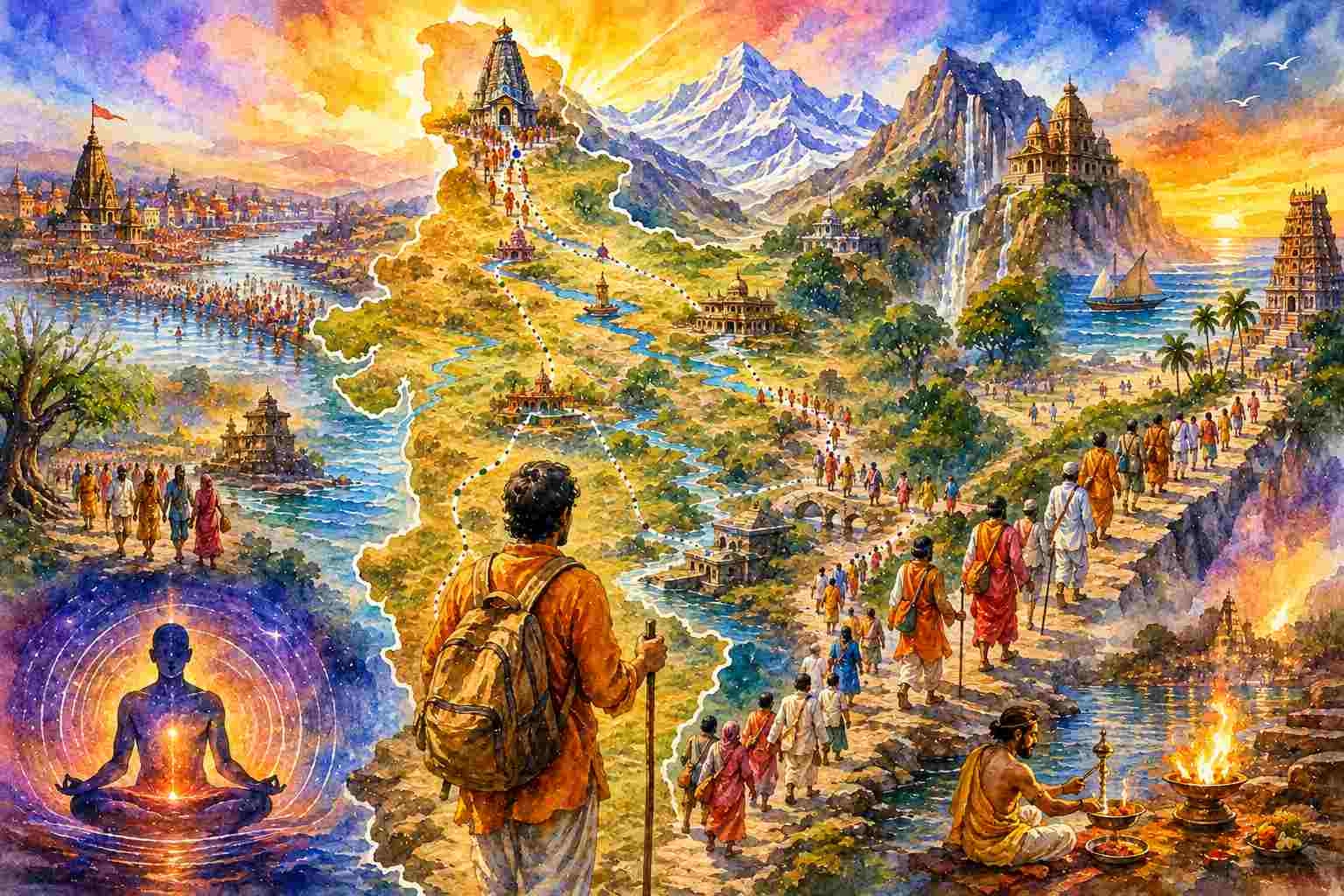
The Indic expression yat pinde tat brahmande—what exists in the individual exists in the cosmos, and what exists in the cosmos is reflected in the individual—provides another dimension to sacred geography. The pinda is the embodied, individual existence. The brahmanda is the larger cosmic order. Sacred geography creates movement between these scales.
The pilgrim begins with the body. He walks. She travels. The body becomes tired, hungry, exposed to weather and unfamiliar terrain. Geography is no longer an abstract map viewed from above. It is experienced through feet, breath, temperature, sound, distance and physical effort. But the journey simultaneously places the individual within something larger. A single person enters a route travelled by countless others. A small body stands before a mountain. An individual performs ritual beside a river whose course crosses regions and sustains communities. The pinda encounters the brahmanda through geography.
This is perhaps the deepest geographical meaning of pilgrimage.
The journey moves outward across physical space while simultaneously moving inward across scales of consciousness. The individual does not simply travel to geography. The individual experiences himself as existing within a larger geographical and cosmic order. The mountain, river, forest and sea are not external scenery. They become part of the relationship through which the self understands its own position.
Yatra Creates a Geography of Connections
A yatra is therefore not merely movement from Point A to Point B.
It creates a network. Consider the sacred geography of Bharat. The Char Dham connects distant edges of the subcontinent. Jyotirlingas create another network. Shakti Peethas another. The Kumbh Mela connects sacred rivers, pilgrimage cycles and large populations. The Narmada Parikrama creates a geography around a river rather than through administrative boundaries.
What is remarkable is that these networks often cross linguistic, ecological and political regions. A person from Gujarat may travel to Rameswaram. A devotee from Tamil Nadu may visit Kashi. Someone from Maharashtra may travel to Kedarnath. The geographical result is not uniformity. These journeys do not erase local cultures.
Instead, they create connection without requiring sameness.
This is an important alternative to the modern assumption that integration must always emerge through centralized administration. Bharat was certainly governed through political institutions, kingdoms and states. But its spatial integration also developed through other networks: pilgrimage, trade, monastic institutions, learning, migration, marriage and sacred landscapes.
The political map is only one geography of integration.
A Sacred Place Is Also an Ecological Place
Sacred geography is sometimes discussed as if it exists outside material geography. In fact, many tirthas reveal extraordinary attention to landscape. They emerge around:
- river confluences,
- mountains,
- forests,
- caves,
- springs,
- coastlines,
- islands,
- distinctive geological formations.
Why?
Because human beings do not experience geography only through political territory. Certain landscapes produce awe, dependence, vulnerability and memory. A river gives water and simultaneously creates floods. A mountain provides a route and also creates a barrier. A forest sustains life and simultaneously remains beyond complete human control.
Sacred geography can therefore preserve ecological memory.
A modern environmental planner may see a river as a hydrological system. An economist may see it as a resource. An administrator may divide it between jurisdictions. Sacred geography sees another relationship: this is also a place through which communities remember their dependence upon something larger than themselves.
Of course, sacred status does not automatically guarantee ecological protection. Pollution around pilgrimage centres proves that reverence can coexist with environmental failure. Romanticising the past would be as intellectually weak as dismissing it.
The important question is whether sacred geography offers a framework that modern environmental education has neglected: a relationship of belonging rather than mere management.
The Geography That the Map Cannot Fully Show
A political map of Bharat can show the distance between Kashi and Rameswaram. But it cannot fully show the relationship. A road map can calculate travel time. But it cannot map generations of movement. A demographic map can count pilgrims. But it cannot explain why the same route remains meaningful for centuries. This is the limitation of studying geography only through measurable distance. Physical distance and cultural distance are not the same thing.
A place may be geographically distant but ritually connected. Two neighbouring territories may be politically close but culturally disconnected. A river may cross several states while producing one ecological system.
Tirtha helps us understand this. It suggests that geography is not only about where places are located. Geography is also about the relationships that movement creates between them.
Beyond the Boundary
This is why tirtha should occupy a more serious place in Geography curriculum. Not because students need another civilizational term to memorise, but because the concept raises a fundamental geographical question: how is space integrated?
Modern Geography studies trade networks, migration corridors, transport routes and political boundaries. Sacred geography adds another dimension: networks of meaning. The pilgrim moves across Bharat, but the movement also creates Bharat. The journey connects grama to sacred city, river to mountain, region to region and individual body to collective memory. At another level, the movement of the pinda through the landscape becomes an encounter with the brahmanda. This returns us to the original meaning of tirtha. A ford allows one to cross a river. But perhaps a true tirtha allows something more.
It allows the individual to cross the narrow boundary between “my place” and “the larger world.” And that may be the most powerful geographical lesson of all.
Movement does not merely connect places. It can create the relationships through which distant places begin to belong to the same world.
