
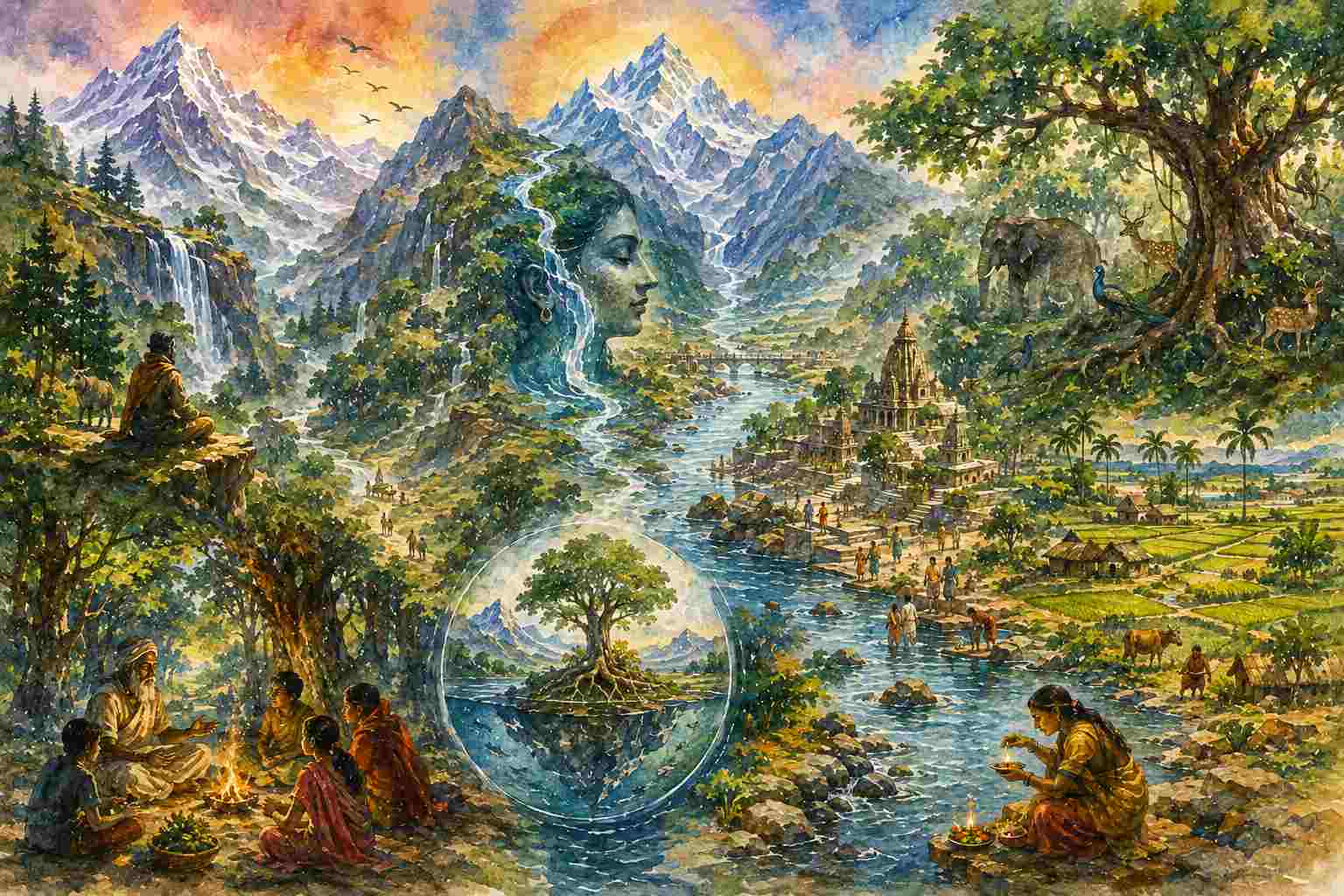
An Indic Geography of Living Landscapes
A modern geography textbook can describe a river through its source, drainage basin, tributaries, discharge and economic uses. A mountain can be classified according to its formation and elevation. A forest can be measured through its area, biodiversity and carbon capacity. All of this is necessary. But something disappears when these categories become the complete meaning of geography. A river is then reduced to water, a mountain to relief and a forest to vegetation. The landscape remains visible, yet its relationship with the people who live within it becomes strangely invisible.
The Indic geographical imagination offers another drishti. It does not deny the physical reality of nadi, parvat and van, but understands them as living relationships within which human life unfolds. A river is water, certainly—but it is also a route, a source of settlement, an agricultural system, a site of pilgrimage and a carrier of memory. A mountain is a geological formation, but it also determines climate, water, movement, livelihood and cultural imagination. A forest is an ecosystem, but for communities living within and around it, it may also be a source of food, knowledge, worship, medicine and identity.
The important question is therefore not whether geography should become spiritual or scientific. The more interesting question is: why should a geographical feature be understood through only one kind of relationship?
The River as a Relationship
Consider a river. Modern development language often asks how much water it contains, how much irrigation it can provide, how much electricity it can generate or how efficiently it can be transferred elsewhere. These are legitimate questions. Yet they begin from a particular assumption: the river is something outside human society, available to be measured, managed and used.
But civilizations have rarely experienced rivers in such a narrow manner.
The Narmada is not simply a water body for those who undertake its parikrama. The Ganga is not merely a drainage system for the communities living along its course. The Kaveri, Godavari and Krishna are connected with agricultural cycles, settlements, festivals, memories and regional identities. The geography of a river is therefore much larger than its channel.
A river produces a civilization around it. It influences where people settle, what they cultivate, how they travel and what stories they remember. Over generations, this relationship becomes part of culture. The landscape enters language, ritual, song and memory.
This is why calling a river a “resource” can be insufficient. A resource can be extracted and consumed. A relationship must be maintained.
When the relationship disappears, the consequences are deeper than environmental degradation. A river may remain physically present while disappearing from the social imagination of a community. People who once understood its seasonal rhythms may begin to encounter it only through pipes, reservoirs, data and policy documents. The water remains, but the geographical relationship weakens.
Parvat: Geography That Teaches Limits
Mountains offer another philosophical dimension.
Human civilization has often looked at mountains as obstacles to be crossed, mined, tunnelled or conquered. Modern infrastructure naturally requires us to travel through difficult terrain. Yet the language of conquest can sometimes hide an important geographical reality: mountains impose limits.
The Himalayas regulate climate and water systems. The Western Ghats influence monsoons and contain extraordinary ecological diversity. Mountain landscapes determine where and how human settlements can survive. They remind us that the Earth is not infinitely adjustable to human desire.
In the Indic imagination, mountains frequently become sacred not because people were unaware of geology but because certain landscapes produced a recognition of dependence and limits. A mountain is difficult to control. It is larger than the individual. It shapes human life while remaining fundamentally beyond complete human command.
Sacredness, in this sense, can be understood as a cultural language of restraint.
This does not mean that every mountain must be placed outside all human activity. Communities have lived, cultivated and travelled through mountains for centuries. The question is whether use recognises the conditions that make such life possible. Development without geographical humility often discovers ecological limits only after landslides, erosion, water shortages and displacement have made them impossible to ignore.
Van Is Not an Empty Space
Perhaps the greatest loss of modern geographical thinking concerns the forest.
A map may mark a region green and call it forest. A state may classify it as reserved, protected or unclassed. An economist may calculate timber or mineral value. Yet for many Adivasi and forest-dwelling communities, van is not an empty geographical space waiting to be administered.
It is home.
Knowledge of forests is often distributed through generations: which plants are medicinal, which paths are safe, when animals migrate, when water appears, how seasons change and which areas require restraint. This is geographical knowledge, even when it is not written in the language of modern cartography.
Yet modern policy has repeatedly produced a strange paradox. The people with the most intimate geographical relationship with forests are often treated as external to the forest. A map is drawn from above, a boundary is created and a community suddenly becomes an “encroacher” in the landscape through which it has lived for generations.
This does not mean that all traditional practices were environmentally perfect or that communities should be romanticised. Human beings can damage nature under any cultural system. But a geography that does not even ask communities how they understand their own landscape is intellectually incomplete.
The forest is not merely where people live.
People may be among the relationships through which a forest has historically been sustained and understood.
When Geography Loses Its Cultural Memory
The loss of this drishti has produced a peculiar form of alienation. Students learn the physical features of the Narmada without understanding the communities connected to it. They study the Himalayas without considering pilgrimage routes, pastoral knowledge and cultural adaptation. They learn about forests as carbon sinks while knowing little about the social knowledge developed by communities within them.
Geography becomes an inventory of the Earth rather than an inquiry into how life exists upon it.
The division between “physical geography” and “human geography” also becomes problematic when treated too rigidly. A river does not become physical in one chapter and human in another. The same river flows through both.
The nadi shapes agriculture, and agriculture shapes society. The parvat shapes climate, and climate shapes settlement. The van sustains biodiversity, and biodiversity enters medicine, food and livelihood. Ecology and culture are not separate layers placed upon the same landscape. They are continuously interacting.
Towards a Geography of Connection
An Indic geographical drishti therefore asks us to move from isolated objects towards relationships.
The river is connected with the mountain from which it flows. The mountain is connected with forests that protect water systems. The forest is connected with communities that depend upon and shape its landscape. Communities create settlements, agriculture, routes and cultural practices. These relationships collectively produce what we call civilization.
This may be the deeper meaning of nadi, parvat, van.
They are not merely three categories of physical geography. They are three reminders that geography is relational.
When we see a river only as water, a mountain only as land and a forest only as timber or carbon, we may become efficient managers of geography while losing the ability to understand where we actually live.
A more complete geography must therefore retain scientific measurement without abandoning cultural memory. It must study ecosystems without removing the people who belong to them. It must recognise use without assuming that use requires domination.
The question before Geography is not whether nature is physical or cultural.
It is both.
And perhaps the real loss begins when a civilization forgets that its rivers, mountains and forests are not simply things within its territory. They are the relationships through which its territory becomes a living world.
