
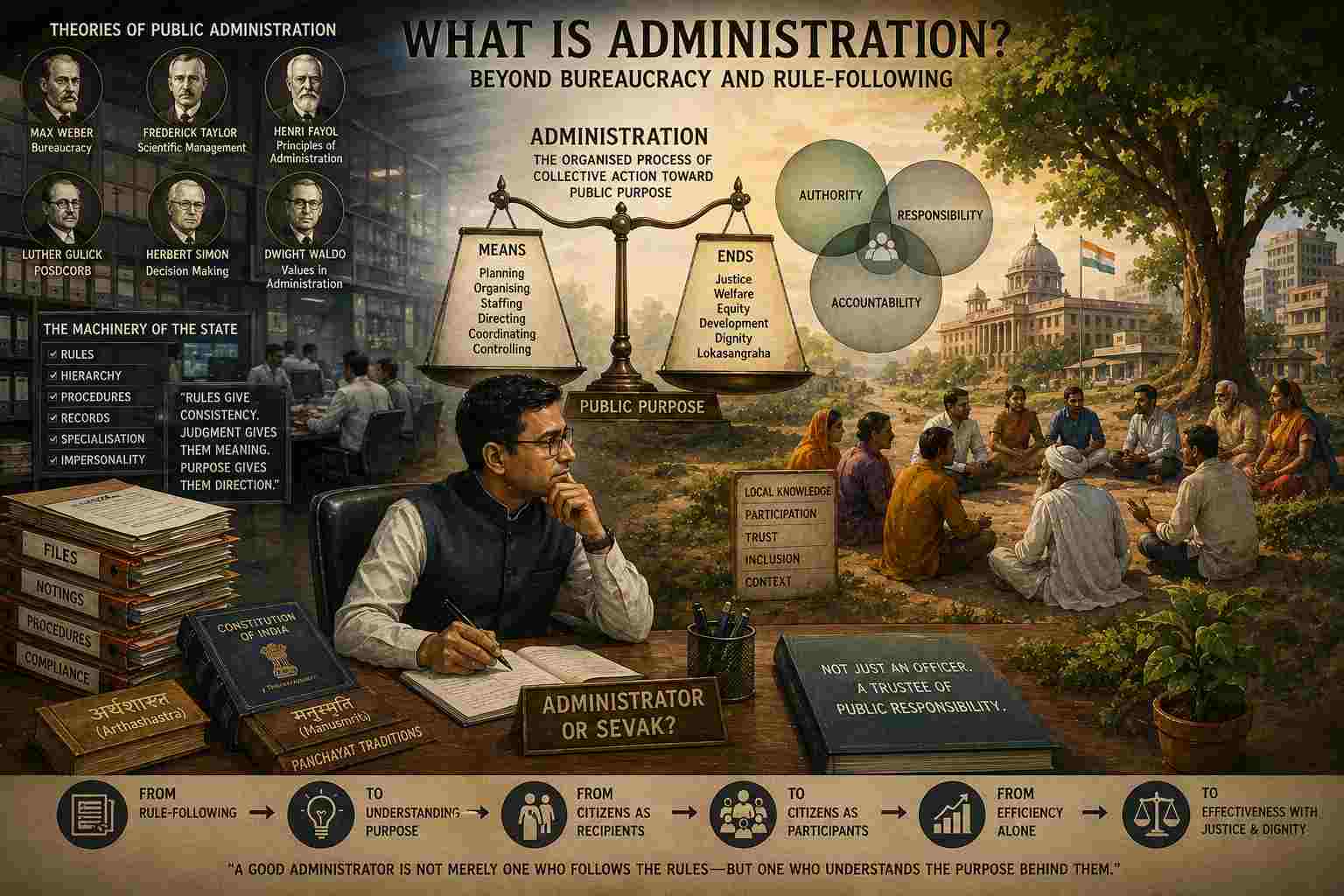
Beyond Bureaucracy and Rule-Following
The first problem with the way Public Administration is usually taught is that students often encounter administration only after it has already been reduced to government offices, hierarchy, files, procedures, policy implementation and bureaucracy. We learn about Woodrow Wilson’s call for a science of administration, Max Weber’s ideal type of bureaucracy, Henri Fayol’s principles, Luther Gulick’s POSDCORB and Frederick Taylor’s scientific management. These are important theories and, in many ways, indispensable for understanding the modern administrative state. But the discipline’s own intellectual history has gradually produced an unintended assumption: administration appears to exist wherever there is a formal organisation, while the society outside that organisation appears as something to be administered.
This is too narrow.
Administration, at its most basic level, is the process through which collective action is organised toward a purpose. A household allocates responsibilities. A community manages common spaces. A religious institution maintains collective practices. A municipality coordinates public services. A state governs millions of people. The scale differs, but the basic problem remains similar: how do human beings organise responsibilities, authority and resources in order to achieve something that cannot be achieved through isolated individual action?
The modern state did not invent administration. It gave administration a particular institutional form.
From Management to Administration
Early modern administrative thought was deeply influenced by the problem of efficiency. Frederick Taylor’s scientific management attempted to discover the most efficient method of performing a task by studying work scientifically. Henri Fayol developed principles concerned with planning, organising, commanding, coordinating and controlling. Luther Gulick’s famous POSDCORB—planning, organising, staffing, directing, coordinating, reporting and budgeting—gave students a concise framework for understanding executive functions.
These theories addressed real problems. Large organisations cannot function if responsibilities are undefined and resources are poorly coordinated. An administration that cannot plan, organise or coordinate will eventually fail, regardless of how noble its objectives may be.
Yet there is a conceptual danger when such theories become the foundation through which students understand administration itself. They can gradually make means appear more important than ends.
An administrator can plan efficiently, organise carefully, coordinate perfectly and still pursue the wrong objective. A highly efficient administrative system is not automatically a good administrative system. Taylor’s methods could increase productivity, but they did not answer the question of what productivity should ultimately serve. POSDCORB describes administrative functions, but it does not tell us whether the purpose of administration is just.
This distinction is fundamental and yet surprisingly easy to lose in the classroom. Administration answers the question of how collective action is organised; public administration must also answer what that action is organised for.
The Weberian Achievement—and Its Limits
Max Weber remains unavoidable in any serious study of Public Administration because bureaucracy solved a major historical problem: how to exercise authority impersonally and predictably across large populations. The bureaucratic organisation was characterised by clearly defined offices, hierarchy, rules, specialised knowledge, written records and separation between the office and the person who occupied it.
These features remain essential. Citizens generally prefer an administration governed by rules to one governed by the personal moods of officials. Impersonality can protect equality. Records create continuity. Specialisation can produce competence.
But the strength of bureaucracy also contains its limitation. Rules are general, while human situations are particular.
A welfare rule may be designed for equality but encounter a person whose circumstances do not fit the category. A procedure may prevent corruption but create delays that defeat the purpose of the service. An official may follow every regulation and yet fail to resolve the public problem that justified the institution’s existence.
The central administrative challenge is therefore not to abandon rules but to understand what rules are for.
The Human Problem of Administration
Herbert Simon challenged the older “principles of administration” by arguing that many supposedly universal principles contradicted one another. Instead, he shifted attention toward decision-making and bounded rationality. Administrators do not possess complete knowledge, unlimited time or perfect information. They make decisions under conditions of limitation.
Simon’s contribution should be taken further in the curriculum. The administrator is not simply a neutral machine applying established procedures. Every administrative decision involves judgment about information, priorities and consequences. Even deciding that a rule should be applied without considering wider circumstances is itself a form of judgment.
The real question is therefore not whether administration can be completely objective. It is whether administrative judgment is guided by an adequate understanding of public responsibility.
This is where the curriculum becomes overly organisational. Students are taught structure, hierarchy, leadership and decision-making, but the intellectual relationship between administrative action and social purpose often remains underdeveloped. Administration begins to appear as a technical process when it is also a moral and political activity.
The Purpose of Administration
The thinker most associated with bringing values back into Public Administration was Dwight Waldo. He challenged the belief that administration could be separated entirely from political and ethical questions. Administration inevitably involves values because it distributes public resources, exercises authority and affects citizens differently.
This is particularly important for students in Bharat. A government decision about land, education, water or welfare is never merely administrative. It reflects a judgment about what the state considers important, who requires support and how public resources should be distributed.
The older politics–administration dichotomy associated with Woodrow Wilson suggested that political leaders could determine policy while administrators would execute it efficiently. Modern governance has demonstrated that this distinction is rarely so clean. Implementation shapes outcomes. Administrators interpret policies, exercise discretion and influence what citizens actually experience.
Therefore, administration cannot hide entirely behind the language of neutrality. Administrative neutrality is necessary in relation to partisan political loyalty; it does not mean that administration is free from responsibility for its consequences.
Administration in the Indian Context
A decolonised curriculum must begin by recognising that administration in Bharat cannot be understood solely through the institutional history of the European modern state. The existing curriculum is largely organised around the evolution of Western administrative thought: Wilson, Goodnow, Weber, Taylor, Fayol, Simon, Waldo, the New Public Administration and New Public Management. Students then arrive at “Indian administration” as a later application.
The sequence itself reveals a problem. Why should Indian administrative traditions be studied as an addition to the theory, rather than as a source from which theory can also be developed?
Texts such as the Arthashastra demonstrate sophisticated thinking about revenue, local administration, public works, intelligence, personnel and state capacity. Yet even here, caution is necessary. Decolonising the curriculum does not mean replacing every Western thinker with Kautilya. The real task is to ask what administrative questions emerge when we study institutions within their own historical and social context.
For example, administrative life in Bharat has historically involved more than the state. Panchayats, shrenis, local communities, religious institutions and other collective bodies have organised aspects of social life. This raises a question that modern administrative theory does not always place at the centre: must administration always begin with a formal state organisation, or can society itself possess administrative capacity?
Efficiency Is Not Enough
This question becomes particularly important after the rise of New Public Management. Influenced by market ideas, it sought to make government more efficient, measurable and performance-oriented. Citizens increasingly became service users, while administrators became managers responsible for outputs and targets.
These reforms often addressed genuine bureaucratic weaknesses. Public institutions can become slow, opaque and self-serving. Measurement and accountability matter.
But an efficient administration may still fail to serve society if it measures the wrong outcomes.
A school system can improve enrolment while failing to create meaningful learning. A welfare programme can achieve its numerical targets while missing those who most need support. A city can improve its “ease of service delivery” while weakening the community institutions that previously supported vulnerable populations.
Public Administration therefore needs to distinguish between outputs, outcomes and purpose. The first asks whether a service was delivered. The second asks what changed because of it. Purpose asks whether the change contributed to the larger public good.
The curriculum too often stops at the first two.
From Administration to Lokasangraha
The Indic idea of lokasangraha, most prominently discussed in the Bhagavad Gita, offers an alternative intellectual starting point. It directs attention toward the holding together or sustaining of the larger social order. Applied to administration, this does not mean replacing modern governance with religious vocabulary. It means asking whether administrative action contributes to the stability, welfare and coherence of collective life.
This is a broader standard than efficiency.
An administration can deliver services quickly while fragmenting society. It can implement rules uniformly while ignoring the circumstances that make citizens unequal. It can pursue economic growth while weakening the ecological foundations of future prosperity. Lokasangraha invites us to ask whether administration helps sustain the wider conditions of collective life.
This changes the central question of the discipline.
Instead of asking only, “How do we administer?”, we must also ask, “What conditions of collective life are we trying to sustain through administration?”
A Different Way to Teach Public Administration
The modern theories of Public Administration should not be discarded. Weber explains why rule-bound institutions matter. Taylor and Fayol demonstrate the importance of organisation. Simon reveals the limits of rational decision-making. Waldo reminds us that administration is inseparable from values. New Public Management raises necessary questions about performance and accountability.
But these thinkers should be taught as responses to particular problems rather than as universal stages in the intellectual evolution of administration.
A decolonised curriculum would place them in conversation with administrative traditions from Bharat and other civilisations, while also studying the institutions through which societies organise themselves outside the formal state. It would teach students that administration is not merely the management of people and resources through offices. It is the exercise of organised responsibility in pursuit of collective purposes.
The good administrator is therefore not simply the one who follows the rules, nor the one who disregards rules in the name of good intentions. The real administrative challenge lies in the difficult space between them.
A rule provides consistency. Judgment gives the rule meaning. Purpose tells both of them what they are for.
Perhaps that is where Public Administration should begin. Not with the machinery of the state, but with the more difficult question of what collective action is ultimately meant to achieve.
