
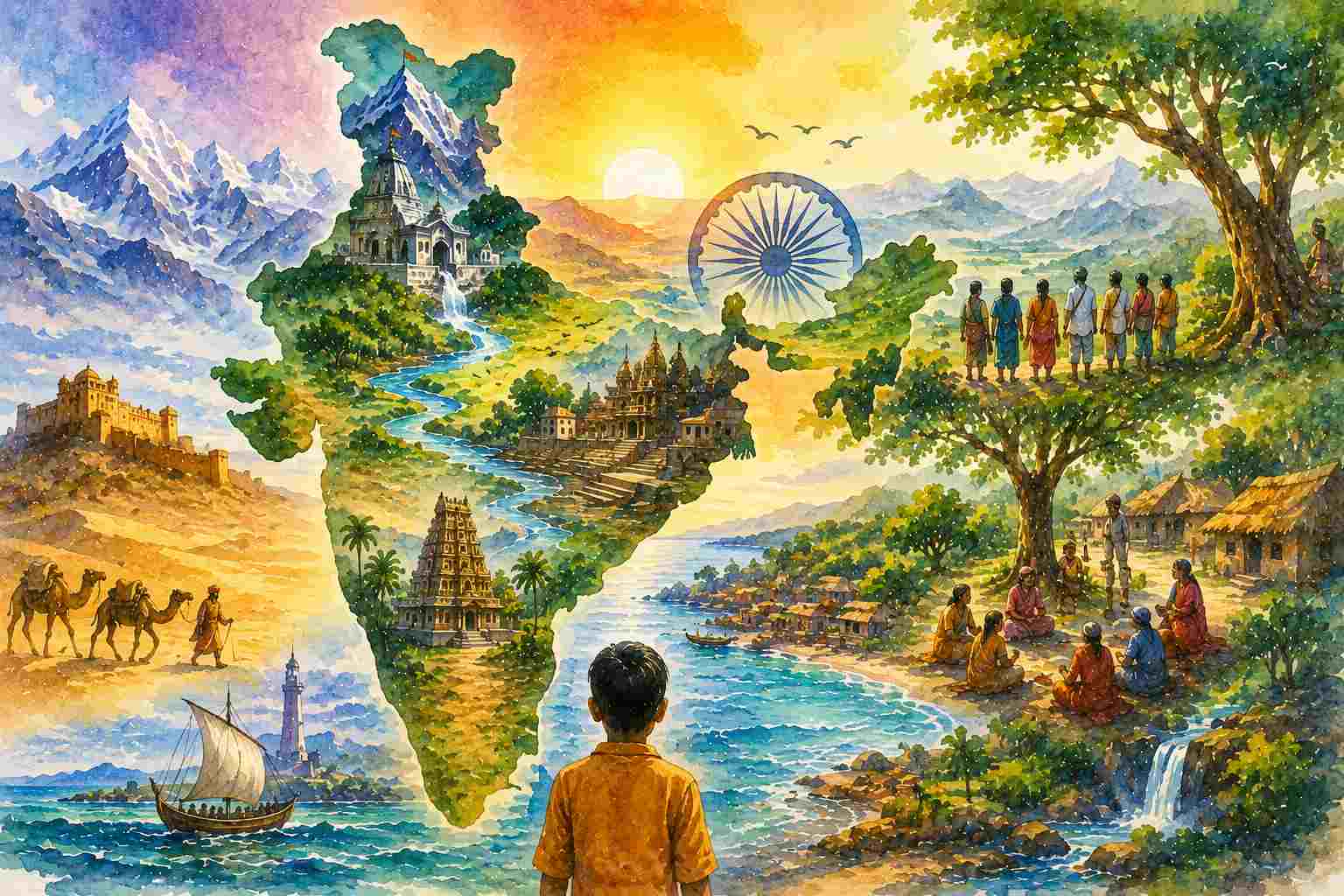
Land, Memory and the Geographical Imagination of Nationalism
A country can be measured in square kilometres. A desha cannot.
This distinction is fundamental to understanding the geography of nationalism. Modern political geography often begins with territory: a bounded area under the authority of a state. Borders define sovereignty, maps define jurisdiction and institutions govern the population within them. But human attachment to land does not begin when a boundary is drawn. Nor does a boundary automatically create belonging.
A person may live within a state without feeling that its territory forms a desha. Another may carry a deep attachment to a land from which his family migrated generations ago. A mountain range may divide two countries while remaining part of one shared cultural imagination. A river may pass through several states while being remembered as one continuous sacred and civilizational presence.
So what transforms geographical space into a meaningful place?
The Indic concept of desha opens an important geographical question. A desha is not simply a portion of land on a political map. It is land as experienced, remembered and inhabited. It exists through a relationship between place, people, memory and belonging. This relationship does not eliminate politics or territory, but it cannot be reduced to them.
Territory Is Governed. Desha Is Experienced.
Modern geography has developed powerful ways of understanding territory. Territory can be surveyed, mapped, administered and defended. These are essential functions of the modern state. But nationalism cannot be understood through territory alone.
Why do people defend land? It is not usually because they have memorised its coordinates. People defend places because those places become connected with their existence. A river may represent livelihood. A village may contain the memory of generations. A mountain may define a region’s ecological and cultural identity. A pilgrimage route may connect places that political maps keep separate. The geographical territory may be the same, but the meaning of the territory changes.
This is where desha differs from a merely administrative understanding of space. The Sanskrit term can carry the sense of a country, region or locality, but its cultural significance lies in the fact that land is rarely experienced as abstract territory. One belongs to a desha through language, memory, landscape, social relationships and shared historical experience. Nationalism, at its deepest geographical level, begins when a large population starts imagining that many different places belong to a meaningful whole.
But this raises an important question: how does a nation emerge from geographical diversity?
A Nation Does Not Require Geographical Uniformity
The modern nation-state often encourages us to imagine unity as sameness. One territory. One people. One political authority. Perhaps one language and one national story.
Bharat presents a different geographical challenge.
Its unity has never depended upon ecological uniformity. The Himalayas and the southern coast do not resemble one another. The Thar Desert and the Brahmaputra valley are not parts of the same physical landscape. Linguistic regions developed their own literary worlds, political traditions and cultural practices. Food, clothing, architecture and livelihoods vary enormously. And yet, diversity did not necessarily produce complete civilizational separation.
Why? Because geography also creates connections.
The Ganga connects regions across its basin. The Narmada creates another geographical and cultural world. Pilgrimage routes link distant regions. Trade routes connect coasts and interiors. Monastic networks, educational centres and sacred sites allow ideas to travel. Epics and Puranic traditions create shared geographical imaginations. A person who had never physically travelled across the subcontinent could still encounter Kashi, Rameswaram, the Himalayas or the ocean within a larger civilizational imagination.
This is where nationalism requires geographical depth.
A nation is not necessarily a land in which everything is identical. It can also be a land in which diversity has developed within long-standing relationships of movement, memory and mutual recognition.
This is particularly important for Bharat. The unity of Bharat cannot be understood simply by placing a modern national border around an ancient civilization and declaring the two identical. That would be historically simplistic. But it would be equally simplistic to imagine that Bharat became geographically meaningful only after the emergence of the modern nation-state.
The modern Republic of India and the civilizational geography of Bharat are not identical categories. Yet neither can be understood while ignoring the other.
Desha, Bhumi and Kshetra: Different Ways of Knowing Place
The richness of Indic geographical thought becomes clearer when we consider related categories such as bhumi and kshetra.
Bhumi draws attention to the Earth or land itself—the ground upon which life is sustained. It reminds us that geography begins with material reality. Soil, water, forests and terrain shape what human societies can become.
Kshetra can refer to a field or a defined area, but it also acquires deeper meanings of cultivated, sacred and action-oriented space. A kshetra is not merely where something exists; it may be a place where particular relationships and actions become meaningful.
Desha, meanwhile, can represent the larger geographical-cultural world to which people belong.
These categories are not perfectly interchangeable. And that is precisely the point. Modern geographical vocabulary often uses “place,” “space,” “region” and “territory.” Indic categories also suggest that land can be known through different relationships. A single landscape may simultaneously be bhumi as earth, kshetra as a meaningful field and desha as a homeland.
Why should a student of Geography not study these distinctions?
Nationalism Begins with the Transformation of Space into Place
Nationalism is often criticised as if attachment to one’s country must necessarily imply hostility towards another. That is a serious historical danger when nationalism becomes exclusionary or supremacist. But this should not prevent us from studying nationalism itself.
A person can love a place without imagining that every other place is inferior. Indeed, geographical nationalism can begin with a simple recognition: this landscape is part of who we are.
The problem emerges when nationalism is separated from geography and converted into abstract political slogans. A nation then becomes merely an idea that must be repeated. But a geographical nationalism is more concrete. It asks us to understand the rivers, mountains, villages, cities, forests, coasts and routes that have shaped collective life. What does it mean to claim love for desha while knowing nothing about its geography? How can patriotism remain meaningful if one does not know the ecological systems that sustain the country? Can a nation be loved only on ceremonial days while its rivers are polluted, its forests destroyed and its communities displaced?
Here nationalism meets responsibility. If desha is meaningful land, then belonging to it must involve more than emotional attachment. It requires geographical consciousness.
From Map to Memory
The map of a country is politically necessary. It defines sovereignty and enables administration. But a map cannot contain everything that makes a desha. It cannot fully show why a river matters to a community. It cannot map the emotional weight of an ancestral village. It cannot easily measure the relationship between a mountain and a people’s cultural imagination. It can display a pilgrimage route, but not the generations of movement that gave the route meaning.
A map shows where a nation is.
A geographical drishti asks why that land matters.
Perhaps this is the deeper lesson of desha. A place becomes meaningful when people enter into relationships with it, remember it, move through it, cultivate it, protect it and locate their own existence within it. A nation is therefore not merely territory occupied by people. Nor is it merely an abstract political imagination. It is a continuous relationship between land and memory, ecology and culture, diversity and belonging. And perhaps this is the question Geography must return to: when we ask where people live, should we not also ask what the land means to them?
Because a geographical space becomes a desha not when it first appears on a map, but when generations begin to see their own story as inseparable from the land beneath their feet.
