Rethinking Human–Nature Geography
Geography is often introduced as the study of the Earth: its landforms, climate, rivers, soils, vegetation, minerals, population and human settlements. The curriculum divides the discipline into physical and human geography and then studies the relationship between them. Yet something is often missing even from this formulation. What kind of relationship is being imagined between human beings and the Earth?
For a long time, geography was associated with exploration, mapping and the discovery of territories. Colonial expansion gave this activity a particular direction. To map a region was not merely to understand it; it could also become the first step towards controlling it. Mountains became strategic barriers, rivers became routes, forests became timber reserves, soils became agricultural potential and territories became resources waiting to be classified and utilised. Geography was therefore never entirely innocent of power.
Even today, the curriculum often retains the language that emerged from this intellectual history. Land, water, forests, minerals and biodiversity are placed under the category of natural resources. The term appears neutral. But every word carries a perspective. When nature becomes primarily a resource, the first question becomes: What can human beings obtain from it?
What if geography began with another question: What relationships make human life possible in a particular place?
The Earth as Object of Study
Modern geography made an extraordinary contribution by demonstrating that human societies cannot be understood independently of their physical environments. Friedrich Ratzel’s environmental determinism attempted to explain human development through geographical conditions. Paul Vidal de la Blache reacted against this determinism through possibilism, arguing that the environment provides possibilities while human societies make choices. Carl Sauer later shifted attention towards cultural landscapes, showing how human beings transform and inhabit geographical space.
These debates remain important. But they also reveal the way modern geography has often constructed its basic problem: environment on one side, human society on the other, and their interaction in between.
The curriculum thus frequently asks how humans adapt to, modify, exploit or manage the environment. This has produced valuable knowledge, but it can also preserve a subtle separation. Nature becomes something “out there,” while humans become the agents who act upon it.
But is this how human life actually exists?
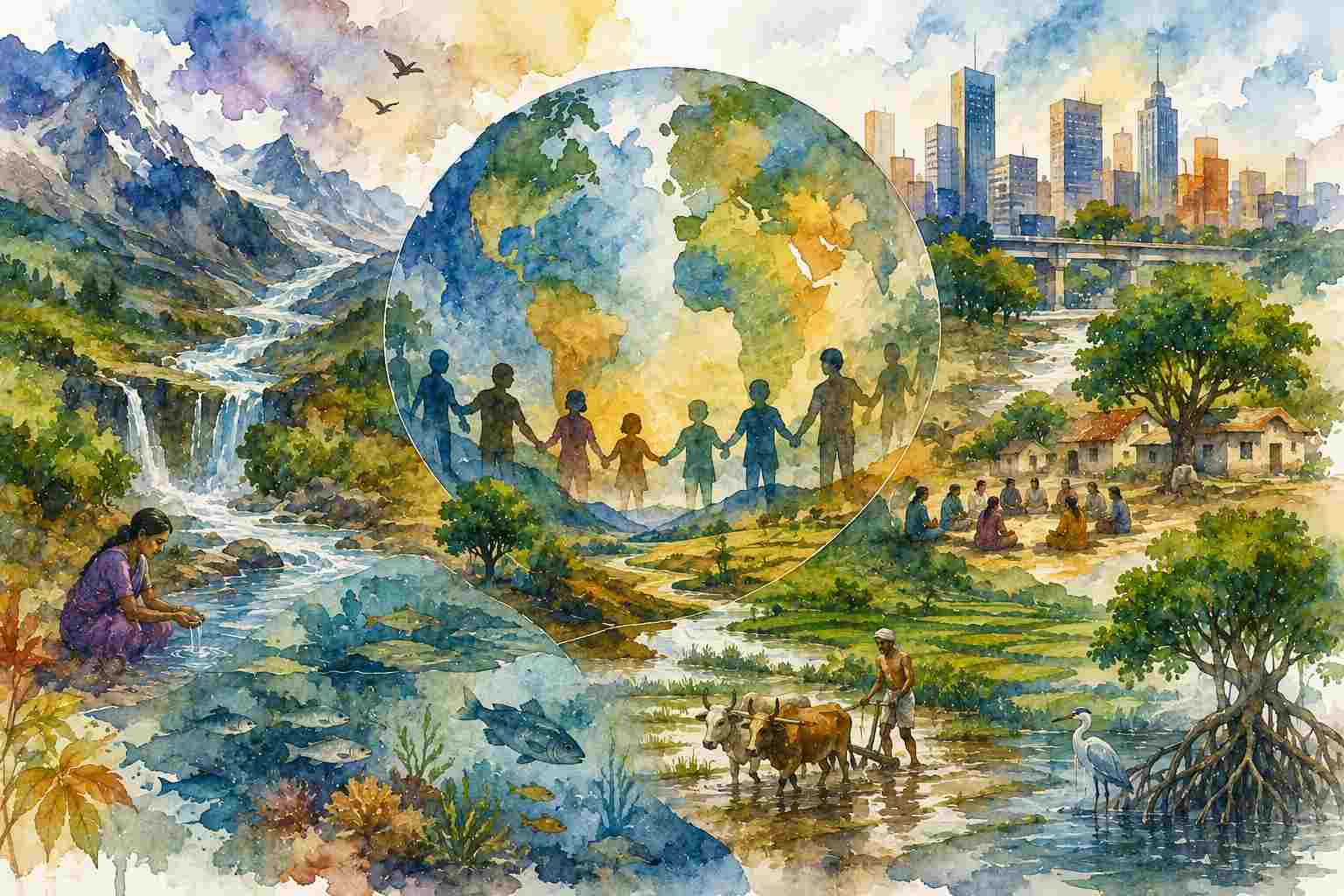
A river is not merely a water resource. It may determine settlement patterns, agricultural cycles, occupational practices, pilgrimage routes, cultural memory and political boundaries. A forest may provide livelihoods, but it may also contain systems of knowledge about food, medicine and seasonal change. Geography therefore becomes impoverished when it studies a landscape only through what it contains rather than through the relationships it sustains.
From Mapping the Earth to Reading It
Geography is not merely about exploring new lands. Its deeper purpose is to understand why human life takes particular forms in particular places.
Why did certain settlements emerge near rivers? Why did communities develop specific agricultural practices? Why did occupations adapt to climate and terrain? Why did trade routes emerge where they did? Why does the same geographical feature become sacred to one community, economically significant to another and strategically important to a third?
These are geographical questions because geography is fundamentally concerned with relationship, location and context.
A decolonised curriculum should therefore recover the idea of geography as a way of reading relationships in space. The Earth is not a blank surface upon which human activity takes place. Nor is human society simply a disturbance within an otherwise independent natural world. Both are part of a continuous geographical relationship.
This does not mean that humans and nature are identical. A river flows according to its own physical processes, but human beings construct settlements around it. The relationship is neither complete separation nor complete unity. Geography studies precisely this complex interaction.
The Problem with “Resources”
The language of resources is not entirely wrong. Human societies do depend upon land, water, forests and minerals. The problem arises when use becomes the only relationship that the curriculum recognises.
Consider a forest. Geography can map its area, calculate its biomass, identify its timber value and classify its biodiversity. Economics can estimate its monetary contribution. Policy can determine how efficiently it should be managed.
But what disappears if we ask only these questions?
The forest may be part of a community’s historical memory. It may regulate water systems beyond its boundaries. It may sustain seasonal livelihoods that do not appear adequately in formal statistics. Its ecological value may only become visible after its destruction.
A geographical understanding must therefore distinguish between use and dependence.
We use many things without recognising the relationships that sustain that use. We use groundwater without understanding recharge systems. We use soil without understanding the processes that regenerate fertility. We use forests without accounting for the wider ecological networks that they support.
A society that understands everything as a resource may become extremely efficient at extraction while remaining geographically ignorant of the conditions that make extraction possible.
Relationship Geography and Local Knowledge
This is where indigenous and local knowledge becomes central to geography, not as folklore or cultural decoration but as geographical knowledge.
Communities living in particular landscapes often develop detailed understandings of rainfall, soil, water movement, seasons, seeds, forests and animal behaviour. This knowledge may not always appear in formal scientific language, but neither should it be dismissed because it emerged outside modern institutions.
A pastoral community knows a landscape differently from a geologist. A farmer knows it differently from a hydrologist. A forest-dwelling community may know ecological relationships that a satellite image cannot reveal.
The purpose is not to romanticise all local knowledge. Communities can also damage ecosystems, and traditional practices must be examined critically. The point is that knowledge of place is plural.
The modern curriculum often privileges knowledge produced from above: maps, surveys, satellite imagery and administrative data. A relationship-based geography also asks how landscapes are understood from within.
This produces a different classroom question. Instead of asking only, “What resources does this region possess?” students might ask, “What relationships have communities developed with this region, and what happens when those relationships are disrupted?”
Bharat and the Geography of Relationship
An Indic perspective provides an important possibility here, although it should not be reduced to a romantic slogan about “living in harmony with nature.” The deeper insight lies in relational thinking.
Bhoomi is not simply land as property. Jal is not merely a unit of water supply. A kshetra is not just territory on a map. These categories can carry ecological, social, cultural and civilizational meanings simultaneously.
The geographical imagination of Bharat developed through relationships between rivers and settlements, forests and livelihoods, mountains and pilgrimage, seasons and agriculture, and regions and cultural networks. Geography was therefore not simply about possessing territory but about understanding the conditions of life within a particular space.
The modern curriculum can learn from this without abandoning scientific geography. Geographical Information Systems, climate science, remote sensing and spatial analysis remain essential. The question is: what are we using them to see?
Technology can show us land-use change. But do we understand what social relationships were transformed when that land changed? Satellite data can identify deforestation. But can a satellite alone tell us how a forest functioned within the life of the communities around it?
Geographical knowledge requires both scale and intimacy.
A Different Curriculum of Geography
A decolonised geography curriculum should not reject maps, exploration or resource studies. Rather, it should expand them.
Students should certainly learn about minerals, soils, rivers, population and spatial distribution. But they should also study how geographical relationships produce forms of life. They should examine colonial mapping and territorial classification alongside indigenous ways of understanding place. They should study ecological systems alongside cultural landscapes and ask how the disruption of one transforms the other.
The basic progression could change:
Land → Resource → Relationship → Responsibility
Land is identified. Its potential use is understood. Its ecological and social relationships are studied. Human responsibility follows from that understanding.
This changes geography from a discipline concerned merely with what exists where into one concerned with why relationships emerge where they do and what happens when they are broken.
The central question therefore remains: Do we merely live on the Earth, or do we live within relationships with it?
Perhaps geography has to answer both. We inhabit land, but we do not create the conditions that make it inhabitable by ourselves. We settle near rivers without producing the water cycle. We cultivate soil without creating the geological and biological processes beneath it. We build cities, but those cities remain dependent on ecological systems extending far beyond their boundaries.
The great geographical mistake may therefore be to imagine that the Earth is merely the stage upon which human history occurs.
Geography begins to deepen when we recognise that the stage is alive with relationships—and human beings are not standing outside them.
