Rethinking Historical Periodization
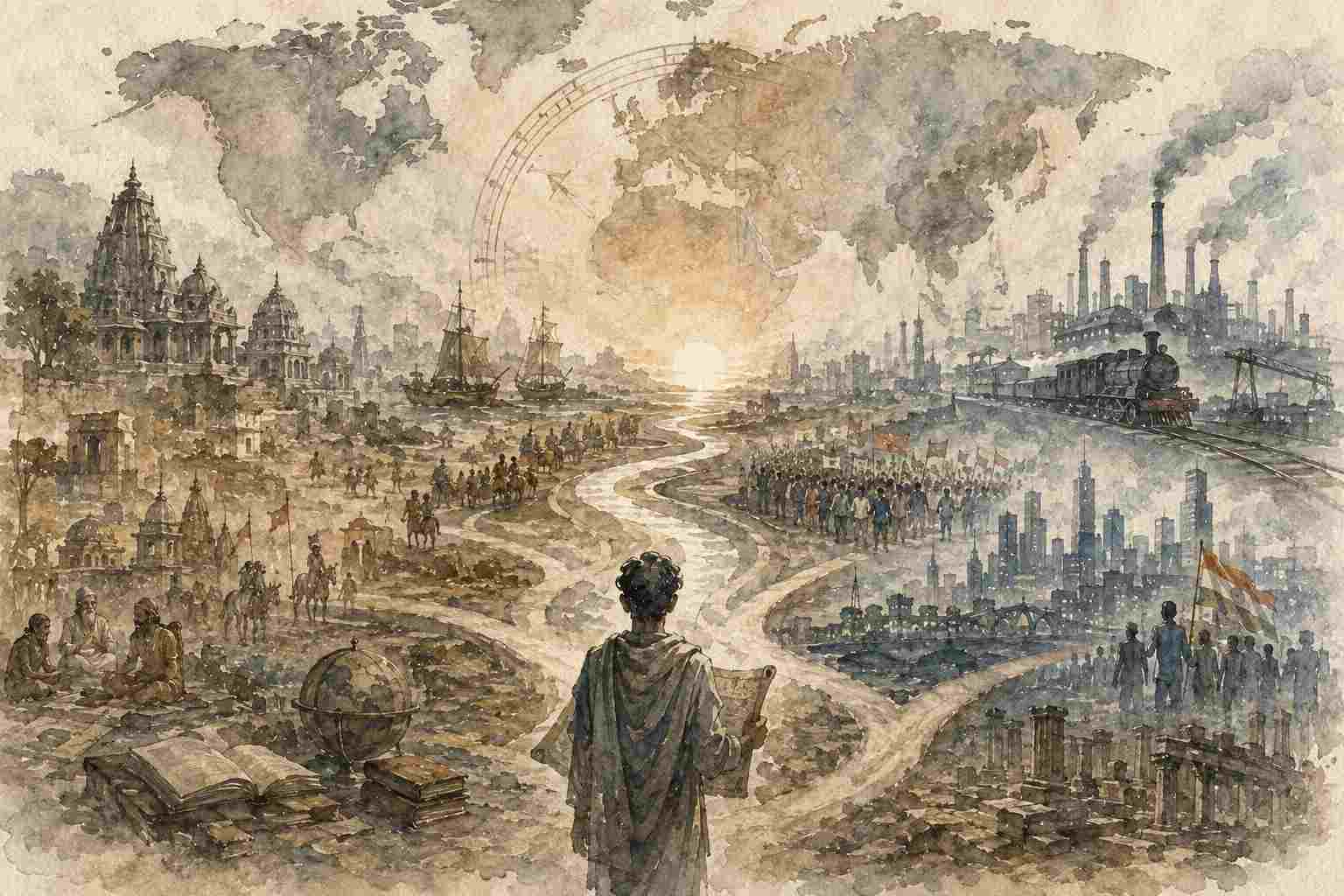
Every student of History encounters the same three boxes: Ancient, Medieval and Modern. Ancient comes first, Medieval occupies the middle and Modern arrives at the end, usually carrying progress, reason, science and the nation-state. The arrangement appears so natural that we rarely ask the most important question: Who decided that history should be divided in this way?
Periodization is not history itself. It is a way of organising history. We divide time because the past is too vast to study without structure. Yet once a structure becomes familiar, it begins to appear natural. The danger is that a classification developed to understand one historical experience can quietly become the timeline through which every civilization is expected to understand itself.
The Ancient–Medieval–Modern framework emerged from attempts to understand European history. Classical Greece and Rome came to represent antiquity; the period between the fall of the Western Roman Empire and the Renaissance was later conceptualised as the “Middle Ages”; and “modernity” emerged through narratives of Renaissance, Reformation, scientific transformation, overseas expansion and industrialisation. But this is a particularly European story.
What exactly is “medieval” about a civilization that did not experience the fall of Rome? Why should the European Renaissance become the invisible clock against which other societies measure their historical progress?
This is not merely a problem of terminology. The way we divide time determines what we expect to find within it.
When European Time Became Universal Time
The Ancient–Medieval–Modern sequence appears neutral only because it became globally familiar through European scholarship and colonial education. Its deeper structure is often evolutionary: the ancient world is distant and formative, the medieval world is transitional and the modern world is advanced.
But even Europe does not fit this neat progression.
The Roman Empire did not simply “end” in 476. The Byzantine Empire continued for nearly a thousand years. Classical knowledge did not disappear during the so-called Middle Ages; much of it was preserved, developed and transmitted through Byzantine and Islamic intellectual networks. The Abbasid period was producing major developments in mathematics, medicine, philosophy and astronomy while parts of Europe were described through the language of medieval backwardness.
Which period, then, was “medieval” for the world?
The question becomes even more difficult in China. A civilization that experienced the Tang, Song, Yuan, Ming and Qing periods does not naturally organise its history around the fall of Rome, the European Renaissance or the Industrial Revolution. China possesses dynastic periodization, but even that has limitations because political dynasties do not always correspond to social, technological or cultural transformations.
Japanese history similarly contains distinctive transitions: the Nara, Heian, Kamakura, Muromachi, Tokugawa and Meiji periods. The Meiji Restoration marks a major transformation, but calling everything before it “medieval” would conceal enormous differences within Japanese history.
The same problem appears across Africa, West Asia and the Americas. The history of the Mali Empire, the Ethiopian kingdoms, Mesoamerican civilizations or the Inca world cannot be adequately understood simply by locating them somewhere on a European timeline.
The world did not experience time simultaneously.
What Happens to Bharat?
The problem becomes particularly important in the study of Indian history.
The familiar division of Ancient India, Medieval India and Modern India often appears to explain the past while actually imposing a structure upon it. The transition from “Ancient” to “Medieval” is usually located somewhere around the decline of large early empires and the emergence of new regional political formations. But what exactly changes at this point so completely that one historical world ends and another begins?
Political authority changed, certainly. New kingdoms emerged. Regional languages and literary traditions expanded. Religious and intellectual traditions transformed. Trade networks shifted. New military technologies appeared. Islam became an important part of the subcontinent’s political and social history.
These are major developments.
But did they produce a complete civilizational break?
The answer is more complicated. Sanskrit intellectual traditions continued. Temples continued to function and develop. Pilgrimage networks remained active. Agrarian communities preserved long institutional continuities. Legal, philosophical and literary traditions did not suddenly become “medieval” because political power changed hands.
The same question applies to “modernity.”
If modern Indian history begins with European colonialism, what happens to earlier processes of economic change, political transformation and technological development? If it begins with British administration, are we unconsciously accepting colonial rule as the threshold that made India “modern”?
This is precisely why periodization requires scrutiny.
A Period Is a Question, Not a Box
Perhaps historians should begin by asking what exactly is being studied.
If the subject is political authority, periods may be organised around changes in kingdoms, empires and states. If the subject is social history, different transformations may become more important: migration, urbanisation, caste formation, gender relations or demographic change. Economic history may be organised around agriculture, trade networks, currency, industrialisation or global integration.
A civilizational historian may ask different questions altogether: what intellectual traditions continue? What institutions survive political change? How do societies absorb new communities and ideas?
One historical transformation may therefore create a rupture in one sphere while another sphere continues.
The arrival of colonial rule, for example, transformed political sovereignty and administrative institutions profoundly. Yet languages, religious traditions, family structures, pilgrimage networks and social institutions continued—though often under new pressures and classifications.
History therefore contains both rupture and continuity.
Periodization becomes misleading when it assumes that an entire civilization changes simultaneously because one major political event has occurred.
Alternative Ways of Dividing Time
This does not mean that historians should abandon periodization and simply study an undivided past. That would make history impossible to organise. The solution is not to eliminate periods but to become conscious of them.
Bharat’s history might sometimes be studied through political formations, but also through the expansion of agriculture, the growth of regional cultures, changing trade routes, religious movements, technological transformations or colonial intervention.
Consider the development of the Indian Ocean world. Its historical rhythm cannot be understood only through the political periods of individual states. Maritime trade connected East Africa, Arabia, Persia, India and Southeast Asia across multiple kingdoms and centuries. The ocean created a historical world whose chronology followed commercial winds, monsoons, technologies and networks as much as dynasties.
Similarly, the history of jati cannot simply follow the dates of kings. A sociological institution may continue across several political periods while changing internally. The history of a river civilisation, a language or a pilgrimage network may follow another chronology altogether.
There may not be one correct periodization for every historical question.
This is the key insight.
Periodization as Power
The way we divide history also carries political consequences.
Calling a period “dark,” “golden,” “classical,” “feudal,” “medieval” or “modern” does more than identify dates. It already suggests how that period should be interpreted. A “dark age” is expected to decline. A “golden age” is expected to shine. A “modern age” is expected to progress.
The label can become the argument before the evidence is examined.
Colonial historiography frequently classified societies through evolutionary stages, placing Europe at the advanced end of a universal developmental journey. Other civilizations could then be studied according to how far they had supposedly progressed toward European modernity.
Decolonizing History therefore does not mean rejecting chronology. It means asking whether the categories through which chronology is organised have been mistaken for universal truths.
Beyond the Three Boxes
Ancient, Medieval and Modern may remain useful categories when clearly defined and used critically. They are not inherently useless. The problem begins when students inherit them without learning their intellectual history.
History education should therefore ask: What makes one period different from another? Political change? Social transformation? Economic restructuring? Civilizational rupture? Technological change? Or merely a date inherited from a textbook?
Once students ask this, periodization becomes intellectually productive.
The most important historical shift may not always coincide with the beginning of a century, the fall of a dynasty or the arrival of a conqueror. Civilizations often change gradually, absorb shocks unevenly and preserve older forms within new circumstances.
A political map may change overnight. A civilization rarely does. That is why history must move beyond the comfort of three universal boxes. Ancient, Medieval and Modern are not the past. They are one particular way of arranging it.
And perhaps the first lesson of historical thinking is to recognise that the moment we divide time, we also begin to interpret it. The question, then, is not simply: “When did one period end and another begin?”
It is: “Whose historical experience made us draw the line there in the first place?”
