
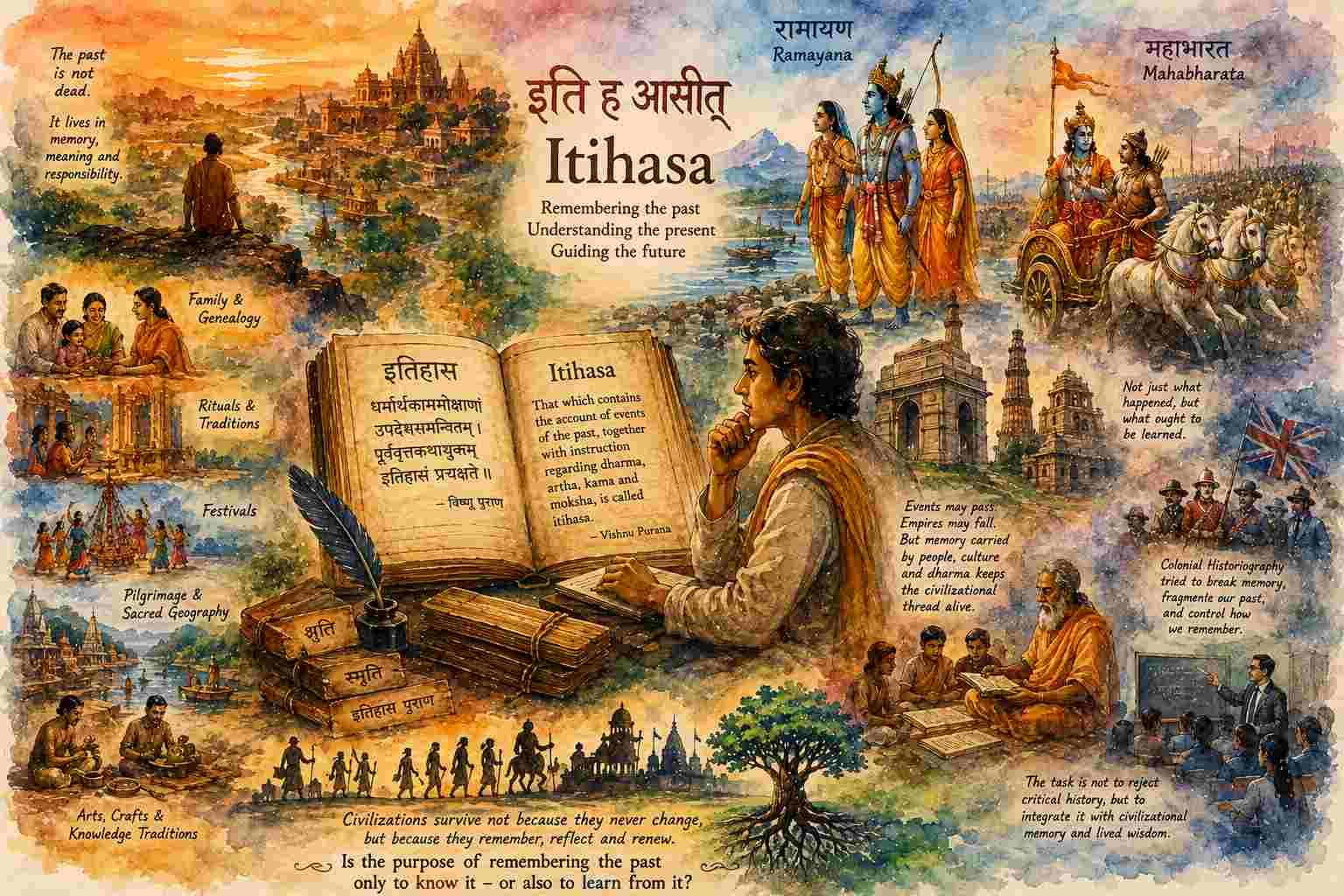
Beyond the Past as a Dead Record
Modern academic history is often concerned with a fundamental question: what happened? It investigates evidence, establishes chronology, compares sources and attempts to reconstruct the past as accurately as possible. These are essential tasks. Without critical methods, history can easily become propaganda, nostalgia or invention.
But another question is equally important: why should human beings remember the past at all? Do we remember merely to know what happened on a particular date? Or does remembering also involve learning from accumulated human experience?
The Indic category of itihasa opens a different possibility. It is commonly explained through the expression iti ha asa—“thus indeed it happened.” Whether treated as a literal etymological formula or a traditional interpretive understanding, the category suggests that the past is not simply imagined but remembered and transmitted. Yet itihasa is not identical to what a modern university department means by “History.” It connects memory with narrative, action with consequence, and events with questions that remain relevant beyond their immediate historical moment.
This difference is important. Modern history generally asks us to maintain distance from the past. The historian investigates a world that has disappeared. Itihasa, however, allows the past to remain intellectually present.
The question is not only: What did they do? It is also: What did their actions reveal about human conduct, power, responsibility and consequence? That does not mean itihasa should replace historical method. It means that historical method itself does not exhaust the meaning of remembering.
History Records the Past. Itihasa Carries It Forward
The modern historical discipline developed rigorous methods for dealing with evidence. Chronology, source criticism, archaeology, inscriptions and documentary verification allow historians to distinguish what is known, what is probable and what remains uncertain. This discipline should be strengthened, not abandoned.
But modern history sometimes creates another limitation. In its desire to avoid moral preaching, the past can become intellectually detached from life.
Students may learn that a kingdom expanded between two dates, that a ruler introduced a particular policy or that a battle altered a political boundary. But what should they do with that knowledge? If historical education produces only information, while leaving the student unable to reflect upon the recurring problems of power, ambition, loyalty, justice or social responsibility, then the past has been studied without becoming meaningful.
Here itihasa offers a wider understanding.
The remembered past contains events, but those events also become material for reflection. The past becomes a space in which a civilization repeatedly examines questions that do not disappear simply because centuries have passed.
What happens when political power becomes detached from responsibility? How does personal ambition affect collective life? Can victory produce long-term consequences more destructive than defeat? What does a ruler owe to society? When should institutions preserve continuity and when should they change?
These are historical questions, but they are also enduring human questions.
The value of itihasa lies precisely here. The past is remembered because human beings continue to encounter problems that earlier generations also confronted, although under different circumstances.
A King Is Not Only a Date
Consider the difference between two ways of studying Ashoka.
A conventional historical account may discuss the chronology of the Mauryan Empire, the extent of Ashoka’s territory, the Kalinga war and the contents of his inscriptions. All of this is necessary. Without inscriptions and other forms of evidence, historical interpretation would become speculation.
But Ashoka’s own inscriptions suggest that political events were not being remembered merely as administrative facts. His encounter with the consequences of warfare became connected with questions of dhamma, restraint, welfare and the responsibilities of authority.
The historical event matters. The ethical reflection that emerges from the event also matters.
This does not mean every statement in an inscription should be accepted as transparent truth. A ruler can use moral language politically. Historians must ask why Ashoka represented himself in particular ways. Yet once those questions are asked, we still encounter something important: political experience was being connected to a larger reflection about how power ought to be exercised.
This is closer to the spirit of itihasa. An event does not remain trapped in its date.
It enters memory because later generations can continue to ask what it teaches.
The same is true of many other traditions. The story of the fall of Troy in Greek civilization survived not merely because Greeks wanted information about an ancient military conflict. Roman political thinkers repeatedly engaged with the memory of their Republic because its collapse became a warning about the relationship between liberty and power. Chinese historical traditions repeatedly studied the rise and decline of dynasties because the past was understood as a reservoir of political experience.
Civilizations have rarely remembered the past simply because they enjoyed chronology.
They remembered because the past was believed to contain consequences.
The Historian and the Storyteller Ask Different Questions
This is where the distinction between historical evidence and civilizational memory becomes essential.
An inscription, coin or archaeological layer can often be examined through methods of dating and corroboration. A traditional narrative may preserve memory in a different way. It may combine remembered events with later interpretation, moral reflection and symbolic imagination.
The historian must not confuse these categories.
But neither should we conclude that only the first has intellectual value.
Kalhana’s Rajatarangini provides a fascinating example of the relationship between evidence, memory and historical writing. Writing in twelfth-century Kashmir, Kalhana did not simply copy every tradition available to him. He consulted earlier chronicles, inscriptions, genealogies, documents and local traditions. He compared accounts and expressed scepticism toward sources he considered unreliable. Yet his purpose was not identical to that of a modern academic historian. His account also reflected upon the transience of power and the cyclical instability of political life.
The text is therefore important in two ways. It provides material for reconstructing Kashmiri history, while also revealing how an Indian historical writer understood the meaning of political memory.
This is an important point for students. A source does not have to be either “modern history” or “useless mythology.” Historical texts can contain multiple layers. They may preserve information, transmit memory, offer interpretation and express philosophical reflection at the same time.
The task of the historian is to separate these layers as carefully as possible without destroying the source in the process.
Remembering Is Also a Form of Responsibility
Why does a community remember its ancestors?
The simplest answer is identity. But identity is only one part of the story. Communities remember migrations because the movement shaped who they became. They remember conflicts because those conflicts altered relationships. They preserve genealogies because belonging connects generations. They commemorate certain places because geography becomes a repository of collective experience.
In such cases, memory performs a social function.
Consider the memories of Partition preserved within displaced communities. Government records can tell us about administrative decisions, migration numbers and demographic transformation. These sources are indispensable. But families also preserved memories of homes left behind, journeys undertaken, objects carried across borders and institutions rebuilt in unfamiliar places.
The historical record tells us that displacement occurred.
Memory tells us what displacement meant.
Neither should replace the other. But a serious history of civilizational experience requires both.
This is particularly relevant for Bharat because so much historical continuity has been carried outside the modern archive. Communities preserved knowledge through oral traditions. Pilgrimage preserved geographical memory. Local festivals remembered historical events long after official records disappeared. Family traditions transmitted experiences that states did not record.
To dismiss all such forms as “unscientific” would be a methodological error. The correct approach is critical engagement. Which elements can be corroborated? Which have changed over time? When did a particular tradition emerge? Why has it survived?
But these questions require us to investigate memory, not simply dismiss it.
The Past Is Not a Courtroom
One of the dangers of contemporary historical politics is that every discussion of the past becomes a trial.
The historian becomes a prosecutor. A community becomes the accused. Another becomes the victim. The objective becomes to establish permanent civilizational guilt or innocence.
This is not the only way to remember.
The past certainly contains violence, injustice and conflict. These must not be erased in the name of harmony. Yet remembering injustice should not mean imprisoning every generation within inherited resentment. Historical consciousness must be capable of criticism without becoming permanently captive to grievance.
This is another useful insight offered by the Indic understanding of memory. Remembering can become a form of viveka—discernment.
What should be continued? What should be reformed? What should be learned from? What should never be repeated?
A civilization that remembers everything uncritically becomes trapped by tradition. A civilization that forgets everything in the name of progress becomes detached from its own accumulated experience.
Both are forms of historical blindness.
Learning From the Past Without Living Inside It
Perhaps this is the deeper distinction between itihasa and a narrowly factual understanding of history.
History asks us to establish what can be known about the past. Itihasa asks whether that knowledge should remain morally and intellectually inactive.
The answer cannot be that historians must turn every historical event into a simple moral lesson. History is too complex for that. The past rarely provides ready-made solutions. A decision that was appropriate in one century may be disastrous in another. Context matters.
But complexity is not the same as irrelevance.
The purpose of remembering a political crisis is not to repeat the actions of earlier rulers. The purpose is to understand the relationship between action and consequence. The purpose of remembering social transformation is not to recreate an earlier society. It is to understand what changed, why it changed and what was lost or gained in the process.
This is why itihasa can remain relevant to contemporary historical education. It does not ask students to worship the past. It asks them to enter into a relationship with it.
A mature student of History should therefore be able to hold two disciplines together. The first is critical distance: evidence must be tested, chronology examined and interpretation challenged. The second is civilizational proximity: the past must also be understood as part of a continuing human conversation about life, society and responsibility.
Without critical distance, memory becomes myth-making. Without civilizational proximity, history becomes a museum catalogue. The challenge is not to choose one and abandon the other. It is to learn how to investigate the past without silencing the meanings through which generations remembered it. Perhaps this is the real significance of itihasa. The past is not remembered merely so that we can say, “This happened.”
It is remembered so that we may also ask: What happened because it happened? What did people learn? What did they fail to learn? And what will happen if we remember the event, but fail to understand its meaning?
That is when remembering becomes more than information. It becomes historical consciousness.
