Authority, Responsibility and the Limits of Power
Political science often begins with a deceptively simple question: Who has power? Who rules, who makes decisions, who controls institutions, who commands the army, who collects revenue, who makes the law? These are important questions, but they leave us with a much more difficult problem: why should anyone obey? A person may possess the ability to compel obedience, but does that ability by itself make his rule legitimate? A state may have the machinery to punish, tax and regulate, but does the existence of that machinery establish a moral claim over society? The distinction between power, authority and legitimacy begins precisely here, because power tells us what someone can make others do, authority concerns the recognised right to exercise that power, while legitimacy asks a deeper question—what makes that authority worthy of obedience?
Modern political thought has developed several answers to this problem, ranging from constitutional procedures and popular consent to elections, representation, law and institutional accountability. These mechanisms are undoubtedly important because arbitrary power needs restraints, and modern constitutionalism has developed sophisticated ways of limiting the exercise of political authority. Yet even the most carefully designed constitution cannot completely answer the question of legitimacy, because a legal order may tell a ruler what he is permitted to do, while it does not necessarily tell us what he ought to do. Legality and legitimacy can overlap, but they are not identical. A ruler may act within the formal powers of an office and still exercise that power in a manner that destroys public trust, weakens social institutions or violates the deeper expectations through which society understands responsible rule.
Indic Polity
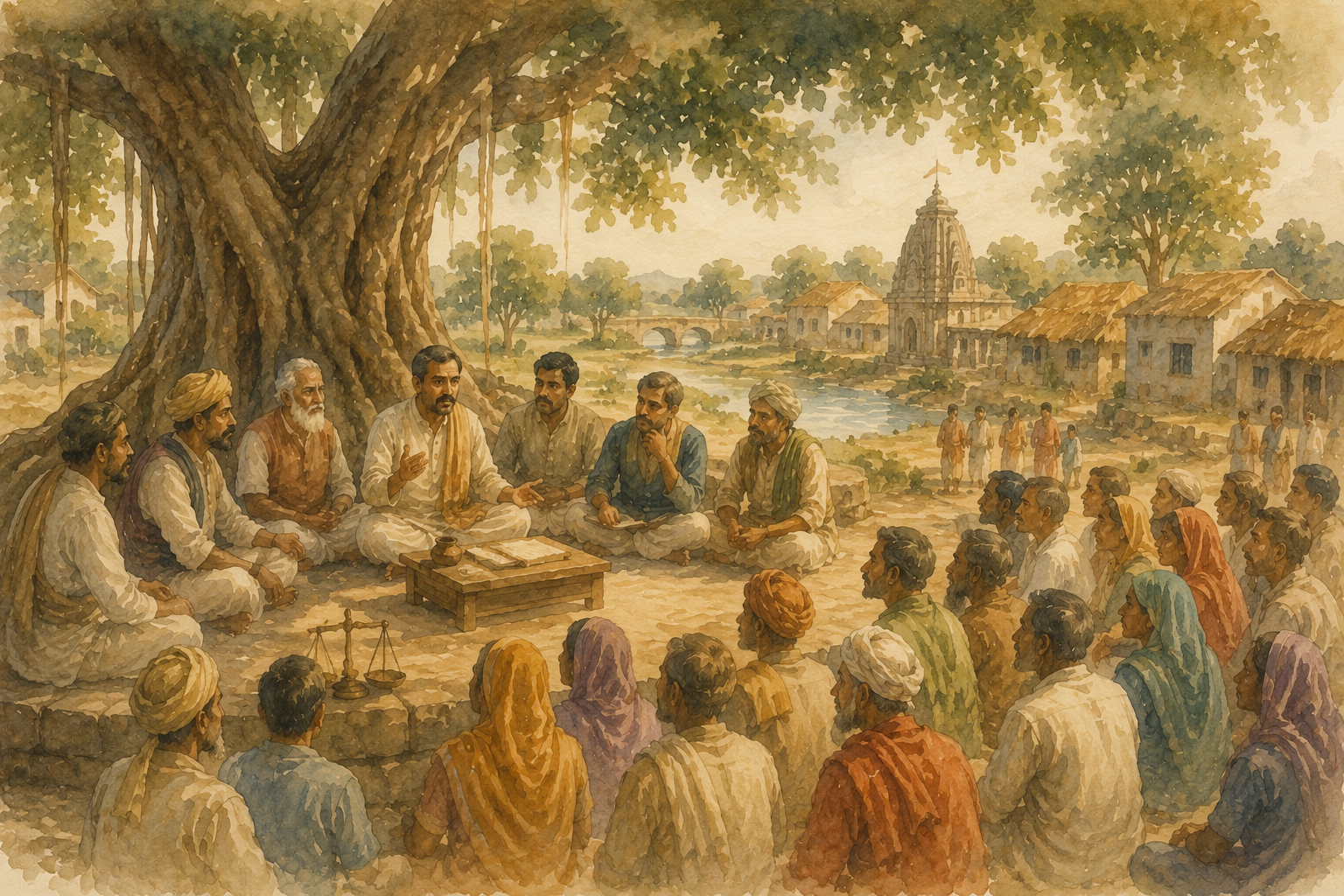
This is where an Indic political vocabulary opens another line of inquiry. The question of political authority in the Bharatiya tradition was not exhausted by asking who occupied the throne. The ruler was situated within a larger moral and social order, and Rajadharma provided one way of thinking about the obligations attached to political authority. The king possessed power, but power was not understood as an unrestricted personal possession; it carried duty, restraint and responsibility. The ruler was expected to protect the people, maintain order, uphold justice and secure the conditions through which society could pursue its legitimate purposes. Authority therefore carried obligations towards those over whom authority was exercised.
The distinction becomes particularly important when we consider the relationship between Dharma and Danda. Danda represents the coercive capacity of the state—the ability to punish, enforce and maintain order—but its legitimate exercise cannot be separated from Dharma. Coercion without an ordering principle can become oppression, while an abstract moral principle without institutional capacity may become incapable of protecting society. The political problem, therefore, is not simply whether the state possesses sufficient power, but whether power is exercised within an order that gives it purpose and limits its arbitrary use. This makes the Indic question rather different from the simple opposition between a powerful state and a powerless society.
The Mahabharata repeatedly places the ruler under obligation to protect rather than merely dominate. The Shanti Parva develops extensive discussions on kingship, duty, justice and the responsibilities of the ruler, while the Manusmriti states, in its discussion of kingship, that the king should protect his subjects and that the king who fails in his duty towards them does not fulfil the purpose of kingship (Manusmriti 7.35–36).
Kautilya’s Arthashastra, often read primarily as a manual of statecraft, similarly places the welfare of the subjects at the centre of kingship: “In the happiness of his subjects lies his happiness; in their welfare his welfare” (Arthashastra 1.19.34). Whatever differences exist between these texts, a common question emerges: what is political power for?
And that question changes the way we understand legitimacy.
If power exists only because someone possesses greater force, then the strongest person should always have the strongest claim to rule. But political communities rarely survive on coercion alone. They require trust, recognition, institutional continuity, shared expectations and some conception of justice. A ruler who constantly needs to force obedience has already revealed a weakness in his authority. Power may compel the body, but legitimacy seeks the consent of the social and moral order within which power operates.
This also means that legitimacy cannot be reduced to elections alone. Elections answer an important question—who has received political authorization?—but they do not eliminate the question of responsibility. A government can be elected and still exercise power irresponsibly; a majority can possess political authority and still require constitutional, institutional and ethical restraint. Democratic legitimacy therefore cannot mean simply that the majority is always right. Political authority must remain accountable to something beyond its own capacity to reproduce itself.
The Indic idea of Rajadharma becomes significant here not because it offers a ready-made constitutional model for the modern state, but because it changes the conceptual starting point. Instead of beginning with “What powers does the ruler possess?”, we can begin with “What duties arise because the ruler possesses power?” Instead of treating authority primarily as a collection of rights, we can examine it as a structure of responsibilities. The greater the power, the greater the obligation to exercise it with restraint.
Perhaps this is where political science needs to return to a question it sometimes leaves behind. We have become remarkably skilled at studying institutions, elections, constitutions, regimes and distributions of power, but political life cannot be understood merely by mapping who controls what. The deeper question is whether the exercise of power contributes to the order, security, dignity and flourishing of the society over which it is exercised.
So, what makes power legitimate? Not power itself. Not merely the ability to command. Not even legality by itself.
Power becomes legitimate when authority is recognised, restrained, justified and exercised as a responsibility towards the larger social order.
And perhaps the most important question for political science is therefore not simply “Who should rule?”, but the more uncomfortable one: “What must the ruler become worthy of the power that society has placed in his hands?”
