
Political Order
Political Science has spent considerable time asking who rules, how rulers acquire power, how institutions are organised, and how states exercise authority, but there is a prior question that is often left unanswered: why do we need political order in the first place? If the purpose of the Rajya is reduced to maintaining territorial boundaries, collecting revenue, enforcing laws and protecting the interests of the state, then political order becomes little more than an elaborate mechanism of control. But what if the state exists for something larger than itself? What if the real question is not merely who governs society, but what conditions political order is expected to create so that society itself can flourish? This takes us towards a very different understanding of Rajya, where political power is not the end of social existence but one of the instruments through which collective life is protected, ordered and enabled.
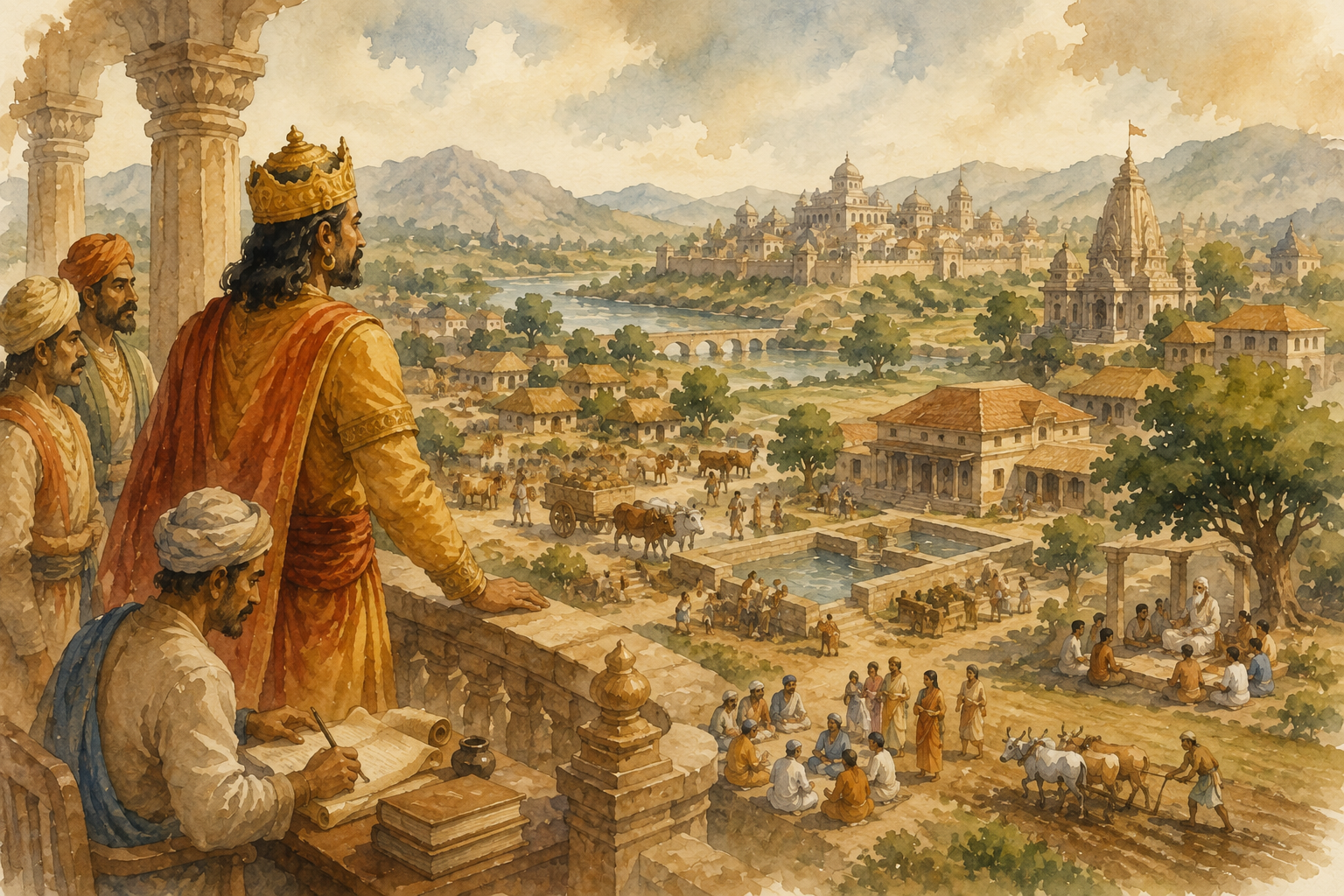
The modern idea of the state often encourages us to imagine society as something that exists below the state, as though political authority stands above an otherwise unorganised population and provides it with order. The Indic experience gives us reasons to question this assumption. Society was not imagined as being created by the state; families, communities, occupational groups, gramas, janapadas, institutions of learning, religious establishments, guilds and numerous local arrangements possessed their own forms of organisation long before the modern centralised state. The Rajya, therefore, entered an already living social world. Its responsibility was not necessarily to manufacture society according to a political blueprint, but to protect the conditions under which society could continue to organise and reproduce itself.
This becomes particularly visible in the Mahabharata’s discussions of kingship, where the ruler’s responsibilities extend far beyond warfare and territorial expansion. In the Shanti Parva, Bhishma tells Yudhishthira that the king should look upon his subjects “as his own children”, while insisting at the same time that justice must be administered without partiality; the same passage links the functioning of the kingdom directly with the proper administration of justice and the protection of the people (Mahabharata, Shanti Parva, 69). The important point is not simply that the king should be benevolent. It is that political order has a social purpose: protection, justice and the maintenance of conditions in which ordinary life can continue.
There is another remarkable insight in the same tradition which deserves much greater attention. The Mahabharata does not imagine the kingdom as the possession of the king alone. In its discussion of the seven limbs of the state—king, ministers, territory, fort, treasury, army and allies, the text presents political order as an interdependent arrangement in which different elements sustain one another. Indeed, another passage makes the striking observation that these limbs exist “depending upon one another, like three sticks standing with one another’s support” (Mahabharata, Shanti Parva, 313). This is conceptually important because it moves us away from the image of the king as the state itself. Rajya is an institutional ecology, not simply the person of the ruler.
That insight allows us to rethink what we mean by political stability. A kingdom may possess a powerful ruler and still be fragile if its treasury is empty, its ministers are corrupt, its provinces are alienated, its fortifications are weak, its productive economy is damaged, or its alliances have collapsed. Conversely, a political order may remain resilient precisely because authority is distributed across institutions capable of supporting one another. Political order is therefore not merely the ability to command; it is the capacity to coordinate multiple systems of social existence.
This is also why the Indic political tradition did not treat prosperity as something entirely separate from political responsibility. The ruler was expected to protect agriculture, markets, roads, water systems, productive resources and the conditions of livelihood. The Shanti Parva speaks of the king appointing trustworthy people over mines, salt, grain, ferries and elephants, while also requiring the construction of roads and provision of water at appropriate places (Mahabharata, Shanti Parva, 69). Read carefully, this is not merely an ancient administrative checklist. It suggests a conception of political order in which infrastructure, economy, security and public welfare are interconnected.
And this raises an uncomfortable question for modern political science: when does a state become too large, too intrusive or too centralised for the society it is supposed to serve? If the purpose of Rajya is to enable social flourishing, then political expansion cannot automatically be equated with political success. A state may increase its administrative reach while weakening the institutions through which communities organise themselves. It may produce uniformity while destroying local capacity. It may increase regulation while reducing responsibility. It may become administratively stronger and socially weaker at the same time.
The Indic conception of political order gives us another useful distinction here: the state and society are related, but they are not identical. The Rajya has a responsibility to protect the social order, but it does not necessarily have to absorb every function of that order. This becomes particularly relevant when we think about India’s historical diversity, where village institutions, community organisations, temples, guilds, educational lineages, pilgrimage networks and local authorities often performed functions that a modern state might attempt to centralise. The question is therefore not simply whether the state can perform a function, but whether every social function should become a function of the state.
Political order also has a temporal responsibility. A ruler does not inherit society merely to consume its resources during his own lifetime. He receives institutions, land, infrastructure, knowledge, wealth and social relationships from previous generations and is expected to transmit them in viable form to those who come after. This is one reason why the language of protection becomes so important. To protect does not merely mean defending territory from an external enemy; it can also mean preserving the conditions through which agriculture, knowledge, family, commerce, culture and community life remain capable of continuing.
The Mahabharata goes even further by linking the moral quality of the ruler with the condition of the age itself. Bhishma states that the king is capable of producing the conditions associated with different ages and warns that a ruler who allows wrongdoing to flourish shares in the consequences of the disorder of his subjects (Shanti Parva, 69). This is a powerful political idea: governance is not morally neutral. The quality of political leadership can influence the wider social environment.
This gives us a richer way to understand Rajya. It is neither simply a coercive apparatus nor merely an administrative machine. It is a guardian institution within a larger social and civilizational order, whose legitimacy depends partly upon whether it can protect life, uphold justice, maintain stability, facilitate prosperity and allow society to pursue its wider purposes. So perhaps the central question of Political Science should not stop at “Who governs?” or even “How is government organised?” The more fundamental question is: What kind of political order allows a society to remain secure, prosperous, just, socially capable and civilizationally continuous without turning political power itself into the centre of social life?
That is where Rajya becomes more than an ancient word for the state. It becomes an invitation to reconsider what political order is ultimately for.
