Recovering Indigenous Sources and Voices
Anthropology has always claimed to study human beings in their social and cultural worlds. Yet an uncomfortable question remains: who gets to decide what counts as knowledge about those worlds?
For much of its disciplinary history, anthropology privileged particular forms of evidence—field observation, interviews, ethnographic description and the written record produced by the researcher. Colonial anthropology in India makes this problem especially visible. Administrators and ethnographers such as Herbert Risley and William Crooke classified Indian communities through official glossaries, censuses and ethnographic handbooks. In the process, complex local traditions could become fixed categories created for administrative purposes.
Gloria Raheja has shown how oral speech and folklore in colonial India were extracted into official reports and glossaries, often stripping them of their contextual and dialogical character. The community could therefore become the object of knowledge without being recognized as a producer of knowledge.
Decolonizing anthropology requires reversing this relationship.
Who Is the Knowledge-Holder?
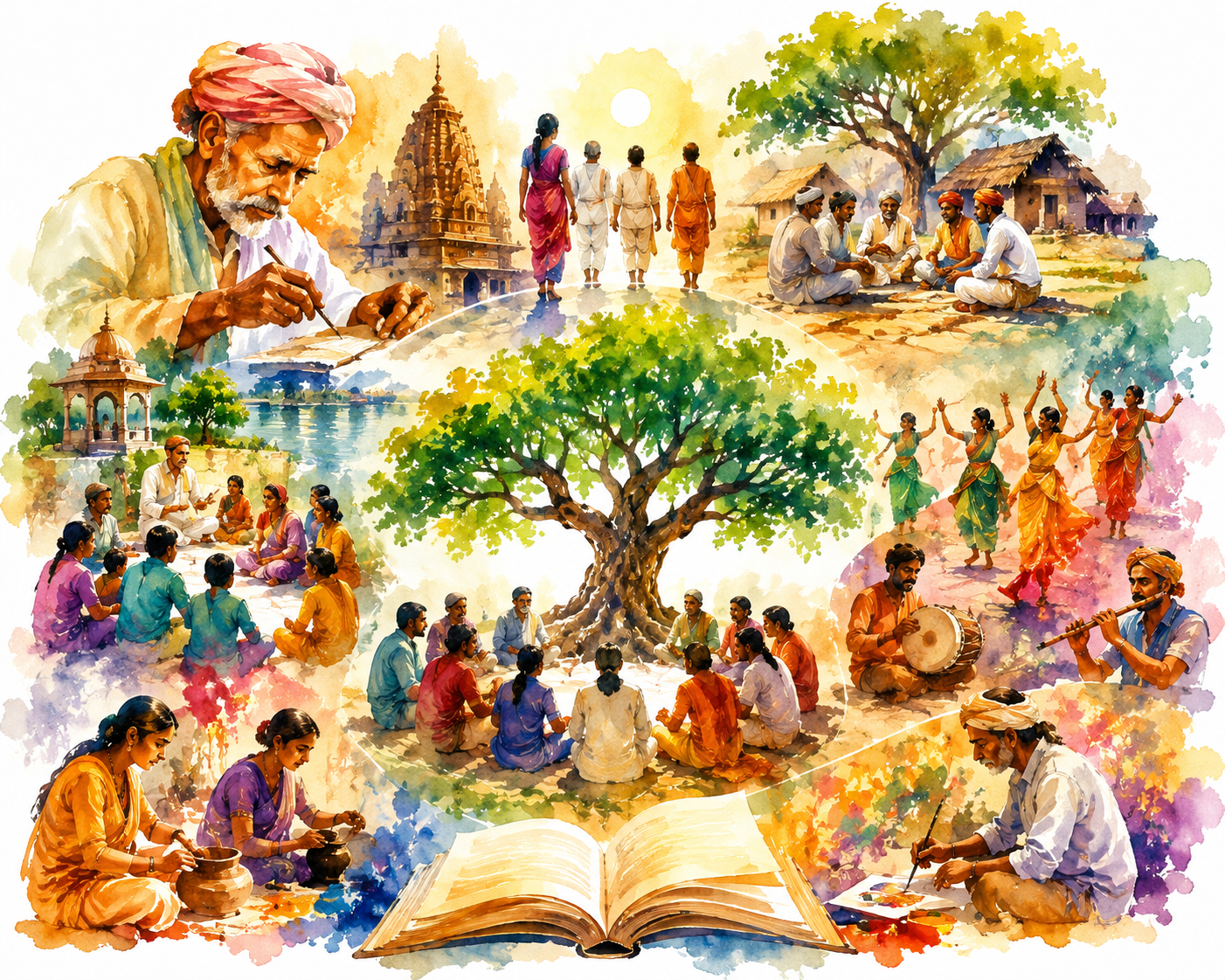
Consider an elderly woman who knows the medicinal properties of local plants. A temple family preserving ritual procedures for generations. A community genealogist maintaining vaṃśāvalī. A storyteller who remembers dozens of versions of a local itihāsa. A craftsman who knows techniques never written in a textbook.
Are these merely “informants”? Or are they knowledge-holders? The distinction is fundamental.
India possesses enormous bodies of knowledge transmitted through oral traditions, folklore, genealogies, ritual practice, customary law, inscriptions, architecture, performance, memory and lived experience. The Sahitya Akademi notes that many Indian languages and literary traditions have historically been preserved primarily through oral transmission. Contemporary anthropology and archaeology are increasingly recognizing oral traditions as records of history, ecological knowledge, memory and situated learning rather than simply as folklore.
The implication is profound:
The absence of a textbook is not the absence of knowledge.
Śāstra and Lokācāra
An Indic anthropology can go further by placing śāstra and lokācāra in conversation. Śāstra represents articulated and systematized knowledge—conceptual traditions, classifications, arguments and normative frameworks. Lokācāra points toward lived practice: what communities actually do, transmit and recognize. The relationship between textual knowledge and customary practice is itself deeply embedded in Indic traditions. Dharmaśāstra literature, for example, recognizes ācāra or established conduct as an important source of normative knowledge alongside textual traditions.
This suggests a methodological possibility. Rather than studying śāstra separately from society, anthropology can ask:
How does a concept move from text into practice?
And equally:
How does lived practice challenge, reinterpret or supplement the text?
That is a much richer anthropology.
From Informants to Co-Producers
This does not mean accepting every oral account as historically or empirically true. Memory can change. Genealogies can be selective. Traditions can be reconstructed. Texts can contain contradictions. Customs can be contested. That is precisely why triangulation matters. Oral testimony can be studied alongside inscriptions, manuscripts, archaeology, archival records, linguistic evidence and ethnographic observation. The goal is not to replace one hierarchy of evidence with another.
It is to expand the evidentiary field.
This is also where Linda Tuhiwai Smith’s critique of colonial research becomes relevant: decolonization requires reconsidering who controls research, how knowledge is produced and whose intellectual authority is recognized. Indian ethnographic scholarship has similarly begun questioning researcher positionality and the treatment of communities as passive objects of study.
From Studying Communities to Learning From Them
The deeper transformation is therefore epistemological. A community should not enter anthropology merely as a sample. It can enter as an epistemic partner. Its categories may become analytical questions. Its memories may become sources. Its practices may reveal institutions invisible to the researcher. Its vocabulary may challenge the assumptions built into the research design itself. This does not mean abandoning critical scholarship. It means beginning with intellectual humility.
The anthropologist should not arrive with the assumption that knowledge begins when the researcher starts observing. Sometimes the researcher is entering a knowledge system that has already been observing, remembering, classifying and interpreting its world for generations. That is the real promise of a decolonized anthropology.
Not simply studying different people. But recognizing different ways of knowing people.
And perhaps the most important question is therefore not:
“What can anthropology learn about them?”
but:
“What might anthropology learn if it allowed them to speak not merely as informants, but as knowledge-holders?”
Decolonization begins there—not only by expanding what we study, but by expanding what we are prepared to recognize as knowledge.
