
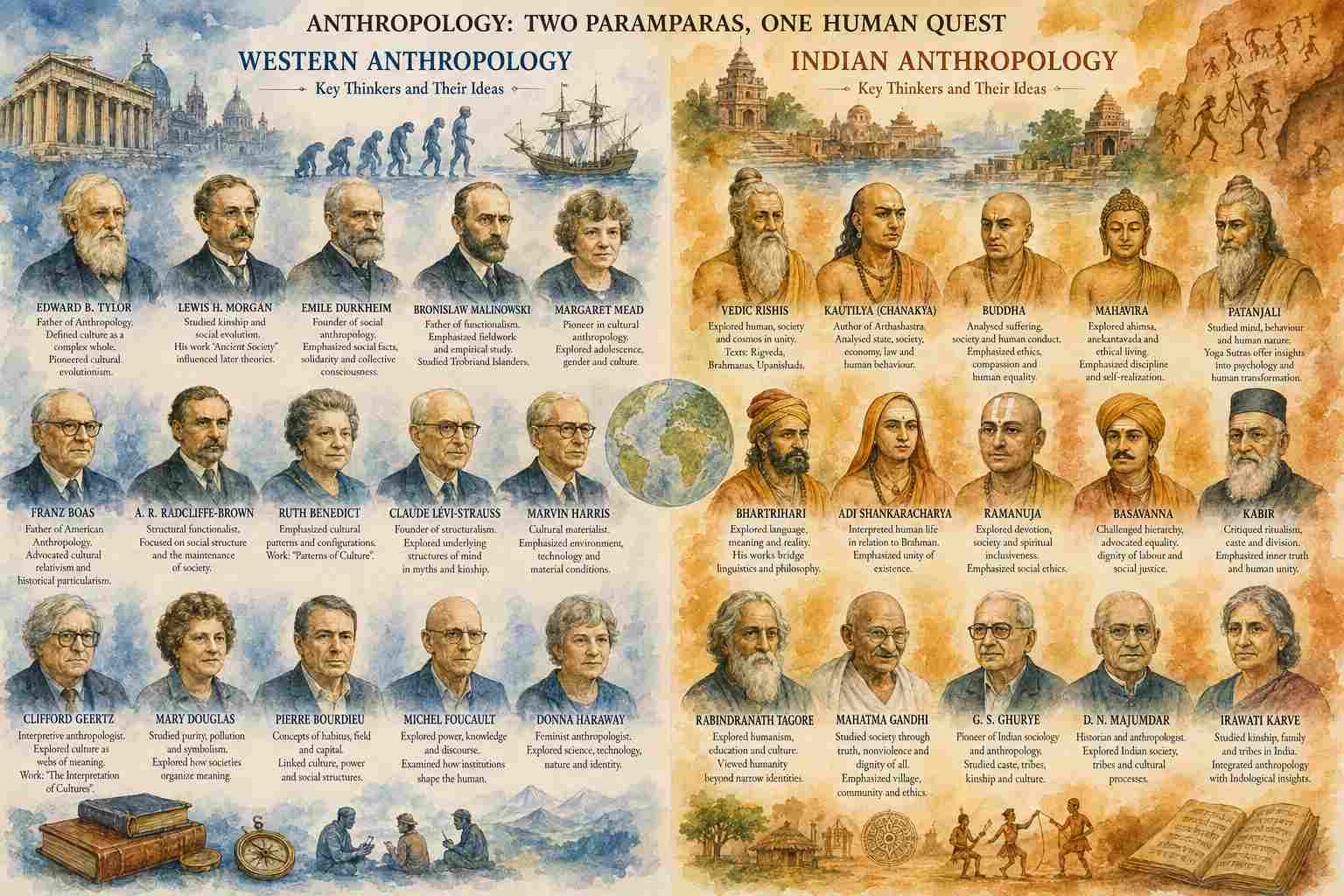
The Evolution of the Western Anthropological Gaze
Anthropology asks a deceptively simple question: What does it mean to be human? But the moment this question is asked, many others follow. Why do human beings live in groups? Why do they create families, rituals, religions and political institutions? Why do different communities speak different languages, follow different customs and organise their lives in such different ways? And beneath all this diversity, is there something common to humanity?
The modern academic discipline of Anthropology would emerge much later, particularly through European and American universities. But the curiosity behind it was much older. Long before anthropology became a profession, travellers and historians had already begun looking carefully at peoples whose customs differed from their own.
(1) Herodotus (c. 484–425 BCE, Histories) is one of the earliest figures in this story. As he travelled through the ancient world, he described Egyptians, Persians, Scythians and other peoples, paying attention not only to wars and rulers but also to customs, religious practices, marriage, burial and everyday life. His curiosity was important because he did not simply assume that everyone lived according to the same rules. Yet his accounts also mixed direct observation with stories and hearsay, reminding us that curiosity alone does not guarantee reliable ethnography. More than a millennium later, the question of society received a much more systematic treatment from (2) Ibn Khaldun (1332–1406, Muqaddimah). He wanted to understand why societies rise and decline, why dynasties become powerful and then lose their strength, and why groups sometimes possess a remarkable capacity for collective action. His concept of ʿasabiyyah, or group solidarity, connected social cohesion with political power and historical transformation. He also considered environment, economy and patterns of settlement. The study of society was becoming more analytical, although Ibn Khaldun’s concern remained principally historical rather than anthropological in the modern disciplinary sense.
Europe’s intellectual world then began changing rapidly. The Renaissance and Enlightenment encouraged a new confidence in reason, history and the possibility of discovering patterns in human life. (3) Giambattista Vico (1668–1744, The New Science) challenged the assumption that human affairs could be understood simply through abstract universal reason. Human beings create institutions, languages, customs and meanings, and therefore the human world must also be understood historically. Vico’s insight opened an important possibility: perhaps societies could be studied through the worlds they themselves had created.
(4) Johann Gottfried Herder (1744–1803, Ideas for the Philosophy of the History of Humanity) pushed this argument further. Different peoples developed within distinctive historical, linguistic and cultural environments. A culture therefore could not be understood simply by measuring it against another culture’s standards. Herder’s emphasis on cultural particularity would become important for later anthropological thinking, even though he himself was not an anthropologist in the modern professional sense.
Then the nineteenth century changed the entire intellectual atmosphere. European expansion brought Europeans into contact with an enormous variety of peoples across Africa, Asia, the Americas and the Pacific. Museums accumulated objects. Colonial administrations produced reports. Missionaries recorded languages and customs. Naturalists classified plants, animals and human populations. At the same time, the natural sciences were developing powerful theories of change and evolution.
(5) Charles Darwin (1809–1882, On the Origin of Species, 1859) transformed this intellectual environment through his explanation of biological evolution by natural selection. Darwin’s own work was not a theory of cultural evolution, but the evolutionary imagination soon travelled beyond biology. If species changed over time, perhaps societies and cultures had also developed through stages. (6) Herbert Spencer (1820–1903, The Principles of Sociology) helped carry evolutionary reasoning into the study of society. Societies could be imagined as moving from relatively simple forms toward increasingly differentiated and complex ones. The attraction was obvious: evolution appeared to offer a single grand explanation of social development. But it also created a problem that would become one of Anthropology’s most persistent weaknesses. Once societies were placed on a ladder from “simple” to “advanced,” someone had to decide which society occupied the top.
That confidence became especially visible in (7) Edward B. Tylor (1832–1917, Primitive Culture, 1871). Tylor became one of the founding figures of academic anthropology and gave culture one of its most influential early definitions, describing it as a complex whole involving knowledge, belief, art, morals, law, custom and other acquired capacities. Culture could now be studied systematically rather than treated merely as a collection of curiosities. Yet Tylor’s evolutionary framework also divided human societies into stages of development. The discipline had gained a powerful comparative vocabulary, but it had also inherited a hierarchy in which some societies appeared to represent humanity’s past while others represented its supposed future.
(8) Lewis Henry Morgan (1818–1881, Ancient Society, 1877) carried evolutionary thinking particularly into kinship. His studies of kinship terminology became foundational, and his comparisons revealed that family and kinship could be organised in remarkably different ways. Yet his division of societies into “savagery,” “barbarism” and “civilization” would later become one of the clearest examples of the limitations of nineteenth-century evolutionary anthropology. Human societies did not actually move along one universal staircase in the orderly manner his model suggested. Then came (9) James George Frazer (1854–1941, The Golden Bough, 1890), whose enormous comparative study brought myths, rituals, magic and religion together into one sweeping intellectual narrative. Frazer proposed that human thought moved historically from magic to religion and ultimately toward science. The ambition was extraordinary: to discover a general pattern behind the world’s religious and ritual traditions. But again, the attraction of a universal sequence came at a cost. Complex traditions could be made to look like surviving fragments of an earlier stage of European intellectual development.
(10) Adolf Bastian (1826–1905, The Mind of Man) offered a somewhat different possibility. Beneath cultural differences he searched for what he called “elementary ideas”—fundamental tendencies shared by human beings. Cultures could therefore be diverse without requiring the assumption that human minds themselves were fundamentally unequal. His work contributed to later discussions about cultural universals and human diversity.
By the beginning of the twentieth century, however, the discipline was beginning to recognise the weaknesses in the evolutionary scheme. Perhaps the problem was not that some societies were “behind” others. Perhaps the problem was the assumption that there was only one path of development in the first place.
This was where (11) Franz Boas (1858–1942, The Mind of Primitive Man, 1911) became transformative. Boas challenged racial and evolutionary hierarchies and argued that cultures had to be understood through their particular historical development. Instead of asking how close a society was to some presumed universal standard of civilization, anthropology could ask how that society had actually become what it was. Cultural relativism and historical particularism redirected the discipline. Yet even this correction produced a new challenge: if every culture had to be understood within its own history, how could anthropologists develop broader explanations without once again imposing their own categories? The answer increasingly came through fieldwork.
(12) Bronisław Malinowski (1884–1942, Argonauts of the Western Pacific, 1922) transformed anthropology by insisting that the anthropologist should not depend primarily upon the reports of travellers and administrators. One had to go into the field, live among the people being studied, learn their language and observe their everyday activities. His research among the Trobriand Islanders made participant observation central to modern ethnography. The distant “object” of study had become a living community whose institutions had to be understood from within. But fieldwork brought its own difficulty. The anthropologist might live among people, but the final account was still written by the anthropologist. Observation was never completely free from interpretation.
(13) A.R. Radcliffe-Brown (1881–1955, Structure and Function in Primitive Society, 1952) therefore turned attention toward the relationships that held societies together. Kinship, law, ritual and political institutions were not isolated customs; they formed interconnected structures. His structural-functionalism helped anthropology understand society as an organised system. Yet the emphasis on social equilibrium could sometimes make societies appear more stable than they really were. Conflict, historical disruption and individual agency could easily become secondary.
(14) Émile Durkheim (1858–1917, The Elementary Forms of Religious Life, 1912) had already provided much of the intellectual foundation for this concern with collective life. Religion, for Durkheim, could be studied as a social phenomenon because rituals and symbols created forms of collective consciousness. The individual was never simply an isolated unit; social life produced realities that shaped individual behaviour. But the same emphasis on solidarity and integration raised the question of what happened when society was marked by inequality, disagreement and conflict.
That question became particularly interesting when anthropologists examined exchange. (15) Marcel Mauss (1872–1950, The Gift, 1925) showed that a gift is rarely merely an economic transaction. Giving, receiving and returning could create obligations involving morality, status, religion and political relationships. An apparently simple exchange could therefore carry an entire social world within it. The anthropologist had to look beneath the visible action to understand the relationships embedded within it.
Meanwhile, American anthropology increasingly explored the relationship between culture and personality. (16) Margaret Mead (1901–1978, Coming of Age in Samoa, 1928) examined adolescence, gender and socialisation and questioned assumptions that behaviours considered natural in one society must necessarily be universal. (17) Ruth Benedict (1887–1948, Patterns of Culture, 1934) similarly argued that societies organise values and behaviour into distinctive cultural patterns. Together they strengthened the idea that personality and behaviour are deeply shaped by cultural environments. Yet later scholars questioned some of their interpretations and fieldwork conclusions, again reminding anthropology that ethnographic authority is never beyond criticism.
The discipline now faced a deeper question: how can an anthropologist understand a belief system without judging it through categories external to that society? (18) E.E. Evans-Pritchard (1902–1973, Witchcraft, Oracles and Magic Among the Azande, 1937) addressed precisely this problem. His study of Azande witchcraft demonstrated that what appears irrational from outside can possess an internal logic within a particular social world. The anthropologist therefore had to understand how beliefs functioned for the people who held them rather than simply dismissing them according to external standards. But perhaps the diversity of human cultures itself concealed deeper patterns.
(19) Claude Lévi-Strauss (1908–2009, The Elementary Structures of Kinship, 1949) searched for those patterns beneath myths, kinship systems and symbolic practices. Structural anthropology proposed that apparently different cultural systems might express deeper structures of human thought. Binary oppositions, classification and symbolic organisation became central. Yet the elegance of structuralism also carried a danger: the more powerful the underlying structure became, the easier it was for actual historical people and their individual choices to disappear behind the model. (20) Mary Douglas (1921–2007, Purity and Danger, 1966) then turned anthropological attention toward classification itself. Why are certain things regarded as clean, others polluted, some sacred and others dangerous? Such distinctions, she argued, are connected to the boundaries through which societies organise themselves. What looks like a simple rule about purity can therefore reveal an entire social order.
(21) Victor Turner (1920–1983, The Ritual Process, 1969) moved into the moments when that social order becomes temporarily unstable. His concept of liminality described the transitional condition in which people move between established social positions, while communitas captured the distinctive solidarity that could emerge during such transitions. Ritual was no longer simply a mechanism maintaining society; it could also create moments in which ordinary structures were suspended or transformed.
By the 1970s, anthropology was increasingly asking whether describing social structures was enough. What about meaning itself? (22) Clifford Geertz (1926–2006, The Interpretation of Cultures, 1973) argued that human beings live within webs of meaning. Culture could therefore not be reduced to institutions or observable behaviour. The anthropologist had to interpret the symbolic worlds through which people understood their own lives. His idea of “thick description” became enormously influential. Yet interpretive anthropology also exposed a new vulnerability: if anthropology is interpretation, then the anthropologist’s own position and language inevitably influence the final account.
The next generation became increasingly concerned with practice and power. (23) Pierre Bourdieu (1930–2002, Outline of a Theory of Practice, 1972) examined how social structures become embodied through everyday practices. His concepts of habitus, field and cultural capital showed how inequalities could reproduce themselves without requiring constant conscious direction. (24) Marshall Sahlins (1930–2021, Culture and Practical Reason, 1976) challenged explanations that reduced human behaviour to economic calculation, arguing that material objects acquire meanings within cultural systems. (25) Marvin Harris (1927–2001, The Rise of Anthropological Theory, 1968) moved in a more materialist direction, emphasising environment, technology, production and material conditions. The debate between cultural meaning and material explanation revealed that anthropology still had no single answer to the question of what ultimately shapes human behaviour.
Then the discipline began looking at itself.
(26) Michel Foucault (1926–1984, The Archaeology of Knowledge, 1969) asked how knowledge becomes connected with power and how institutions participate in producing particular kinds of human subjects. Talal Asad (1932–2024, Genealogies of Religion, 1993) questioned whether categories such as “religion” and “secularism” could simply be treated as universal when those categories themselves had particular historical genealogies. Donna Haraway (1944–, Simians, Cyborgs, and Women, 1991) pushed the questioning further by examining the unstable boundaries between science, technology, nature, gender and the human. The anthropologist was no longer simply studying the categories of other societies; anthropology itself had become an object of scrutiny. At the same time, the world being studied was changing. Technology transformed communication and social relationships. Marshall McLuhan (1911–1980, Understanding Media, 1964) argued that media themselves reshape human perception and social organisation. The anthropological field could no longer be imagined only as a distant village or isolated community.
And then came globalisation.
(27) Arjun Appadurai (1949–, Modernity at Large, 1996) described a world of moving people, media, technology, finance and ideas. His concepts of ethnoscapes, mediascapes, technoscapes, financescapes and ideoscapes captured a world in which culture increasingly travelled across territorial boundaries. The journey that began with the traveller’s curiosity had therefore become something much more complicated.
The early anthropologist wanted to classify human diversity. The evolutionary school tried to arrange that diversity into stages of development, but its hierarchy was challenged when scholars began recognising that societies did not necessarily follow one universal path. Fieldwork then transformed the discipline by demanding direct engagement with living communities, while functionalism tried to understand how their institutions fitted together. The study of exchange, personality, ritual and symbolism gradually made anthropology more attentive to meaning, and structuralism searched beneath cultural differences for deeper patterns. Interpretive anthropology then reminded the discipline that human beings do not merely inhabit structures—they inhabit worlds of meaning. Materialists, practice theorists and scholars of power subsequently disagreed about what most fundamentally shapes those worlds.
By the end of the twentieth century, anthropology had become increasingly self-reflexive. It was no longer confident that the anthropologist stood outside the society being studied, neutrally recording reality. The observer had a position. The categories had histories. The field encounter involved relationships of power. Even the act of writing an ethnography could shape the reality it claimed merely to describe.
This is perhaps the most distinctive feature of the Western anthropological journey: its theories repeatedly generated the questions that eventually challenged them. Evolutionism produced the critique of evolutionism; armchair anthropology helped produce the demand for fieldwork; functionalism generated questions about history and conflict; structuralism invited questions about agency and change; interpretation raised questions about the authority of the interpreter; and the study of power eventually turned the anthropological gaze back upon anthropology itself.
The discipline that began by asking “How are other peoples different?” eventually found itself asking a much more uncomfortable question: “How much of what we see in other peoples is shaped by the way we have learned to look?”
