CALL FOR APPLICATIONS
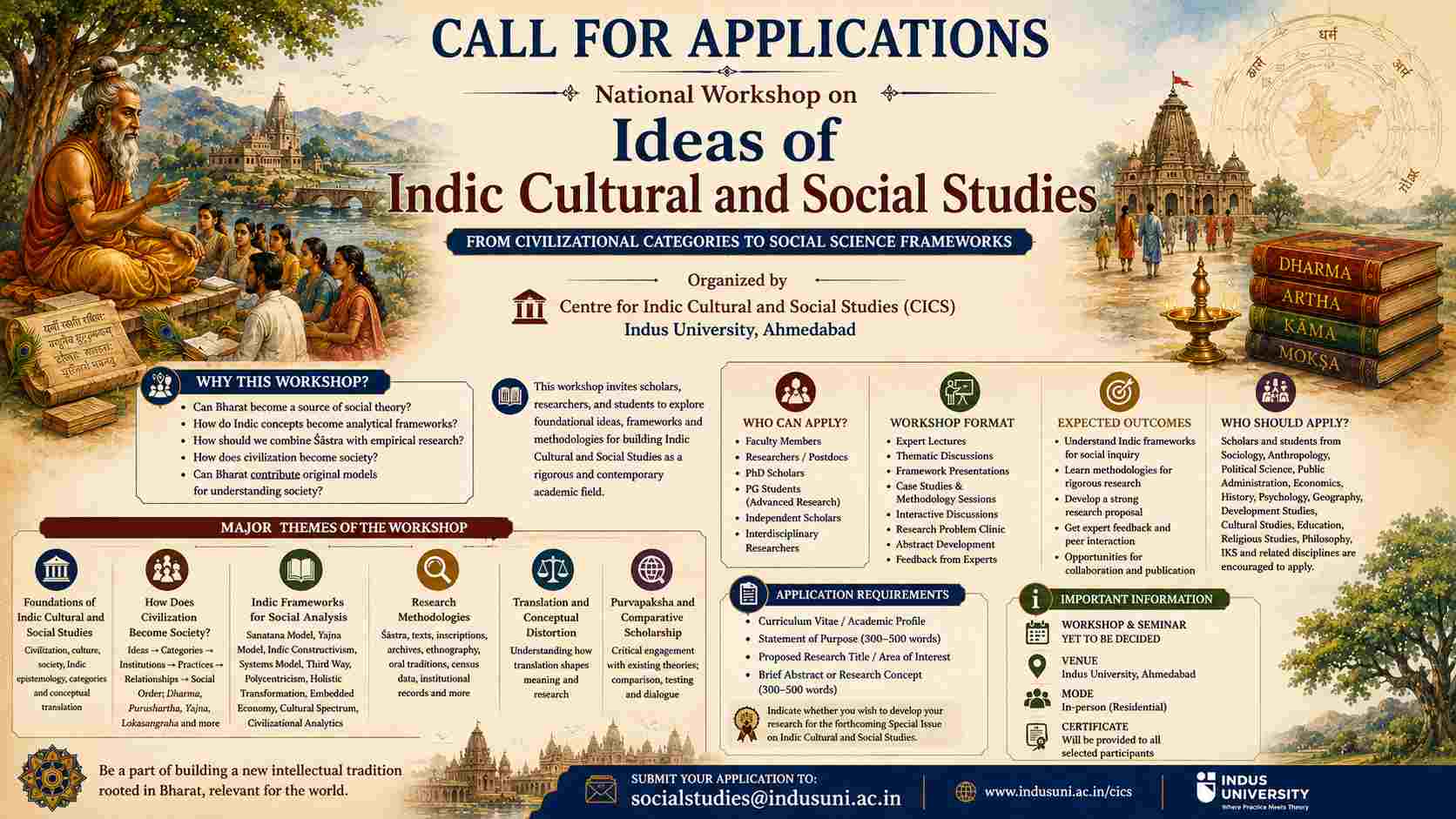
Workshop
on
Ideas of Indic Cultural and Social Studies
From Civilizational Categories to Social Science Frameworks
Organized by
Centre for Indic Cultural and Social Studies (CICS)
Indus University, Ahmedabad
Why This Workshop?
Bharat has been extensively studied through the disciplines of sociology, anthropology, political science, economics, history and cultural studies. Yet an important question remains: Can Bharat become a source of social theory rather than merely an object to which existing theories are applied?
How should we study concepts such as Dharma, Jāti, Kula, Samāja, Yajña, Rājadharma, Loka-Saṅgraha and Puruṣārtha? Should they remain subjects of philosophical or historical description? Or can they become analytical categories and frameworks for understanding society?
The National Workshop on Ideas of Indic Cultural and Social Studies is designed to explore this emerging field through a combination of conceptual discussion, methodological training and research development.
Objectives of the Workshop
The workshop aims to:
- Introduce the foundational ideas of Indic Cultural and Social Studies.
- Examine the relationship between civilization, culture, institutions and society.
- Explore the limitations of universal categories when studying civilizationally distinct societies.
- Introduce Indic concepts as potential analytical frameworks.
- Develop methodological approaches for combining Śāstra with empirical research.
- Train participants to convert Indic ideas into research questions and research frameworks.
- Encourage interdisciplinary research across humanities, social sciences and Indian Knowledge Systems.
- Create a network of scholars working on the emerging field of Indic Cultural and Social Studies.
Central Questions
The workshop will engage with questions such as:
- What is Indic Cultural and Social Studies?
- How does a civilization become a social order?
- How do cultural principles enter institutions and everyday life?
- Can Indic categories become tools of social analysis?
- How do frameworks determine what becomes visible in research?
- Can Bharat produce original models for studying society?
- How should Indic concepts be translated into contemporary academic language?
- How can Śāstra, history, ethnography and data be brought together?
- How can we move from an Indic concept to a rigorous research paper?
Major Themes of the Workshop
1. Foundations of Indic Cultural and Social Studies
- Bharat as a civilizational framework
- Civilization, culture and society
- Cultural studies and social studies
- Bharat as a source of theory
- Reconstructing social sciences through Indic perspectives
- The problem of categories and conceptual translation
2. How Does Civilization Become Society?
This session examines how civilizational ideas become social realities. The discussion will explore the relationship between:
Ideas → Categories → Institutions → Practices → Relationships → Social Order
Themes include:
- Dharma and social organization
- Puruṣārtha and human goals
- Yajña and reciprocity
- Loka-Saṅgraha and collective responsibility
- Family and community
- Institutions and civilizational continuity
- Social order beyond the individual–state binary
3. Indic Frameworks for Social Analysis
The workshop will introduce emerging frameworks developed under Indic Cultural and Social Studies, including:
The Sanatana Model: Understanding continuity through transformation.
The Yajña Model: Devapūjan, Saṅgatikaraṇa and Dāna as a framework of reciprocity, cooperation and contribution.
Indic Social Categories: Studying categories such as Kula, Jāti, Varṇa, Āśrama, Grāma, Samāja and Rāṣṭra through their own social contexts.
Indic Constructivism: Understanding how the individual develops through expanding circles of relationships and social responsibilities.
The Systems Model of Society: Moving from society as a machine to society as a complex, interconnected and adaptive system.
The Third Way: Exploring Madhyama Mārga beyond binaries such as individual versus collective, market versus state and rights versus duties.
Indic Polycentricism: Understanding society through multiple centres of authority, institutions and networks.
Holistic Transformation: Moving beyond revolutionary destruction towards regeneration, adaptation and interconnected transformation.
The Embedded Economy: Understanding economic life through its relationship with society, ecology, Dharma and broader prosperity.
The Cultural Spectrum: Studying exchange, assimilation, acculturation, adaptation, appropriation, alienation and cultural dissolution.
Civilizational Analytics: Studying long-term patterns across demography, institutions, economy, knowledge, ecology, family and cultural continuity.
Research Methodology Sessions
Participants will learn how to move beyond broad and descriptive topics.
For example:
Instead of: “The Importance of Dharma in Modern Society”
The workshop will ask: Can Dharma function as an analytical framework for studying the relationship between rights, duties and social responsibility?
Instead of merely writing about pilgrimage, the researcher may ask: How did pilgrimage networks contribute to civilizational integration across political and linguistic boundaries?
The focus will be on developing: Research Problem → Research Question → Conceptual Framework → Evidence → Methodology → Contribution
4. Indic Sources and Evidence
The workshop will explore how different forms of knowledge and evidence can be combined:
- Śāstra and textual traditions
- Historical sources
- Inscriptions and archival records
- Oral traditions
- Ethnography and fieldwork
- Institutional histories
- Census and demographic data
- Economic and social statistics
- Genealogies and community records
- Contemporary policy and institutional evidence
The objective is to move beyond the false choice between textual knowledge and empirical research.
5. Translation and Conceptual Distortion
A special session will examine what happens when Indic categories are automatically translated into modern Western categories.
Questions include:
- Is Dharma simply religion?
- Is Jāti simply caste?
- Is Rāṣṭra simply nation?
- Is Sevā simply charity?
- Is Artha simply economics?
- Is Samāja equivalent to society in every context?
The workshop will examine how translation can sometimes clarify a concept—and sometimes conceal its civilizational meaning.
6. Purvapaksha and Comparative Scholarship
Indic Social Studies cannot develop through intellectual isolation.
Participants will learn to:
- Understand existing theories accurately.
- Identify their historical assumptions.
- Compare them with Indic categories.
- Recognize areas of similarity and difference.
- Test Indic frameworks against evidence.
- Develop stronger theoretical arguments.
The objective is not the rejection of Western knowledge, but the development of confident and rigorous intellectual dialogue.
Workshop Format
The programme will include:
- Expert lectures
- Thematic discussions
- Framework presentations
- Research methodology sessions
- Interactive discussions
- Case studies
- Research problem clinics
- Abstract development sessions
- Participant presentations
- Expert feedback
Research Development Clinic
A major component of the workshop will be the Research Development Clinic. Selected participants will receive academic guidance to refine their proposed research into a structured framework.
Participants will work on:
- Identifying the research problem
- Formulating the research question
- Selecting Indic categories
- Developing conceptual frameworks
- Identifying relevant sources
- Choosing appropriate methodology
- Defining the expected contribution
The purpose is not merely to attend a workshop.
Participants should leave with a stronger and more clearly defined research proposal.
Who Can Apply?
Applications are invited from:
- Faculty members
- Research scholars
- Postdoctoral researchers
- Doctoral candidates
- Advanced postgraduate students
- Independent researchers
- Scholars working in interdisciplinary fields
Applicants from the following areas are particularly encouraged:
- Sociology
- Anthropology
- Political Science
- Public Administration
- Economics
- History
- Psychology
- Geography
- Development Studies
- Cultural Studies
- Education
- Religious Studies
- Philosophy
- Indian Knowledge Systems
- Civilizational Studies
- Related disciplines
Application Requirements
Applicants must submit:
- Curriculum Vitae / Academic Profile
- Statement of Purpose (300–500 words)
- Proposed Research Title or Area of Interest
- Brief Abstract or Research Concept (300–500 words)
Applicants may also indicate whether they wish to develop their research for possible submission to the forthcoming Special Issue on Indic Cultural and Social Studies.
Selection Criteria
Applications will be evaluated on the basis of:
- Relevance to Indic Cultural and Social Studies
- Clarity of the research problem
- Originality of the proposed idea
- Academic potential
- Interdisciplinary relevance
- Willingness to engage seriously with conceptual and methodological questions
The workshop is intended for active intellectual engagement.
Expected Outcomes
Participants will gain:
- A foundational understanding of Indic Cultural and Social Studies.
- Exposure to emerging Indic analytical frameworks.
- Methodological training for interdisciplinary research.
- Experience in connecting Indic categories with empirical research.
- Feedback from scholars and experts.
- A refined research concept or abstract.
- Opportunities for developing research towards the Special Issue and future academic collaborations.
