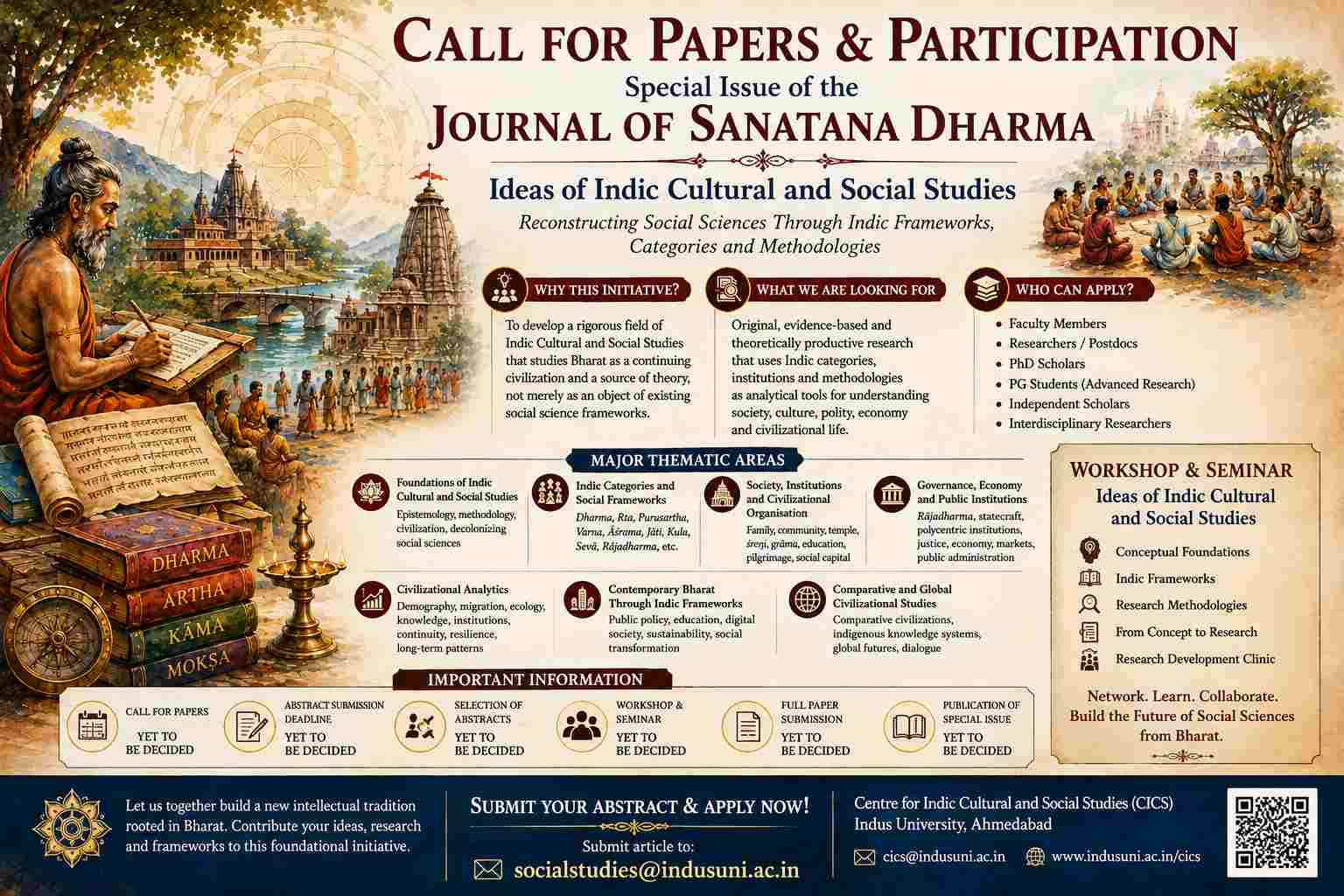
CALL FOR PAPERS & PARTICIPATION
Special Issue of the Journal of Sanatana Dharma
—
Ideas of Indic Cultural and Social Studies:
Reconstructing Social Sciences Through Indic Frameworks, Categories and Methodologies
The Centre for Indic Cultural and Social Studies, Indus University, invites researchers, scholars, faculty members, doctoral candidates and independent researchers to submit research abstracts and apply for participation in the forthcoming Special Issue on Indic Cultural and Social Studies and the accompanying academic workshop and seminar.
Why This Initiative?
- Can Bharat be understood only through categories developed from other civilizational experiences?
- What happens when Dharma becomes merely “religion,” Jāti merely “caste,” Rāṣṭra merely “nation,” or Sevā merely “charity”?
- Can indigenous concepts become analytical tools rather than remaining objects of historical or philosophical study?
- Can Bharat contribute original frameworks to sociology, political science, anthropology, economics, history and other social sciences?
- How does civilization become society?
- How can Indic categories, historical institutions, textual traditions and empirical evidence be brought together to develop new social science frameworks?
This initiative begins from the proposition that Bharat must be studied not merely as an object of social science, but also as a source of social theory. Indic Cultural and Social Studies seeks to develop rigorous approaches rooted in civilizational experience while remaining open to critical engagement with existing academic traditions.
What Are We Looking For?
We invite original, evidence-based and theoretically productive research that attempts to move beyond description towards framework-building.
We particularly welcome research that:
- Studies Bharat through its own civilizational categories and institutions.
- Develops original frameworks for understanding social, cultural, political or economic phenomena.
- Connects Śāstra with fieldwork, historical evidence, archives, ethnography or quantitative data.
- Studies the relationship between civilizational principles and lived social institutions.
- Examines how ideas such as Dharma, Ṛta, Puruṣārtha, Loka-Saṅgraha, Yajña, Sevā and Rājadharma may function as analytical categories.
- Investigates institutions such as Kula, Jāti, Śreṇi, Grāma, Tīrtha, temple networks and educational traditions.
- Applies Civilizational Analytics to long-term questions of demography, migration, ecology, family, economy, knowledge or institutions.
The aim is not cultural nostalgia or the uncritical glorification of the past. The objective is the development of a rigorous and pluralistic field capable of studying Bharat on its own terms while contributing to global social sciences.
Major Thematic Areas
1. Foundations of Indic Cultural and Social Studies
- Conceptual foundations of Indic Social Studies
- Indic epistemology and social inquiry
- Civilizational approaches to social sciences
- Methodological frameworks for Indic research
- Reimagining humanities and social sciences through Indic perspectives
2. Indic Categories and Social Frameworks
- Dharma and social organization
- Ṛta and social order
- Puruṣārtha and human development
- Yajña and reciprocity
- Loka-Saṅgraha and collective responsibility
- Rājadharma and governance
- Varṇa–Āśrama as social categories
- Kula, Jāti and Samāja
- Seva, obligation and social responsibility
3. Society, Institutions and Civilizational Organisation
- Family and kinship systems
- Jāti, Śreṇi and occupational institutions
- Temple networks
- Pilgrimage and sacred geography
- Gurukulas and knowledge transmission
- Village institutions
- Community organizations and social capital
- Social cohesion and civilizational continuity
4. Governance, Economy and Public Institutions
- Rājadharma and Indic statecraft
- Indigenous governance models
- Decentralized and polycentric institutions
- Traditional markets and economic institutions
- Justice and conflict resolution
- Public administration through Indic frameworks
- Leadership and institutional ethics
5. Civilizational Analytics
Research may examine:
- Governance and political institutions
- Demography and population
- Migration and mobility
- Family and social capital
- Property and tenure
- Economy and livelihood
- Knowledge networks
- Educational institutions
- Ecology and environmental traditions
- Technology and social transformation
- Cultural resilience
- Civilizational continuity and decline
Civilizational Analytics encourages the study of long-term patterns by connecting multiple social dimensions rather than treating institutions or variables in isolation.
6. Contemporary Bharat Through Indic Frameworks
- Public policy
- Urbanisation and community life
- Digital society
- Education and curriculum
- Sustainable development
- Institutional innovation
- Contemporary social transformations
7. Comparative and Global Civilizational Studies
- Comparative civilizations
- Indigenous knowledge systems
- Decolonising social sciences
- Comparative governance
- Civilizational dialogue
- Global futures
The Workshop and Seminar
Selected participants and authors will have the opportunity to engage with the Centre’s emerging ideas, frameworks and research approaches.
The academic programme will explore:
A. Why Indic Social Studies?
- The crisis of frameworks in contemporary social sciences
- Bharat as a civilizational source of theory
- Conceptual decolonization
- How categories shape knowledge
B. How Does Civilization Become Society?
- From philosophy to institutions
- From cultural principles to lived practice
- Family, community and civilizational organization
- Understanding Bharat as an interconnected social system
C. Indic Frameworks for Social Analysis
The programme will introduce emerging analytical models including:
- The Sanatana Model
- The Yajña Model
- Indic Social Categories
- Indic Constructivism
- The Systems Model of Society
- The Third Way
- Polycentricism
- Holistic Transformation
- Embedded Economy
- Cultural Spectrum
D. Research Methodologies
Participants will explore:
- Pramāṇa traditions
- Textual research
- Historical and archival methods
- Ethnography and fieldwork
- Oral traditions
- Temple and institutional archives
- Census and demographic data
- Combining Śāstra with empirical research
- Translation and conceptual distortion
E. From Concept to Research Paper
The workshop will guide participants in developing:
Research Problem → Question → Conceptual Framework → Evidence → Methodology → Contribution
Who Can Apply?
Applications are invited from:
- Faculty members
- Researchers
- Doctoral and postdoctoral scholars
- Students engaged in advanced research
- Independent scholars
- Scholars working across humanities, social sciences, IKS and interdisciplinary fields
Applicants from Sociology, Anthropology, Political Science, Public Administration, Economics, History, Psychology, Geography, Development Studies, Cultural Studies, Education, Religious Studies, Philosophy and related disciplines are encouraged to apply.
Submission Requirements
Applicants should submit:
- Title of the proposed paper
- Abstract of 300–500 words
- Brief academic profile
- Institutional affiliation
- Keywords
- Short statement explaining the relevance of the research to Indic Cultural and Social Studies
Authors may submit:
- Theoretical research papers
- Empirical studies
- Historical analyses
- Ethnographic research
- Comparative studies
- Interdisciplinary research
- Methodological papers
- Policy-oriented research
Important Dates
- Call for Papers: yet to decide
- Abstract Submission Deadline: –
- Selection of Abstracts: –
- Workshop and Seminar: –
- Full Paper Submission: –
- Publication of Special Issue: –
