THE THIRD WAY by Dattopant Thengadi Ji
Third Way is an ambitious and wide-ranging intellectual intervention. Dattopant Thengadi Ji does not merely ask whether capitalism is better than communism. He asks a more fundamental question: why should the future of Bharat be imagined only within the ideological choices produced by the modern West?
The book is a collection of essays and lectures, but it is held together by a clear civilizational argument. Thengadi Ji examines economics, technology, environment, humanism, constitutional and legal systems, the role of the state, world order, Swadeshi, modernization and national reconstruction. The “Third Way” is therefore not limited to economic policy; it is an attempt to question the deeper worldview from which modern political and economic systems emerge.
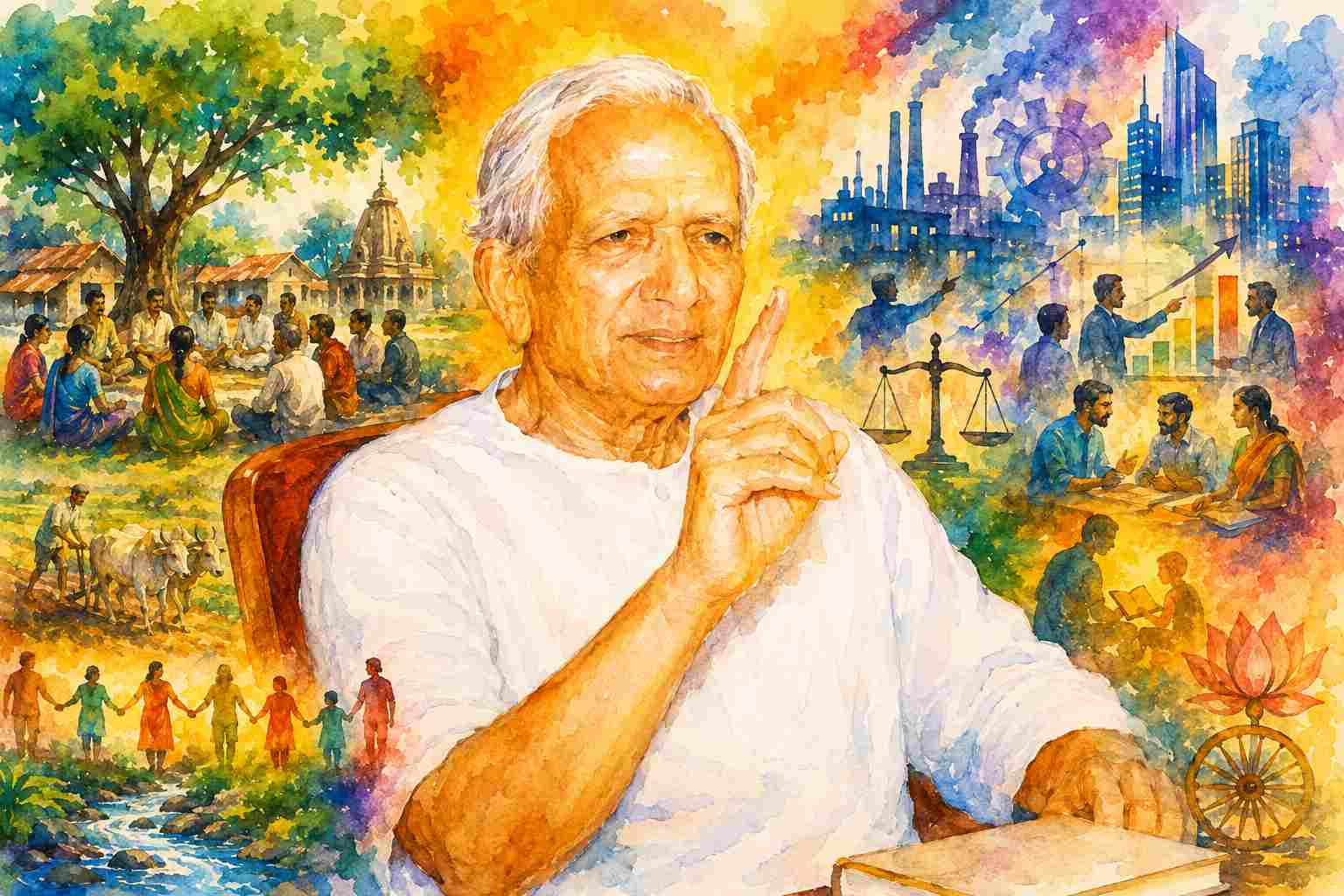
At the centre of the book lies a sharp comparison between two paradigms. Thengadi Ji contrasts what he describes as the Western paradigm with the Hindu paradigm. On one side, he sees compartmentalized thinking, a predominantly material conception of man, consumerism, acquisitiveness, profit as the dominant motive, rights-centred consciousness, exploitation of nature and conflict between the individual, society and nature. Against this, he places an integrated view of the human being as physical, mental, intellectual and spiritual; the Purushartha Chatushtaya; Aparigraha; service; Antyodaya; restraint in consumption; self-employment and Vishwakarma; and harmony between individual, society and nature.
This is the book’s strongest and most provocative idea. The two extremes are not simply capitalism and communism. The deeper extremes are different ways of imagining human life itself.
Capitalism, in its extreme form, can reduce the human being to a consumer and producer operating within the market. Communism, in its extreme form, can reduce the individual to a participant in a material and collective struggle. One absolutizes the market and individual acquisition; the other absolutizes material structures and collective control. Thengadi Ji’s alternative is to reject the assumption that Artha alone can organize civilization. Human life must also account for Dharma, Kāma and Mokṣa.
The book is particularly relevant in its insistence that economics cannot be separated from ecology. Thengadi Ji contrasts the “rape of nature” with the idea of “milking Mother Nature”—an evocative distinction between extraction and responsible use. Similarly, he contrasts consumerism with restrained consumption, profit motive with service motive, and wage-employment-centred economic thinking with greater space for self-employment and decentralized productive activity. These comparisons are not minor ethical additions to economics; they form the foundation of his argument for a different economic paradigm.
The book also challenges the modern obsession with the state as the primary instrument of social transformation. In essays on the state, economic ideology and constitutional systems, Thengadi Ji repeatedly raises the question of whether political structures imported from elsewhere can be mechanically treated as universal models. The state, in his conception, is an instrument—not the creator of the whole social order. Society, culture, ethical obligations and civilizational consciousness cannot be permanently replaced by administrative power.
What makes Third Way particularly important is that it should not be confused with a simple compromise between Left and Right. It is not “half capitalism and half socialism.” Thengadi Ji is attempting something more ambitious: a shift in the coordinates of the debate itself.
- Instead of asking, market or state?, the book asks whether economic life can remain embedded within society, ethics and nature.
- Instead of asking, individual or collective?, it asks whether the individual, society and nature can be understood as interconnected.
- Instead of asking, capitalism or communism?, it asks whether both emerged from a worldview whose basic assumptions themselves need to be questioned.
The book will not always provide ready-made policy formulas, and some readers may disagree with its sharp civilizational contrast between “Western” and “Hindu” paradigms. Yet this is also where its importance lies. Third Way forces the reader to confront a question that Indian intellectual life often avoids: Can Bharat develop modern institutions without allowing its civilizational categories to disappear in the process?
More than twenty-five years after its publication, the book remains relevant because the binaries it challenged have not disappeared. Markets remain powerful but cannot solve every social problem. States remain necessary but cannot replace society. Economic growth continues, while ecological and social crises deepen.
Third Way is dense, intentionally argumentative, but it remains one of the most important works for anyone trying to understand what an indigenous civilizational alternative to ideological absolutism might look like. It does not offer a final blueprint.
Its real contribution is to reopen the question: what if the choice itself is wrong?
