
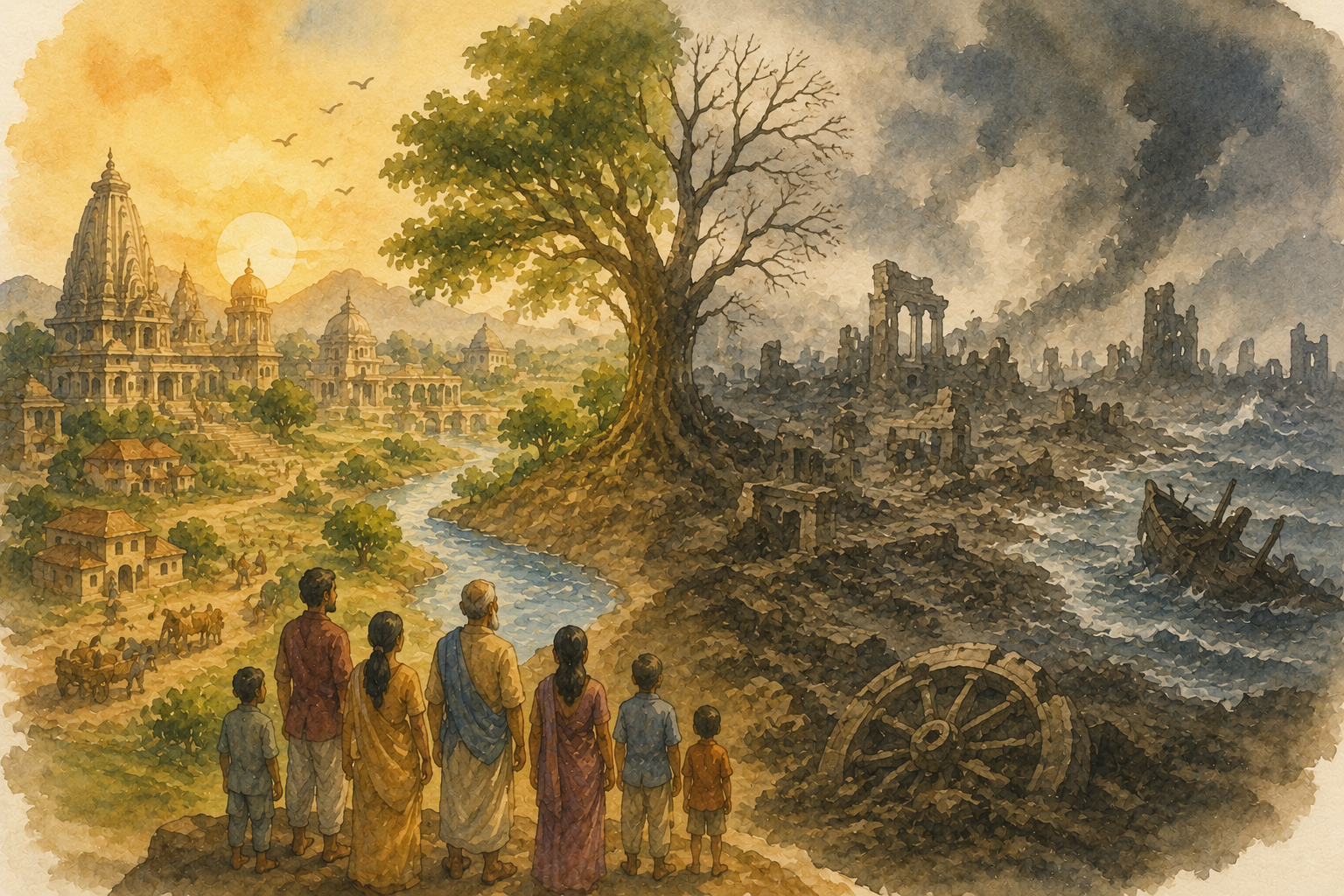
Why Do Civilizations Rise and Fall? Beyond the Cycle of History
Why do some civilizations expand, innovate and generate extraordinary intellectual, economic and cultural energy at one moment, only to become stagnant, fragmented or vulnerable at another? Why does a society that once appears capable of responding creatively to the problems before it sometimes begin repeating solutions that no longer work, while another society facing equally serious difficulties finds new institutions, new technologies, new ideas or new forms of cooperation? And perhaps the most uncomfortable question of all is this: When a civilization begins to decline, does anyone living within it actually recognise the decline while it is happening?
The temptation in civilizational history has been to search for a universal cycle. Civilizations are born, they grow, reach maturity, decline and eventually disappear; Oswald Spengler famously interpreted cultures through a life-cycle model, while Arnold Toynbee approached civilizational development through the capacity to respond creatively to successive challenges. Toynbee’s argument is particularly useful because it moves attention away from simple biological analogy and towards the relationship between challenge and human response. Yet even this approach needs to be treated carefully, because history does not seem to move according to one mechanical timetable. Comparative research on long-term political cycles has found patterns of rise and fall across different world regions, while also suggesting that the Indian case did not necessarily rise and fall in synchrony with East Asian or West Asian systems.
This should make us suspicious of the phrase “rise and fall of civilization” when it is used as though every civilization must pass through exactly the same stages. What if civilizations do not behave like human beings, moving inevitably from birth to old age and death? What if some civilizations collapse politically but survive culturally, some transform so extensively that they become something recognisably different, some experience repeated periods of decline and renewal, and some continue for centuries precisely because they possess the capacity to reorganise themselves? The problem with a rigid cycle is that it turns history into destiny, whereas civilizational history may be better understood as a continuing interaction between circumstances and choices.
A civilization does not rise simply because it becomes powerful, and it does not necessarily decline simply because it loses power. Political power is certainly important, but power itself is an outcome of deeper processes. A society capable of generating productive economic systems, sustaining institutions, managing resources, producing knowledge, integrating different communities and responding to external pressures may accumulate political power as a consequence. Conversely, a state can remain militarily powerful for some time even while the wider social, economic and intellectual systems beneath it are weakening. This distinction matters because the decline of a state and the decline of a civilization are not necessarily the same event.
The rise of a civilization should therefore be understood not merely as expansion, but as a period in which a society’s different capacities begin reinforcing one another. Productive agriculture can support urbanisation; urbanisation can expand trade; trade can circulate ideas and technologies; institutions can organise growing populations; intellectual traditions can produce new forms of knowledge; political structures can create stability; and cultural confidence can encourage experimentation rather than merely imitation. None of these factors operates alone, and there is no reason to assume that the same combination will produce the same result everywhere. The important question is whether the different systems of a society are generating cumulative strength or cancelling one another out.
The opposite is also true. Civilizational decline may begin when the relationships that once generated strength become sources of friction. Institutions become expensive without remaining effective, elites become more interested in preserving privileges than solving new problems, economic arrangements become incapable of supporting social needs, political systems lose legitimacy, knowledge becomes detached from practical challenges, demographic pressures intensify, ecological systems become stressed, or communities lose confidence in the larger purposes that once gave collective action meaning. None of these necessarily produces immediate collapse; indeed, civilizations can survive for remarkably long periods under conditions that would appear to an outside observer to be terminal. But a civilization becomes vulnerable when its capacity to respond becomes weaker than the challenges it faces.
This is where Toynbee remains useful, but only if we push his question further. The important issue is not simply whether a civilization faces a challenge; every civilization does. The real issue is what kind of response does the challenge produce? Does it stimulate experimentation, institutional reform and intellectual creativity, or does it produce denial, imitation, rigidity and defensive nostalgia? A civilization may possess enormous inherited resources and still fail to use them because its institutions have become incapable of converting inherited knowledge into responses to new circumstances. Conversely, a civilization may experience severe disruption and yet generate new forms of organisation precisely because the crisis forces it to rethink assumptions that had previously gone unquestioned.
This also means that civilizational vitality cannot be measured by wealth alone. A rich civilization may be intellectually stagnant; a politically fragmented society may nevertheless be culturally productive; a technologically advanced society may suffer from declining social cohesion; and a materially poor society may preserve extraordinary capacities for social adaptation. Prosperity is one indicator of civilizational vitality, not its definition.
The same caution applies to military strength. History is filled with powerful states that disappeared and communities that survived without states of their own. If military power were the decisive measure of civilization, political history would be enough. But it is not. Civilizational Studies asks what lies beneath political power: the productive capacity of society, the quality of institutions, the circulation of knowledge, the ability to integrate difference, the relationship between population and resources, the capacity to respond to ecological pressures, and the confidence of people that their collective order is capable of producing a meaningful future.
This last point deserves particular attention because civilizations are not machines. They depend upon human beings who interpret circumstances and make choices. A drought is not automatically a civilizational collapse; a new technology is not automatically progress; an invasion is not automatically civilizational destruction; demographic growth is not automatically a demographic dividend. The outcome depends partly upon the institutions through which a society encounters these changes. Recent environmental research on the Indian subcontinent, for example, suggests that climate variability affected ancient societies, while later Indian political and agrarian systems developed irrigation, cropping and administrative adaptations that altered their vulnerability to environmental change. The lesson is important: the same external pressure can produce different civilizational outcomes depending upon the adaptive capacity of the society experiencing it.
This gives us a more useful way of thinking about rise and decline. Instead of imagining civilization as a staircase moving permanently upward or a biological organism moving inevitably towards death, we can think of it as a dynamic field of capacities. At one moment those capacities reinforce one another and produce expansion, creativity and confidence; at another they may become disconnected, producing stagnation, fragmentation or vulnerability. Renewal becomes possible when those relationships are reorganised and new responses become possible.
This also changes how we interpret civilizational crises. A crisis is not necessarily evidence of decline; sometimes it is precisely the moment in which a civilization discovers whether it is capable of renewal. A civilization that can absorb criticism, reform institutions, generate new knowledge, incorporate useful external influences and reinterpret inherited ideas may emerge stronger from a crisis. A civilization that cannot distinguish between preserving its foundations and preserving every historical form may become trapped by its own past. Continuity without adaptation can become rigidity; adaptation without continuity can become dissolution. The civilizational challenge lies in negotiating between the two.
And here perhaps lies a particularly important question for the study of Bharat. Indian history contains repeated political disruptions, regional transformations, economic changes, intellectual debates, technological shifts and encounters with other civilizations, yet the civilizational question cannot be answered simply by counting which kingdoms rose and which kingdoms fell. We have to ask whether the underlying capacities of society expanded or contracted, whether institutions adapted, whether knowledge systems remained productive, whether economic networks reorganised themselves, whether communities integrated new circumstances, and whether new forms of civilizational expression emerged from periods of disruption.
This is why rise and fall cannot be reduced to a chronology.
A timeline can tell us when an empire expanded and when it collapsed. Civilizational analysis must ask why the expansion became possible, what supported it, what vulnerabilities accumulated beneath it, how the society responded to stress, and what survived after the political structure disappeared.
The purpose is not to discover a universal formula that predicts exactly when a civilization will fall. History is too complex for that, and the evidence does not justify such certainty. The more useful task is to identify patterns of civilizational vitality and vulnerability and then test those patterns against different historical experiences.
Perhaps we should therefore stop asking whether civilizations inevitably rise and fall and ask a harder question:
What makes a civilization capable of renewal?
That question shifts the entire discussion. It moves us away from the drama of collapse and towards the study of capacity—capacity to think, adapt, organise, integrate, create, remember, reform and respond. It also allows us to understand why civilizational decline is rarely a single event. It is more often a gradual accumulation of unresolved problems, weakening institutions, missed opportunities and inadequate responses, punctuated by moments when a society either discovers a new direction or becomes increasingly incapable of doing so.
The study of civilizational rise and fall, therefore, should not be an exercise in predicting doom or celebrating greatness. It should be an attempt to understand the conditions under which human societies generate, lose and recover their capacity for collective flourishing.
And perhaps that is where the Indic contribution to Civilizational Studies can become particularly interesting—not by offering another universal cycle of history, but by asking whether concepts such as Dharma, Artha, Lokasangraha, Dandaniti, Rashtra, Desha, Kala and Purushartha can help us construct a more complex vocabulary for analysing civilizational vitality, adaptation and decline.
That, however, is a question for the next stage of the inquiry.
For now, the important conclusion is simpler:
Civilizations do not rise merely because they become powerful, and they do not fall merely because they become weak. They rise when their capacities reinforce one another, and they become vulnerable when their ability to respond to changing circumstances begins to fall behind the challenges before them.
And the real civilizational question is not: “When will it fall?”
It is: “Does it still possess the capacity to respond?”
