Rethinking Cultural Change
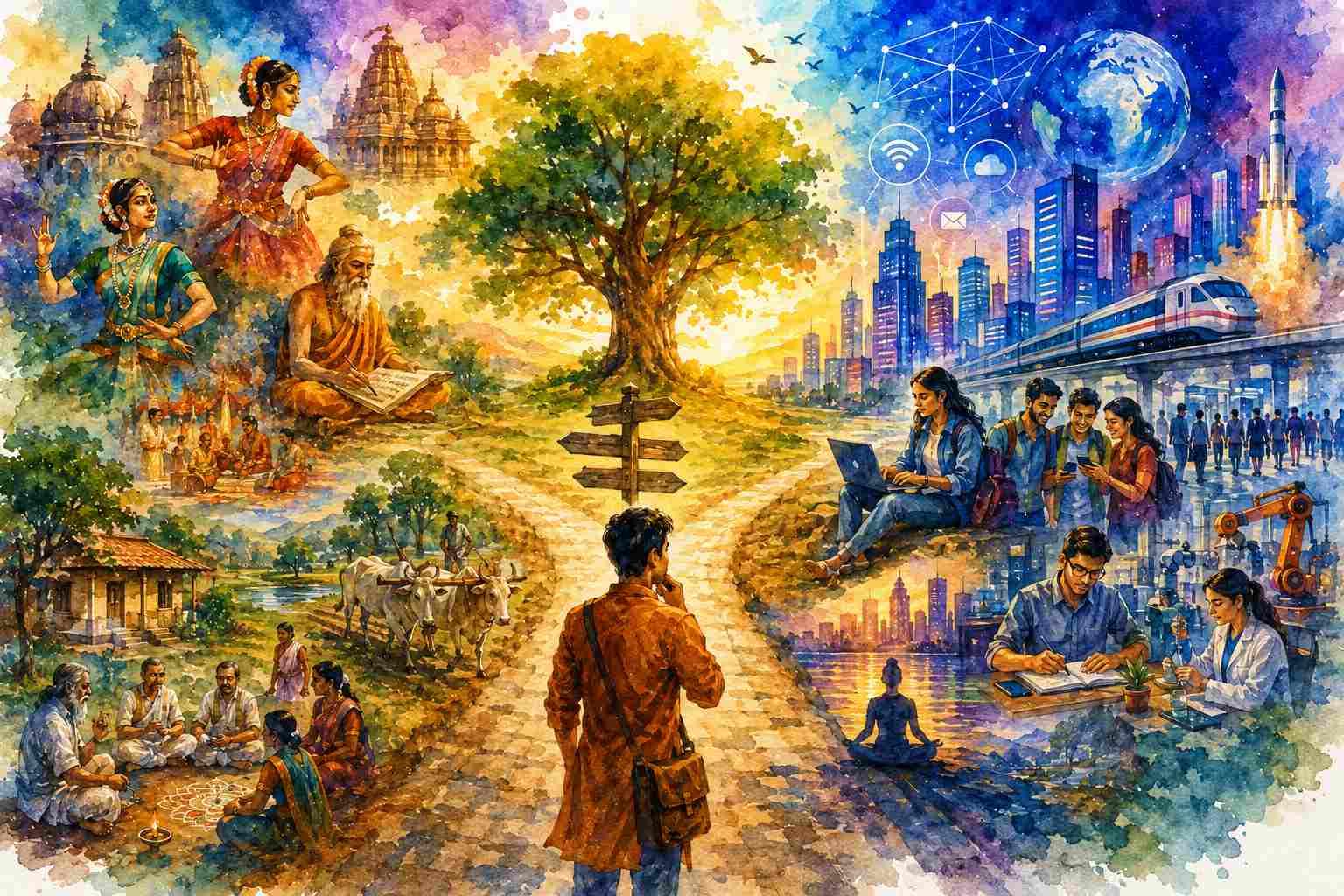
Why do we so often speak about cultural change as if a society has only two choices: remain traditional or become modern?
The question appears harmless because it has become so familiar. Yet embedded within it is a powerful assumption—that tradition belongs to the past, modernity belongs to the future, and cultural development is measured by the distance a society travels from one to the other. Much of twentieth-century sociology, anthropology and cultural theory inherited this evolutionary imagination.
- Ferdinand Tönnies contrasted Gemeinschaft and Gesellschaft;
- Émile Durkheim described the movement from mechanical to organic solidarity;
- Max Weber examined rationalisation and the transformation of inherited authority;
- Talcott Parsons associated modernisation with differentiation and institutional specialisation.
These thinkers gave us valuable tools for understanding genuine transformations in social life, but the problem arises when a historically specific European experience becomes the implicit template against which every civilization is asked to measure itself.
The difficulty becomes particularly visible in the older modernisation literature. Industrialisation, urbanisation, secularisation, bureaucratisation, individualisation and the weakening of customary authority were frequently treated as interconnected features of the transition towards modern society. The underlying sequence was often something like this:
tradition → differentiation → rationalisation → modernity.
The problem is not that these processes do not occur; they clearly do. The problem is assuming that they necessarily produce the same cultural destination everywhere. A village becoming urban does not necessarily mean that community disappears. A family adopting new technologies does not necessarily cease to be a family. A religious tradition using digital media does not thereby become less traditional. A festival conducted through modern transport, broadcasting and social media may be transformed in its form while remaining recognisably continuous in its meaning.
Indeed, sociology itself has increasingly recognised the inadequacy of a single modernisation trajectory. S. N. Eisenstadt’s theory of “multiple modernities” challenged the idea that modernity must reproduce the Western European pattern everywhere, arguing instead that societies continually reconstruct modern institutional and cultural programmes through their own civilizational histories. This was an important correction, and it should be taught much more seriously in Cultural Studies. Yet even this correction raises a further question for an Indic framework: why must we begin by asking what form of modernity a civilization has produced? Why not begin by asking how a civilization transforms itself?
That distinction is subtle but fundamental. Modernity remains a category whose genealogy belongs largely to a particular historical experience. Change, however, is universal. Every civilization changes. The interesting question is not whether change occurs, but how a civilization decides what to retain, what to reform, what to absorb and what to reject.
This is where the modern curriculum often creates a false binary. Tradition is frequently imagined as inherited, repetitive and resistant to change, while modernity is associated with innovation, rationality and agency. But this creates an extraordinary paradox: if a tradition successfully adapts to new circumstances, we often stop calling it tradition and call it modernisation. The category itself becomes unfalsifiable. If the old survives unchanged, it is “traditional”; if it changes, it has “modernised”; if it disappears, modernity has triumphed. Where, then, is the conceptual space for a tradition that changes precisely in order to continue?
The Indic civilizational experience provides a particularly rich field for examining this problem because continuity has rarely required complete institutional sameness. The Bhagavad Gita offers one powerful civilizational formulation in 4.7: “यदा यदा हि धर्मस्य ग्लानिर्भवति…”—whenever there is a decline of Dharma and an increase of Adharma, there is a restoration of the normative order. Whatever one’s theological interpretation, the cultural implication is significant: the preservation of Dharma does not necessarily mean preserving every historical form in which society once expressed it. The form may require renewal precisely because the underlying order must continue.
This is very different from the simplistic opposition of old and new. A tradition can therefore be understood as having at least two dimensions: a principle of continuity and a repertoire of forms through which that continuity is expressed. Change can occur at the level of form without necessarily destroying the deeper civilizational principle. Sanskrit itself provides an interesting example. The language remained connected to an enormous inherited textual corpus while becoming the medium of new philosophical, literary, scientific and aesthetic compositions across different historical periods. The same civilizational tradition could generate new texts without declaring the old texts obsolete.
The idea becomes even clearer through the Indic understanding of Parampara. Parampara is not simply inheritance as passive transmission. It involves receiving, interpreting, practising and transmitting. A teacher does not merely hand a frozen object to a student; knowledge becomes living through śravaṇa, practice, interpretation and further transmission. This is why civilizational continuity cannot be reduced to preservation. A civilization survives because it knows how to reinterpret what it has inherited.
Sri Aurobindo recognised precisely this problem when discussing Indian cultural renewal. His conception of an Indian renaissance involved not merely recovering the past but bringing inherited spiritual knowledge into new forms and developing an original response to modern problems through an Indian temperament and intellect. This is a much more sophisticated understanding of cultural continuity than either nostalgic revivalism or complete Westernisation. The question is not, “How do we return to the past?” It is, “How does inherited knowledge become capable of addressing the present?”
Gandhi’s Hind Swaraj provides an equally provocative but very different critique. His criticism of modern civilisation and machinery was not simply a rejection of technology as such; he was questioning a civilisation that had begun to treat technological power as an end in itself. His discussion of machinery connects industrialisation with the destruction of Indian handicrafts and the social consequences of an economic model centred on machine production. Whether one accepts Gandhi’s conclusions or not, his argument demonstrates an important principle for Cultural Studies: the adoption of a new technology is never merely technological. It changes relationships, occupations, values, institutions and patterns of life.
That insight should radically change how we teach cultural change.
The modern curriculum often asks: What happens when tradition encounters modernity?
An Indic cultural inquiry might instead ask: What does a community do when a new force enters its civilizational world?
Does it reject it? Does it absorb it? Does it transform it? Does it reinterpret it? Does it create a new synthesis? Or does it preserve certain boundaries while changing everything around them?
These are empirically testable questions, and they move Cultural Studies away from the simplistic vocabulary of “traditional versus modern”.
Two Ways of Reading Cultural Change
| Conventional binary | Civilizational approach |
|---|---|
| Tradition → Modernity | Continuity → Adaptation → Renewal |
| Old vs New | Inherited vs Emerging |
| Tradition resists change | Tradition negotiates change |
| Modernity replaces tradition | New forms may carry older meanings |
| Technology destroys culture | Technology can transform cultural expression |
| Globalisation homogenises | Communities selectively appropriate |
| Secularisation removes tradition | Traditions may reinterpret themselves |
| Modernisation is convergence | Civilizations can produce different trajectories |
| Cultural survival = preservation | Cultural survival = capacity for renewal |
The distinction becomes especially important in the age of globalisation. A young person can simultaneously consume global media, use artificial intelligence, study in an English-medium institution, participate in a local festival, maintain a family ritual and identify with a civilizational tradition. Which category describes this person—traditional or modern?
The answer is obvious: the binary has failed.
Human beings do not live inside sociological boxes. Cultures are not museums.
They are processes of selection.
Communities constantly decide what to retain, reinterpret and abandon. The smartphone has not necessarily destroyed pilgrimage; it may have changed how pilgrimage is organised and remembered. Digital media has not necessarily destroyed oral traditions; it can archive, circulate and revive them. Global cuisine does not automatically erase local food traditions; it can coexist with, alter or even stimulate renewed interest in them. Modern education does not necessarily eliminate inherited knowledge; sometimes it creates new institutions through which that knowledge is documented and taught.
The interesting cultural question is therefore not whether modernity destroys tradition.
It is what happens when cultural systems encounter new possibilities.
The Problem with the Curriculum
This is where decolonising Cultural Studies becomes more than adding Indian festivals, folk traditions and Sanskrit quotations to a Western syllabus. The deeper problem lies in the conceptual architecture through which culture is taught.
- If students are taught that societies move from traditional to modern, they will instinctively classify Bharatiya practices according to how far they have travelled along that imagined road.
- If religion is placed on the “traditional” side and secularisation on the “modern” side, the continuing public role of Indian traditions becomes an anomaly.
- If community is associated with the past and individualism with modernity, the Indian family becomes something to be explained as resistance to modernisation rather than studied on its own terms.
- If oral transmission is treated as primitive and written or digital knowledge as advanced, entire systems of knowledge transmission become invisible.
- If globalisation is assumed to produce cultural homogenisation, the capacity of communities to selectively absorb and reinterpret external influences is underestimated.
The curriculum therefore risks turning Western historical experience into a universal sociology of culture. A genuinely comparative Cultural Studies curriculum should instead place different civilizational experiences alongside one another.
- The Japanese encounter with modernity.
- The Chinese negotiation between Confucian inheritance and technological transformation.
- The Islamic engagement with modern institutions.
- The European transformation of Christian societies.
- The African negotiation between indigenous traditions, colonial institutions and contemporary states.
- And the Bharatiya experience of absorbing, resisting, translating and transforming successive external influences while retaining civilizational continuities.
This is not relativism. It is comparison. And comparison is possible only when we allow each civilization to become an analytical subject rather than merely an object of study.
Interestingly, Eisenstadt’s own later work moves in this direction. His theory of multiple modernities recognises that different societies construct distinct modern institutional and cultural programmes and that older civilizational legacies continue to shape modern formations. That is a valuable opening for decolonised Cultural Studies, but the Indic project should go further by asking whether “modernity” itself is always the most useful unit of analysis.
Perhaps civilizational continuity is sometimes the better category. Perhaps the important question is not: “How modern has this culture become?”
but: “How has this culture remained itself while changing?”
That question allows us to see continuity without romanticising it and change without automatically celebrating it. It also allows criticism from within. A tradition may preserve something valuable while carrying practices that require reform. Modernity may introduce institutions that expand freedom while also generating new forms of alienation. Technology can liberate and destabilise simultaneously. Globalisation can produce cultural homogenisation and cultural revival at the same time.
There is therefore no simple moral hierarchy in which old = bad and new = good, or its equally simplistic reverse, old = authentic and new = corrupt.
The civilizational approach is more demanding because it asks us to examine what is changing, why it is changing, what is being lost, what is being gained, and what the community itself considers worth preserving.
Perhaps this is the question Cultural Studies should finally place at the centre:
When a culture changes, what makes it remain recognisably itself?
That question takes us beyond the tired opposition between tradition and modernity.
A tradition is not alive because it refuses to change. It is alive because it possesses the capacity to change without losing its civilizational memory. And perhaps that is the distinction Bharat can contribute to the study of culture: continuity need not mean stagnation, and change need not mean civilizational abandonment.
The real cultural achievement is something much more difficult: to renew without forgetting, to adapt without dissolving, and to become new without ceasing to be oneself.
