
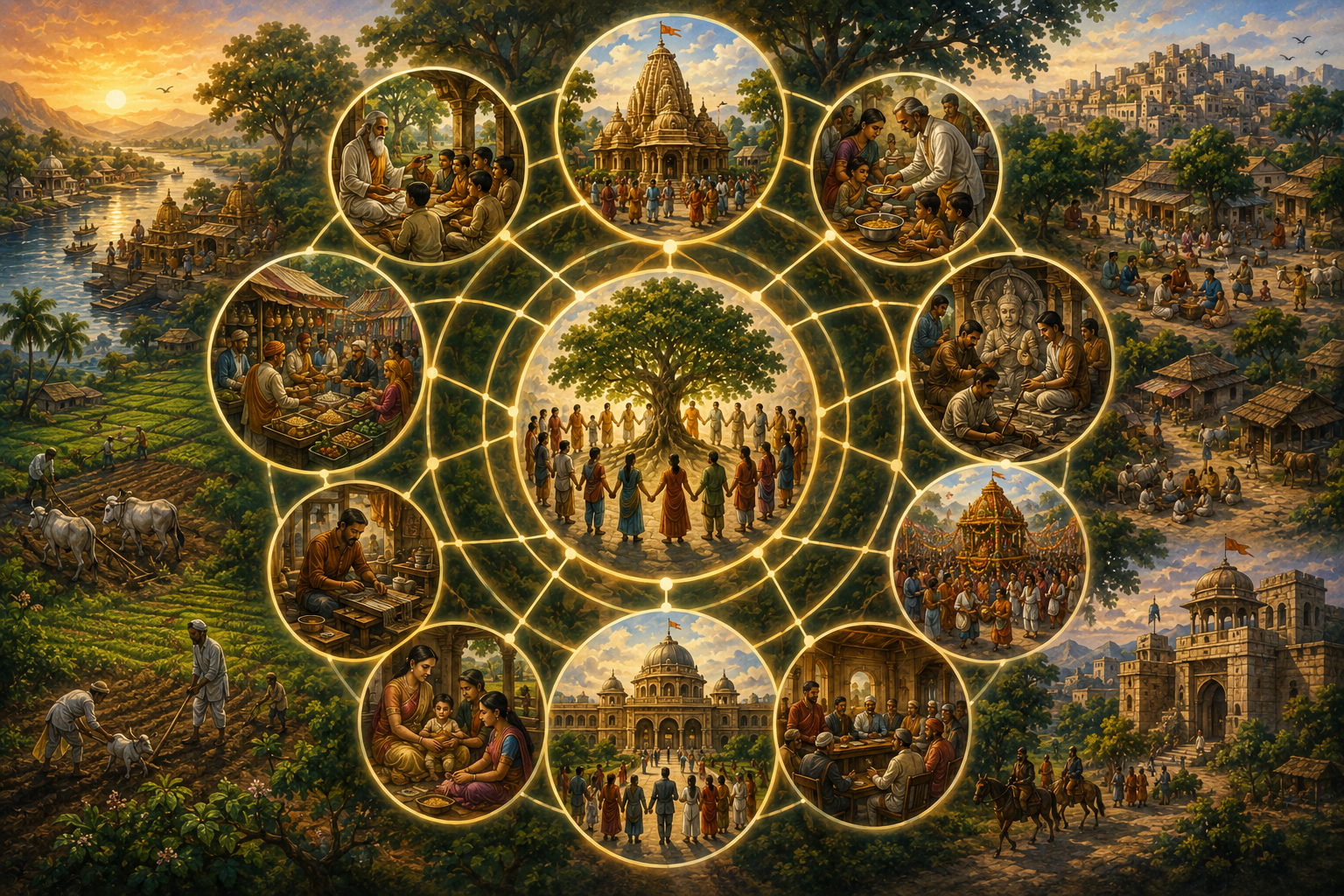
Why have Indic institutions historically shown remarkable resilience?
What happens when we stop studying institutions as isolated structures and instead ask how they sustain one another?
Modern social science often places institutions into separate analytical boxes. The family belongs to sociology, the market to economics, the state to political science, and the temple to the study of religion. But historically, human societies did not experience these institutions as separate departments.
They interacted. They depended upon one another. They sometimes competed, sometimes adapted, and often performed multiple functions simultaneously. This is particularly important for understanding Indic society.
An institution survives not merely because it performs its own function, but because it is embedded within an ecosystem of other institutions.
From Institutions to Institutional Ecology
Consider the temple.
If we understand it merely as a place of worship, we miss much of its possible institutional significance. In different historical contexts, temples could become associated with education, cultural production, charitable activity, employment, festivals, landholding, artisanal networks and redistribution.
The relationship can therefore be imagined as: Temple → Education → Charity → Economy → Festivals → Social Cohesion → Political Legitimacy
The temple does not operate alone. Education creates knowledge and cultural continuity. Charity creates networks of support. Festivals bring communities together. Economic activity sustains the institution and those associated with it. Social cohesion, in turn, can contribute to political legitimacy. The important point is not that every temple performed every one of these functions in exactly the same way. The point is that institutions can be multifunctional and interconnected.
The Family as an Institutional Ecosystem
The same principle becomes even clearer with the Kutumba. The family is not simply a private unit concerned with emotional relationships. It can organize residence, inheritance, occupation, care, socialization and transmission of knowledge.
Consider the chain: Family → Occupation → Knowledge → Culture → Demography → Civilizational Continuity
A child may learn an occupation within a family. The occupation carries specialized knowledge. Knowledge becomes embedded in cultural practices. Family formation influences demographic patterns. Across generations, these processes contribute to continuity. Again, this should not be romanticized. Families can reproduce inequality as well as knowledge and solidarity. The analytical point is that family institutions have consequences far beyond the household.
The Market Is Not an Island
The same argument applies to the market. Markets require more than buyers and sellers. They require trust, property arrangements, networks, skills, infrastructure, social norms and some degree of institutional stability. Economic activity therefore depends upon institutions that economics sometimes treats as external conditions. This insight is already visible in the classical Indian tradition.
Kauṭilya’s Arthaśāstra does not treat economic life as detached from political authority or social order. Agriculture, taxation, trade, labour, infrastructure, regulation and statecraft appear within an interconnected conception of artha. The market therefore exists within an institutional ecology.
No economy floats above society.
The State Within Society
The same applies to the Rājya. The state depends upon society for taxation, legitimacy, knowledge, labour and social cooperation. Society, in turn, depends upon political institutions for security, justice and public order. This relationship is visible in the classical idea of Rājadharma. The ruler does not merely possess power. Power carries responsibility.
Mahābhārata, Śānti Parva and Rājadharma traditions repeatedly connect kingship with the protection and welfare of the social order. Political authority is therefore embedded within a larger moral and institutional world.
This gives us a different way of understanding governance. The state is not necessarily the creator of society. It is one institution within society’s larger ecology.
Why Resilience Matters
This institutional ecology may help explain an important feature of Indic social history: resilience through institutional redundancy and adaptation. When one institution weakens, others may continue to carry parts of its functions. Family can provide welfare.
Community can preserve knowledge. Temples and local institutions can sustain cultural practices. Occupational networks can preserve skills. Markets can maintain economic exchange. Political institutions can provide formal authority. The system is therefore not dependent upon a single centre. This is particularly important for understanding civilizational continuity through periods of political disruption. Political regimes may change, but social institutions can preserve practices, knowledge and identities across those changes. This does not mean that Indic institutions were static or uniformly successful. They changed continuously, and many historical institutions experienced conflict, exclusion and decline.
Resilience is not the absence of change. It is the capacity to adapt while preserving enough continuity to reproduce the system.
Toward an Indic Institutional Ecology
This framework therefore shifts our analytical question.
Instead of asking: What does the temple do?
we ask: What relationships connect the temple to education, economy, family and community?
Instead of asking: What does the family do?
we ask: How does family structure influence occupation, knowledge, demography and culture?
Instead of asking: What does the state do?
we ask: What does the state receive from society, what does it provide, and how does its intervention reshape other institutions?
This is the essence of an Indic Systems Model of Society. Society is not a collection of independent institutions placed next to one another. It is an ecology of relationships. The deeper Indic insight may therefore be expressed through a simple proposition:
Institutions endure when they nourish one another; they decline when the relationships that sustain them begin to break down.
The question for contemporary social science is consequently not merely which institution is strongest.
It is: How healthy is the ecosystem that connects them?
Because civilization rarely survives through one institution alone. It survives through the relationships between institutions.
