The Modern Recovery of an Indian Political Tradition
When we speak about the modern rediscovery of Indian political thought, the name of Kauṭilya’s Arthaśāstra inevitably appears. But the story of its rediscovery is more complicated than the simple claim that a forgotten ancient Indian text was suddenly found in the twentieth century. Behind the printed editions of the Arthaśāstra lies a much older world of manuscripts, commentaries, regional traditions and Sanskrit scholarship. Śrīmūlam, associated with the great Sanskrit scholar H. Gaṇapati Śāstrī, is an important part of this story because it represents the moment when this older textual world entered modern scholarly publication.
What is Śrīmūlam?
The first thing to clarify is that Śrīmūlam is not an independent political treatise authored by Gaṇapati Śāstrī. It is the name associated with his Sanskrit commentary on Kauṭilya’s Arthaśāstra. Gaṇapati Śāstrī prepared an edition of the Arthaśāstra and provided it with his own Sanskrit commentary, known as Śrīmūlam. The work was published through the Trivandrum Sanskrit Series, an important early twentieth-century project devoted to bringing Sanskrit manuscripts into printed form.
The Rājanītikāṇḍa source-list records the work under the year 1923. Later bibliographical references sometimes place the Trivandrum publication in 1924–25, so the precise publication chronology requires some care. For our purposes, however, the date given in the original source-list is important because it places Śrīmūlam firmly within the modern phase of Sanskrit textual scholarship.
A Sanskrit Commentary on a Sanskrit Political Text
The language of Śrīmūlam is Sanskrit, and this is not a minor detail. Gaṇapati Śāstrī was not simply translating Kauṭilya into English or explaining him through modern political terminology. He was engaging with the Arthaśāstra through the Sanskrit scholarly tradition itself.
This gives the work a distinctive position in the history of modern scholarship. By the beginning of the twentieth century, ancient Indian texts were increasingly being studied through European and colonial academic frameworks. Indian political ideas were being compared with Greek political philosophy, Machiavelli and modern theories of statecraft. Śrīmūlam, however, represents another dimension of this encounter with the past: the Sanskrit intellectual tradition examining and explaining its own political texts.
This does not mean that traditional and modern scholarship existed in two completely separate worlds. In fact, Gaṇapati Śāstrī stood precisely at their intersection. He worked with manuscripts and Sanskrit commentarial traditions while participating in the modern world of printed books, Oriental institutions and scholarly publication.
What Does the Work Discuss?
Since Śrīmūlam is a commentary on the Arthaśāstra, its subject is the entire political universe of Kauṭilya. The work takes us into questions of kingship, ministers, officials, taxation, treasury, agriculture, trade, law, punishment, intelligence, military organisation, diplomacy, alliances and war. Kauṭilya’s concern is not merely with the king as an individual but with the functioning of the entire political system.
This is one reason the Arthaśāstra occupies such an important position in the history of Indian political thought. It does not discuss politics merely as an ethical question of whether a ruler is good or bad. It asks how a state actually functions: how revenue is collected, how officials are supervised, how information is gathered, how enemies are assessed, how alliances are constructed and how political power is maintained.
Śrīmūlam becomes important because it helps modern readers enter this difficult Sanskrit political vocabulary. The commentary explains the text and engages with the linguistic and conceptual problems that arise from it. In this sense, Gaṇapati Śāstrī was not simply publishing an ancient book. He was helping to make its intellectual world intelligible.
The Story of the Arthaśāstra’s Rediscovery
The modern story of the Arthaśāstra begins most famously with R. Shamasastry. At the beginning of the twentieth century, Shamasastry, working with the Mysore Government Oriental Library, came across a manuscript of the Arthaśāstra. The Sanskrit text was subsequently published, and Shamasastry’s English translation brought the work to the attention of a much wider international audience.
The Sanskrit edition appeared in 1909, followed by the English translation in 1915. Suddenly, scholars who had previously known very little about the text were confronted with an extensive work dealing with administration, political economy, espionage, diplomacy, war and statecraft.
But this “rediscovery” was only the beginning. Once the Arthaśāstra became known, questions immediately arose about its manuscripts, textual variations and commentarial traditions. Was the Mysore manuscript the only surviving witness? Were there other versions? Did medieval scholars know the text? Were there older commentaries? Could regional manuscript traditions preserve readings that were absent elsewhere?
These questions brought scholars like Gaṇapati Śāstrī into the picture.
The Kerala Connection
One of the most fascinating aspects of Gaṇapati Śāstrī’s work is its connection with the manuscript culture of Kerala and Travancore. The region had preserved an enormous number of Sanskrit manuscripts, many of them on palm leaves. These manuscripts were not necessarily part of the modern academic canon, but they preserved texts and commentarial traditions that could be invaluable for reconstructing India’s intellectual history.
Among the materials associated with the Arthaśāstra tradition was an old Malayalam commentary. This is particularly interesting because it reminds us that the transmission of Sanskrit political knowledge was not confined to a single centre. A text associated today with “Kautilyan political thought” had travelled through regional scholarly networks and survived within Kerala’s manuscript culture.
Gaṇapati Śāstrī’s work therefore becomes part of a much larger story of transmission: a political text composed many centuries earlier, copied onto palm leaves, preserved in a regional intellectual environment, recovered by a modern Sanskrit scholar and eventually published in a printed Sanskrit series.
That is much more than simple textual preservation.
The Commentarial Tradition
Another reason Śrīmūlam matters is that the Arthaśāstra itself had a history of commentary. Gaṇapati Śāstrī was not the first person to explain Kauṭilya. Earlier commentators, including Bhattasvāmin, had already engaged with the text, although much of this commentarial literature has survived only partially.
Other names are also associated with the history of Arthaśāstra commentary, including traditions represented by works such as Pratipadapañcikā, Jayamaṅgalā and other interpretative texts. Some survive in fragments, some through manuscript evidence and some through quotations preserved by later scholars.
This is important because it changes how we understand the relationship between ancient and modern Indian political thought. Kauṭilya was not simply a forgotten author whose book disappeared and then magically returned in 1909. There existed a history of reading Kauṭilya, even though that history was uneven and much of its literature did not survive completely.
Śrīmūlam belongs to this continuing chain of interpretation.
Gaṇapati Śāstrī: More Than an Editor
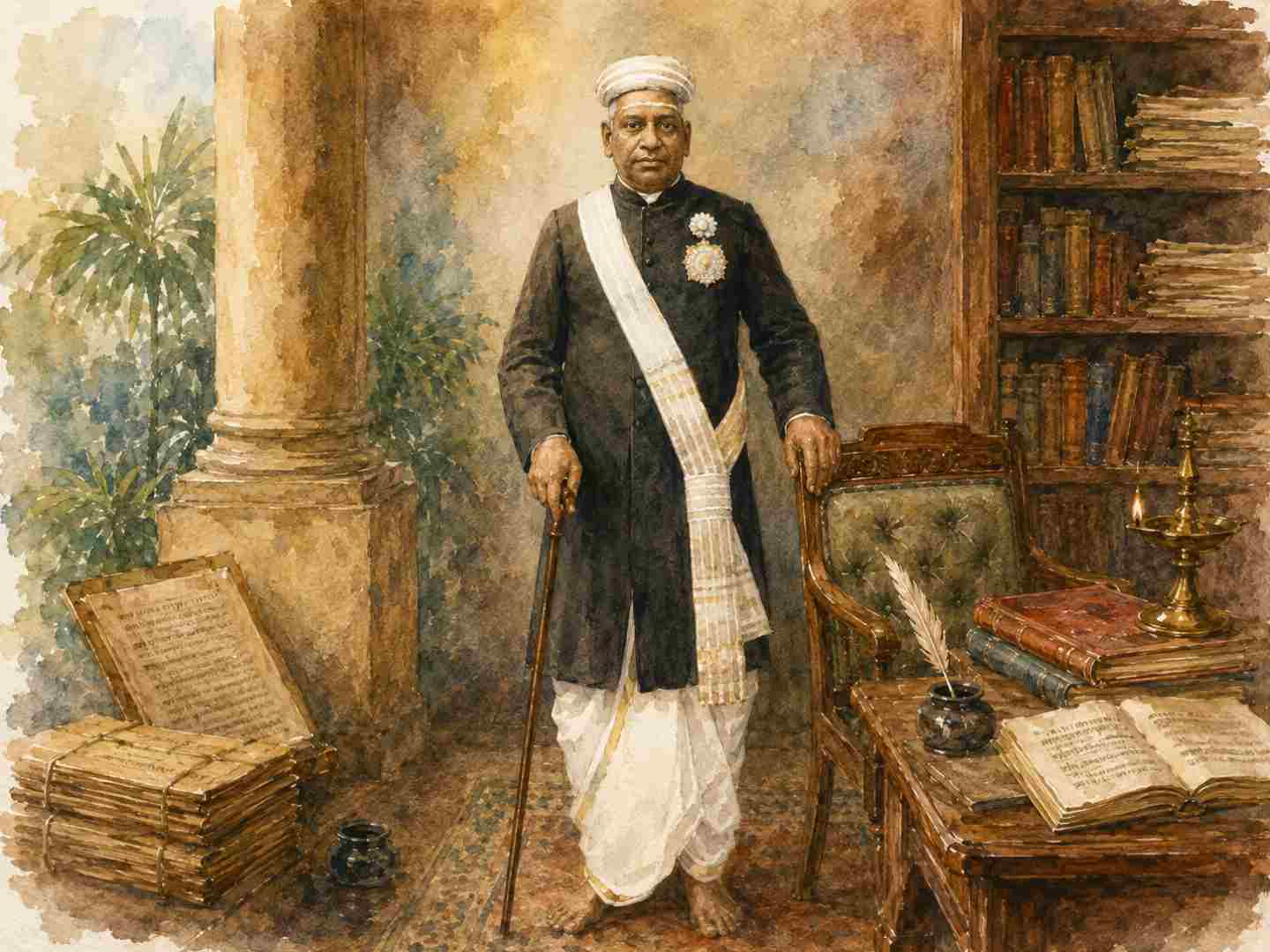
H. Gaṇapati Śāstrī himself deserves attention because his intellectual contribution extended far beyond the Arthaśāstra. He was one of the major Sanskrit manuscript scholars of early twentieth-century India and became particularly famous for his discovery and publication of Sanskrit plays attributed to Bhāsa, works that had long been regarded as lost.
His work in Travancore was part of a broader effort to collect, preserve and publish Sanskrit manuscripts. The Trivandrum Sanskrit Series became an important vehicle for this enterprise. Texts that had existed in manuscript collections could now be printed, circulated and studied by scholars in India and abroad.
This was an important transformation in the history of knowledge. For centuries, access to many Sanskrit texts depended upon manuscript collections and traditional scholarly networks. Printing changed the scale of circulation. A text that might previously have been available only to a small circle could now become part of a library, university and international research collection.
Gaṇapati Śāstrī was one of the scholars standing at precisely this transition.
The Problem of Reading Kauṭilya
Gaṇapati Śāstrī’s work also reminds us that recovering an ancient text is not simply a matter of finding an old manuscript and printing it. There is a substantial scholarly problem between those two steps.
Manuscripts contain variant readings. Words can be corrupted during copying. Sections may be missing. Commentaries can preserve alternative interpretations. Different manuscript traditions may contain different readings. The editor must therefore compare evidence and decide how the text should be reconstructed.
Gaṇapati Śāstrī was deeply involved in precisely this kind of Sanskrit philological work. Even questions concerning the form of Kauṭilya’s name became matters of scholarly attention. He preferred the form Kauṭalya in certain contexts rather than the more familiar Kauṭilya. Such questions may appear trivial to a modern reader, but for a Sanskrit editor they are part of establishing the textual history of a work.
And this is where an important lesson emerges: before we interpret an ancient political thinker, we first need to establish the text of the thinker we are interpreting.
Why Śrīmūlam Matters for Indian Political Thought
The significance of Śrīmūlam therefore extends beyond its immediate commentary on the Arthaśāstra. It belongs to the history of how Indian political knowledge itself became accessible to modern scholarship.
Consider the intellectual journey. Ancient Indian thinkers produced works on dharma, artha, daṇḍanīti, nīti and rājadharma. Later scholars commented upon those works, debated their meaning and compiled their principles into nibandhas. Manuscript traditions preserved these works across different regions. Then, in the modern period, scholars began systematically collecting and printing these manuscripts.
Śrīmūlam belongs to that final transition.
It represents the movement from manuscript to print, from traditional transmission to modern publication, and from limited scholarly circulation to a much wider academic readership.
This also complicates the familiar narrative that Indian political thought was “lost” and then “rediscovered” by modern scholars. The evidence suggests something more interesting. Many texts may have disappeared from mainstream intellectual circulation, but they continued to survive in manuscripts, commentaries and regional scholarly traditions. Modern scholarship recovered these materials and placed them into a new institutional framework.
The rediscovery was therefore real, but it was a rediscovery for modern scholarship, not necessarily the sudden creation of knowledge that had completely vanished.
The Larger Significance
This is why Śrīmūlam deserves attention beyond the history of the Arthaśāstra. It tells us something about the survival of Indian intellectual traditions themselves.
The history of Rājanīti cannot be reduced to Kauṭilya. Nor can it be reduced to a handful of famous Sanskrit texts. The wider tradition includes Dharmasūtras, Smṛtis, epics, Purāṇas, Nītiśāstras, Rājadharma texts, legal digests and hundreds of years of commentary. The modern period then adds another layer: scholars who searched for these works, edited them and brought them into print.
Gaṇapati Śāstrī’s Śrīmūlam is an excellent example of this final layer. He did not invent India’s political tradition. He helped recover the textual world through which that tradition could be studied again.
And perhaps this is the most interesting way to understand the work. The modern rediscovery of the Arthaśāstra was not simply the discovery of an ancient book about politics. It was the recovery of evidence that India possessed a much larger and more complex tradition of thinking about political order than the modern world had previously recognised.
Śrīmūlam therefore belongs not only to the history of Kauṭilya, but to the history of how India remembered its own political thought. The manuscript survived, the commentator interpreted, the scholar edited, and the printing press carried it forward. What reaches us today is the result of all four processes.
The real importance of Śrīmūlam, then, is not that it marks the end of Indian Rājanīti. It marks the moment when an old intellectual conversation became available for a new generation to reopen. And perhaps that is where the modern study of Indian political thought should begin—not by assuming that the tradition was absent until modern scholars discovered it, but by asking how that tradition survived, changed, travelled and eventually returned to public intellectual life through modern scholarship.
