
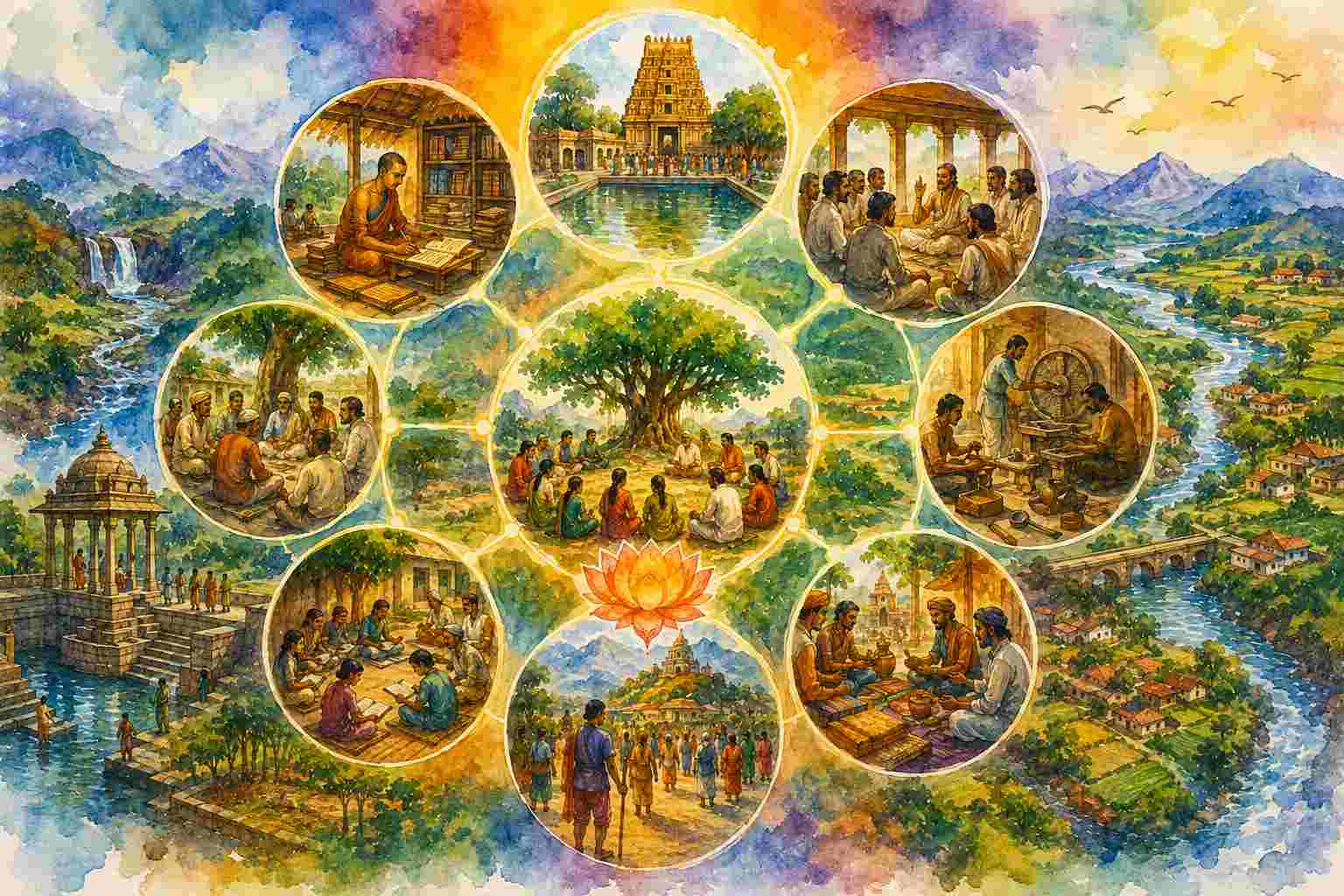
Beyond Centralization: How Bharat Distributed Power, Knowledge and Responsibility
Can a civilization flourish only through a powerful centralized state?
Modern political imagination often assumes that order flows from the top. The stronger the state, the stronger the society. The more centralized the institutions, the more effective the governance. The more resources controlled by central authorities, the more secure and resilient the system appears to become.
But does history always support this assumption?
Bharat presents an important civilizational puzzle. For much of its history, kingdoms emerged and disappeared. Dynasties expanded and contracted. Political boundaries shifted continuously. Yet society and civilization displayed remarkable continuity. Knowledge traditions survived changing rulers. Sacred geographies continued to connect distant regions. Local institutions maintained social life. Water systems continued to sustain communities. Cultural traditions travelled across territories that were never permanently governed by a single political authority.
How did civilization survive when political structures often did not? The answer may lie in a characteristic of Bharatiya civilization that deserves greater analytical attention: polycentric autonomy.
Polycentric Autonomy Is More Than Decentralization
Decentralization usually refers to the transfer of authority from a central institution to lower administrative levels. The centre remains the ultimate source of power, even when it delegates certain functions.
Polycentric autonomy is different.
It describes an order in which multiple centres possess their own spheres of knowledge, responsibility and decision-making, while remaining connected to a larger social and civilizational whole.
A village may manage its local resources. A temple may perform religious, cultural and charitable functions. A guild may regulate occupational practices. A monastic institution may transmit knowledge. A local community may maintain a water system. A political authority may provide protection and wider coordination.
These centres do not perform identical functions, and none needs to perform every function. This is the crucial distinction. The strength of the system emerges not from the concentration of all authority in one centre but from the presence of multiple centres capable of acting within their own domains. Bharat was not sustained by one centre. It was sustained by thousands of centres.
The Central Question of Resource Governance
This framework becomes particularly important when we study local resources.
Who should decide how a village tank is maintained? Who understands a local watershed? Who knows the seasonal rhythms of a region, the condition of its soil, the behaviour of its rainfall or the needs of its agricultural community? Can a distant authority always possess this knowledge?
Across Bharat, communities developed diverse systems of managing water, land, forests and common resources. Talabs, tanks, stepwells, canals, sacred groves and community-managed commons emerged in response to different ecological conditions. These were not simply physical structures constructed by an authority and left for people to use. They were often embedded within communities.
A water system required rules of maintenance, collective labour, knowledge of seasons, distribution mechanisms and institutions capable of resolving conflicts. In this sense, water management was not merely a technical problem.
Water systems organized communities.
This is where polycentric autonomy becomes an important analytical framework. Local communities were not merely consumers of resources administered from above. They could also become custodians, decision-makers and managers.
The principle was not that the state had no role. Large river systems, conflicts between regions and wider infrastructure could require broader coordination. But a local water system did not necessarily require the same scale of authority as a national river basin.
The question, therefore, is not simply centralization or decentralization. It is: which level possesses the appropriate knowledge, responsibility and capacity to manage a particular resource?
Local Autonomy Does Not Mean Local Isolation
This distinction is essential because polycentric autonomy should not be confused with fragmentation.
A village may manage a local resource while remaining connected to a wider ecological, economic and political system. A local community may possess autonomy without becoming separate from the larger society. A region may preserve its distinctive practices while participating in a shared civilization.
The Bharatiya experience therefore suggests a principle of autonomy within interdependence.
The local centre has its own life, but it is not isolated. Different centres may cooperate when the scale of a problem exceeds their individual capacity. A village tank may be locally maintained. A network of water systems may require regional cooperation. A major river may require inter-state coordination. National defence may require a powerful central authority.
Polycentric autonomy does not argue that every question should be decided locally. It argues that authority should not automatically be centralized when the knowledge and responsibility necessary for effective action are distributed elsewhere.
Polycentric Power: Society Beyond the State
The same pattern can be seen beyond resources.
Modern political analysis often begins with the state. Who possesses sovereignty? Who makes law? How does authority flow through institutions? The Indian civilizational experience requires a broader starting point.
Between the individual and the state existed numerous social institutions: Kutumba, Jāti, Śreṇi, Grāma, temples, monasteries, educational traditions, pilgrimage networks and community organizations. These institutions possessed different kinds of authority and social responsibility. A ruler could exercise political power, but political power did not create every social relationship. A temple could serve as a cultural and charitable centre. A guild could organize professional life. A village institution could address local concerns. A teacher or monastic lineage could exercise intellectual authority.
This does not mean that these institutions were always just or should be restored exactly as they existed. Polycentric autonomy is not a romantic argument about the past.
The analytical point is more important: authority itself was plural. The state was one centre of power, not the sole producer of social order.
Polycentric Knowledge
The principle becomes even clearer in the history of knowledge.
Knowledge in Bharat was never confined to a single centralized academy or university. It moved through networks. Temples preserved manuscripts. Libraries collected texts. Monasteries trained scholars. Teachers transmitted knowledge through paramparā. Travellers carried ideas across regions. Storytellers and performers translated complex knowledge into forms accessible to communities. Guilds preserved professional and technical knowledge. Oral traditions carried enormous bodies of memory across generations.
This leads to an important distinction: institutions and knowledge systems are not the same thing.
Institutions are historical. They emerge, flourish, decline and sometimes disappear. Knowledge systems can survive by finding new institutions, new custodians and new forms of transmission. A library may be destroyed. A monastery may decline. A political patron may disappear. Yet a knowledge tradition can survive through teachers, disciples, oral memory, manuscripts or another institution.
There was no single point of failure. The resilience of Bharatiya knowledge emerged partly because it was distributed across multiple centres.
Polycentric Cultural Decision-Making
Culture also operated through plurality.
No single institution designed the entire cultural life of Bharat. Cultural continuity emerged through interaction between families, communities, teachers, temples, pilgrimage networks, literary traditions, regional languages and countless local practices. Different regions could make their own cultural decisions while participating in a larger civilizational world.
This produced a remarkable possibility: unity without uniformity. Tamil, Marathi, Bengali, Gujarati, Kannada and other cultural worlds developed distinct identities. Different philosophical traditions debated one another. Shaiva, Vaishnava, Buddhist, Jain and other traditions developed their own institutions and intellectual lineages.
Yet they were also connected through networks of knowledge, pilgrimage, debate, trade and cultural exchange. The centre did not have to eliminate difference to create coherence. This may be one of the most important insights of the framework: civilizational unity does not always emerge from administrative uniformity. It can emerge from networks of shared relationships between autonomous centres.
Resilience Through Multiple Centres
The greatest strength of polycentric autonomy is resilience.
A highly centralized system may appear powerful because it can mobilize enormous resources. But concentration also creates vulnerability. When everything depends upon a single centre, the failure of that centre can produce systemic collapse. A distributed system functions differently.
If one institution disappears, another may continue. If a kingdom collapses, local communities may remain. If a library is destroyed, knowledge may survive through oral traditions. If political boundaries change, cultural and pilgrimage networks can continue across them. Civilizational resilience therefore does not require every institution to survive permanently.
It requires the functions of civilization to be distributed across multiple institutions. Knowledge can survive the destruction of a university. Cultural memory can survive the fall of a dynasty. Social cooperation can survive the failure of a political regime.
The system can lose parts without losing the whole.
Polycentric Autonomy as an Indian Framework
Polycentric autonomy provides a framework for understanding the relationship between power, knowledge, culture, resources and society. Its central proposition is that civilization does not require a single centre to perform every function. Different questions can be addressed by different institutions at different scales.
Local communities may manage resources. Knowledge traditions may develop through autonomous institutions. Cultural practices may emerge from society rather than administrative command. Political authority may coordinate where coordination is necessary.
The framework therefore proposes four principles.
- First, plurality of centres. Society contains multiple legitimate sites of knowledge and action.
- Second, autonomy within relationships. Different centres can possess their own vitality without becoming isolated.
- Third, distributed responsibility. The responsibility for civilization should not rest upon the state alone.
- Fourth, coordination according to scale. Local problems require local knowledge, while wider problems may require wider coordination.
This is why polycentric autonomy is neither an argument against the state nor a defence of unlimited localism. It is a framework of appropriate distribution. The deeper question is not: Should power be centralized or decentralized?
It is: At what level should power, knowledge and responsibility be located for a particular social or ecological function?
That question has major implications for contemporary governance, resource management, education and cultural policy. To understand Bharat, therefore, we must study not only its empires and states, but also its villages, temples, libraries, monasteries, guilds, water systems and local communities. For the strength of a civilization does not exist only at its centre.
It also exists in the capacity of its countless centres to sustain themselves, make decisions, adapt to change and remain connected to one another. And perhaps this is the deepest lesson of Bharat’s civilizational experience: resilience is not always created by concentrating everything in one hand. Sometimes it is created by ensuring that society itself possesses the capacity to act.
