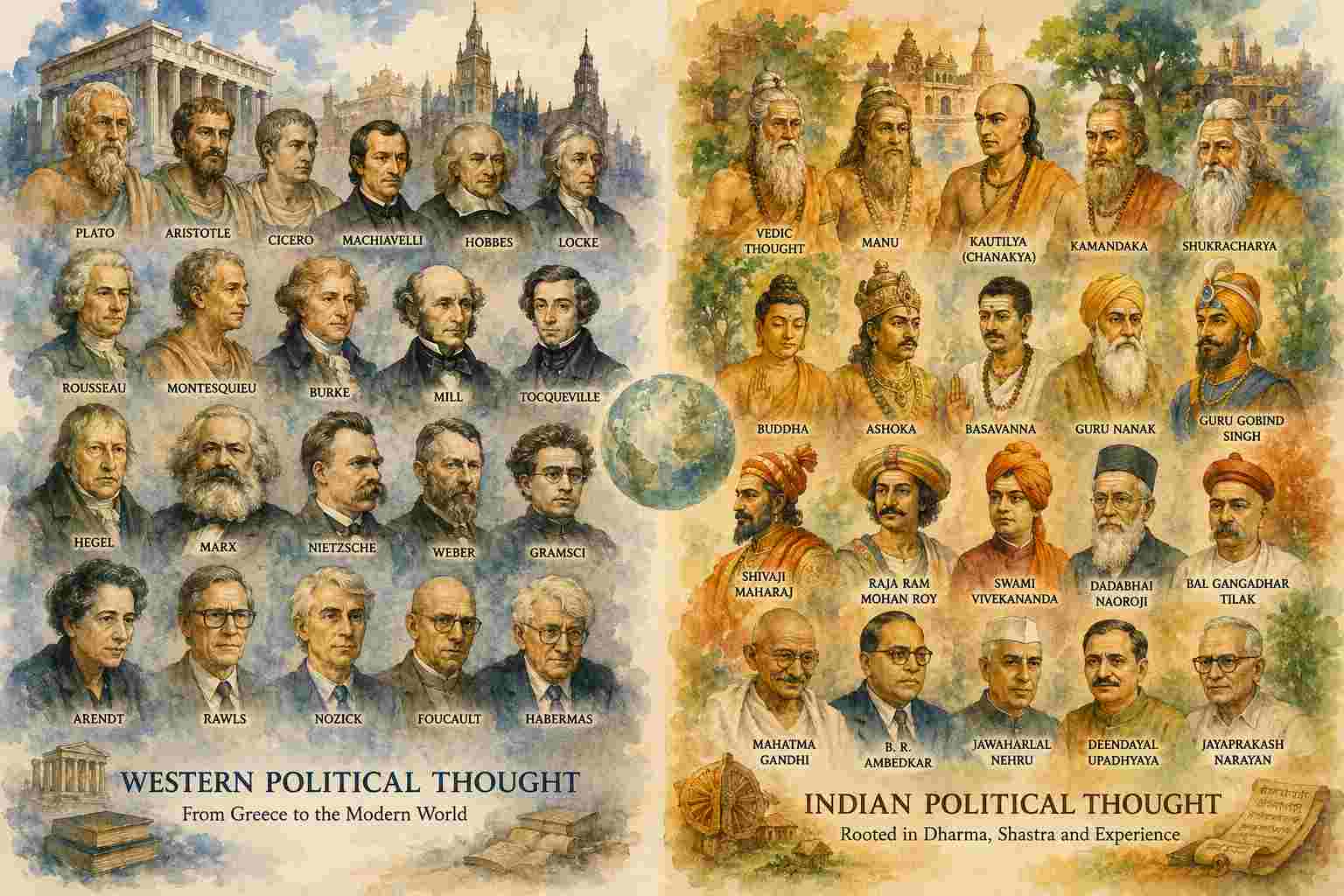
Political science, as taught across universities around the world, is built through a long conversation between thinkers who asked fundamental questions about power, justice, the state, society, law, freedom and political order. This intellectual history developed through different civilizational traditions. The following list places two major paramparas side by side: the Western tradition and the Indian tradition.
The purpose is not to force equivalence where none exists. Plato was not Kautilya, and Aristotle was not Manu. Nor did thinkers in either tradition always ask identical questions. The objective is simply to understand the long intellectual traditions through which political ideas developed.
The Western Political Thought Parampara
1. Plato
Plato is among the earliest systematic thinkers on justice, political order and the ideal state. In The Republic, he argued that political disorder emerges when individuals and classes perform roles contrary to their nature. His ideal polity was governed by philosopher-rulers whose knowledge and wisdom qualified them to rule.
2. Aristotle
Aristotle shifted political inquiry toward empirical and comparative study. He analysed constitutions, classified forms of government and described the human being as a zoon politikon, a political animal. His central concern was the best practicable state and the constitutional balance necessary for political stability.
3. Polybius
Polybius developed the influential theory of the mixed constitution. He argued that political systems naturally move through a cycle of monarchy, tyranny, aristocracy, oligarchy, democracy and mob rule. Rome’s relative stability, in his analysis, came from balancing monarchical, aristocratic and democratic elements.
4. Cicero
Cicero connected political thought with law, republicanism and civic duty. He argued that legitimate political communities depend upon shared laws and a common understanding of justice. His thought became important for later theories of natural law and republican government.
5. St. Augustine
Augustine placed politics within a larger theological understanding of human existence. In The City of God, he distinguished between the earthly city and the city of God. Political authority, in his thought, was necessary in a fallen world but could not provide ultimate human salvation.
6. St. Thomas Aquinas
Aquinas attempted a systematic synthesis of classical philosophy and Christian theology. He developed theories of natural law, the common good and legitimate political authority. Political law, according to Aquinas, should ultimately be connected with a broader moral order.
7. Niccolò Machiavelli
Machiavelli separated political analysis from ideal moral expectations more sharply than many earlier thinkers. His focus was on power, political survival, leadership and statecraft. In The Prince, he examined how rulers actually acquire and maintain power rather than merely how they ought to behave.
8. Jean Bodin
Bodin became one of the foundational theorists of sovereignty. He argued that a political community requires a supreme and continuous power capable of making law. His work contributed significantly to the development of the modern concept of the sovereign state.
9. Thomas Hobbes
Hobbes began with the problem of order. In his account of the state of nature, individuals face insecurity and conflict, leading them to establish political authority through a social contract. The resulting sovereign requires sufficient power to prevent society from returning to conditions of disorder.
10. John Locke
Locke developed a different theory of natural rights and limited government. Individuals possess rights to life, liberty and property, while political authority derives from consent. Government becomes illegitimate when it violates the rights it was established to protect.
11. Montesquieu
Montesquieu is particularly associated with the separation of powers. He argued that political liberty requires institutional arrangements that prevent the concentration of authority. His analysis of legislatures, executives and judiciaries strongly influenced modern constitutional design.
12. Jean-Jacques Rousseau
Rousseau developed the idea of popular sovereignty and the general will. Political legitimacy, in his view, comes from citizens collectively participating in the formation of political authority. His thought remains central to theories of democracy, citizenship and republicanism.
13. Edmund Burke
Burke became an important critic of abstract political reconstruction and revolutionary rupture. He emphasized historical continuity, inherited institutions and gradual political change. His thought is central to the modern conservative tradition.
14. Jeremy Bentham
Bentham developed utilitarianism as a principle of political and legal evaluation. Political institutions should be assessed according to their consequences for human happiness and suffering. His work influenced law, administration, democratic reform and policy analysis.
15. Alexis de Tocqueville
Tocqueville studied democracy as a social condition rather than merely a form of government. In his analysis of America, he examined equality, civic associations, local institutions and the possible dangers of majority power.
16. Georg Wilhelm Friedrich Hegel
Hegel understood political institutions historically and dialectically. He treated the state as an important sphere in the development of ethical life and freedom. His thought influenced later theories of history, nationalism, statehood and dialectical development.
17. Karl Marx
Marx analysed politics through class relations, economic structures and historical change. The state, ideology and law were connected with underlying relations of production. His theory of historical materialism became foundational for socialist and Marxist political thought.
18. John Stuart Mill
Mill made major contributions to liberalism, representative government and individual liberty. He defended freedom of thought and expression while warning against the tyranny of the majority. He also contributed to arguments for women’s political equality.
19. Friedrich Nietzsche
Nietzsche challenged conventional assumptions about morality, power and political values. His analysis of power, culture and the formation of values influenced later political philosophy, particularly existentialism and post-structural thought.
20. Max Weber
Weber analysed political authority through the concepts of legitimacy and domination. His famous classification of authority includes traditional, charismatic and legal-rational forms. He also provided influential definitions of the modern state and bureaucracy.
21. Vilfredo Pareto
Pareto developed theories of elites and elite circulation. He argued that political societies are never entirely free from elite domination; instead, elites change over time. His work became foundational to elite theory.
22. Gaetano Mosca
Mosca argued that every society contains a political class that exercises organized control over the majority. His work focused on the persistence of ruling minorities across different political systems.
23. Antonio Gramsci
Gramsci expanded Marxist analysis through the concept of cultural hegemony. Political power is sustained not only through coercion but also through institutions, ideas and social consent. His work transformed the study of ideology and power.
24. Hannah Arendt
Arendt focused on totalitarianism, freedom, action and the public realm. She distinguished political action from administration and emphasized the importance of plural human participation in public life.
25. Carl Schmitt
Schmitt examined sovereignty, political conflict and the distinction between friend and enemy. He famously argued that sovereignty becomes visible most clearly in decisions made during exceptional situations.
26. John Rawls
Rawls reconstructed liberal political theory around the idea of justice as fairness. His hypothetical original position and veil of ignorance were designed to identify principles that rational individuals would accept without knowing their future social position.
27. Robert Nozick
Nozick provided a libertarian critique of expansive distributive theories. He defended the minimal state and argued that justice depends primarily upon how holdings were acquired and transferred rather than upon achieving a particular pattern of equality.
28. Jürgen Habermas
Habermas developed theories of communicative action and deliberative democracy. Political legitimacy, in his framework, depends significantly upon rational public communication and democratic discussion.
29. Michel Foucault
Foucault moved political analysis beyond the state alone. He examined how power operates through institutions, knowledge, surveillance and disciplinary practices. His work expanded the study of power into everyday social structures.
30. Francis Fukuyama
Fukuyama contributed to debates on democracy, political order and the historical development of institutions. His famous discussion of the “end of history” generated global debate about liberal democracy after the Cold War.
The Indian Political Thought Parampara
The Indian political tradition developed across a wide range of texts, traditions and intellectual schools. Political ideas appeared in Vedic literature, epics, Dharmashastric traditions, Buddhist and Jain thought, statecraft literature and later social and national movements. Not every thinker used the modern vocabulary of “political science,” but questions of authority, justice, law, state, taxation, punishment, social order and political ethics were extensively discussed.
1. Vedic Political Thought
The Vedic corpus contains early reflections on kingship, assemblies, social order and collective authority. Institutions such as sabha and samiti are often discussed in relation to deliberation and political organization. The tradition also connects rulership with ṛta, order and responsibility.
2. Manu
Manu’s political ideas are associated primarily with Rajadharma, law, social order and punishment. The king’s authority is presented alongside duties concerning protection, justice and maintenance of order. Danda functions as an essential instrument of political regulation.
3. Yajnavalkya
Yajnavalkya contributed significantly to discussions of law, judicial procedure and state administration. His tradition gave greater systematic attention to legal processes, evidence, judicial authority and political responsibility.
4. Kautilya (Chanakya)
Kautilya’s Arthashastra is one of the most systematic works on statecraft and political administration. It covers the state, economy, taxation, diplomacy, war, espionage, administration and strategy. The Saptanga theory and Mandala theory remain among its most discussed frameworks.
5. Kamandaka
Kamandaka’s Nitisara continued the tradition of political strategy and diplomacy. It focused particularly on the conduct of rulers, alliances, political calculation and the practical requirements of governance.
6. Shukracharya
The Shukraniti tradition discusses kingship, administration, taxation, military organization and the responsibilities of rulers. Its political thought places considerable attention on the practical organization of the state.
7. Vyasa and the Mahabharata Tradition
The Mahabharata, especially the Shanti Parva, contains extensive discussions on the origin and duties of kingship, Rajadharma, punishment and justice. Political authority is repeatedly examined in relation to dharma, protection and the welfare of subjects.
8. Valmiki and the Ramayana Tradition
The Ramayana contains major reflections on kingship, political responsibility and the relationship between ruler and society. The idea of Rama Rajya later became an important symbol of just and welfare-oriented governance.
9. Buddhist Political Thought
Buddhist traditions discuss political authority in relation to ethical conduct, social consent and welfare. Texts such as the Aggañña Sutta are particularly important for theories concerning the origins of political authority and kingship.
10. Ashoka
Ashoka’s political ideas are known largely through his inscriptions. He combined imperial governance with the public articulation of Dhamma, welfare, ethical administration and religious coexistence. His inscriptions provide direct evidence of political communication and administrative thought.
11. Basavanna
Basavanna challenged inherited social hierarchies and emphasized equality, ethical conduct and community organization. His thought connected social reform with questions of dignity, authority and collective life.
12. Kabir
Kabir was not a political theorist in the conventional sense, yet his critique of religious hierarchy and social exclusion had political implications. His thought questioned authority rooted merely in institutional or inherited status.
13. Guru Nanak
Guru Nanak developed a moral critique of social inequality, oppression and unjust authority. His thought connected spiritual equality with social responsibility and became foundational to later Sikh political traditions.
14. Guru Gobind Singh
Guru Gobind Singh transformed the Khalsa into a collective political and spiritual community. His ideas are important for understanding authority, sovereignty, collective identity and resistance within the Sikh tradition.
15. Chhatrapati Shivaji Maharaj
Shivaji Maharaj’s political practice is central to discussions of sovereignty, state-building, military organization and administrative decentralization. His rule developed institutions of governance under highly competitive political conditions.
16. Raja Ram Mohan Roy
Roy contributed to debates on political reform, rights, education and freedom of expression. He played an important role in the emergence of modern Indian public and political thought.
17. Swami Dayanand Saraswati
Dayanand’s thought connected Vedic reform with social and political regeneration. He advocated educational reform and emphasized the importance of self-rule, social responsibility and institutional renewal.
18. Bankim Chandra Chattopadhyay
Bankim played a major role in developing modern Indian ideas of nationalism and collective identity. His writings connected cultural memory with political consciousness and anti-colonial thought.
19. Swami Vivekananda
Vivekananda connected political regeneration with social strength, education and the upliftment of the masses. His thought emphasized the reconstruction of society through human development and cultural confidence.
20. Dadabhai Naoroji
Naoroji used economic analysis to critique colonial rule, most notably through the Drain Theory. He demonstrated how economic structures could become instruments for understanding political domination.
21. Bal Gangadhar Tilak
Tilak connected political mobilization with public culture and mass participation. He strongly articulated the demand for Swaraj and contributed to the transformation of nationalism into a wider political movement.
22. Mahatma Gandhi
Gandhi developed major ideas around Swaraj, Satyagraha, nonviolence and decentralized social organization. His political thought linked freedom with ethics, self-discipline and local community life.
23. Sri Aurobindo
Aurobindo connected political freedom with the deeper development of human and collective consciousness. His early nationalist thought later expanded into a broader theory of human evolution and collective transformation.
24. Rabindranath Tagore
Tagore offered an important critique of aggressive nationalism and centralized political identity. He emphasized human freedom, cultural openness and education while remaining deeply engaged with questions of colonialism and collective life.
25. Vinayak Damodar Savarkar
Savarkar developed the modern political formulation of Hindutva as a theory of national identity and civilizational belonging. His thought also emphasized political sovereignty, military strength and national consolidation.
26. B.R. Ambedkar
Ambedkar made foundational contributions to constitutionalism, democracy, representation and social justice. He emphasized that political democracy required deeper social transformation and constitutional protection against inequality.
27. Jawaharlal Nehru
Nehru contributed significantly to ideas of parliamentary democracy, secular statehood, planning and postcolonial development. His political thought shaped the institutional direction of the Indian republic.
28. M.N. Roy
Roy moved from revolutionary Marxism toward Radical Humanism. His later thought emphasized individual freedom, rationality and democratic reconstruction beyond traditional ideological frameworks.
29. Ram Manohar Lohia
Lohia developed a distinctive form of Indian socialism focused on social inequality, decentralization and political representation. He emphasized the importance of addressing caste alongside economic and political structures.
30. Deendayal Upadhyaya
Deendayal Upadhyaya formulated the theory of Integral Humanism. His thought attempted to articulate a political and economic philosophy centred on the integrated development of the individual and society.
31. Jayaprakash Narayan
Jayaprakash Narayan moved from socialism toward the idea of Total Revolution. He emphasized decentralization, participatory democracy and ethical political transformation.
32. Ram Manohar Lohia and Jayaprakash Narayan
Together, these thinkers expanded debates on Indian socialism, decentralization and democratic participation. Their influence extended beyond formal theory into political movements and alternative models of democratic organization.
Conclusion: Two Long Conversations
Political thought cannot be reduced to a single civilizational route. One intellectual tradition asks how justice can be institutionalized through the state; another asks how power is limited by law, society and moral responsibility. One thinker studies the social contract; another examines Rajadharma. One develops sovereignty; another studies the state through Saptanga. One asks about liberty; another asks about Swaraj.
But the deeper point is simpler: Political science is a global intellectual discipline built through multiple long paramparas of political reflection.
The Western tradition moved from the Greek city-state to Rome, medieval Christianity, sovereignty, the social contract, liberalism, socialism and modern theories of power and democracy.
The Indian tradition moved through Vedic reflections on order, Rajadharma, Dandaniti, Arthashastra, Buddhist and Jain traditions, medieval political movements and modern debates on nationalism, freedom, democracy, constitutionalism and social justice.
Neither tradition should be treated as a footnote to the other. Both constitute long and internally diverse conversations about the most fundamental political questions: Who should rule? By what authority? What makes power legitimate? What is justice? What is the purpose of the state? What is the relationship between individual, society and political authority?
These questions remain open—and that is precisely why the history of political thought continues to matter.
