Who was Lokmanya Tilak?
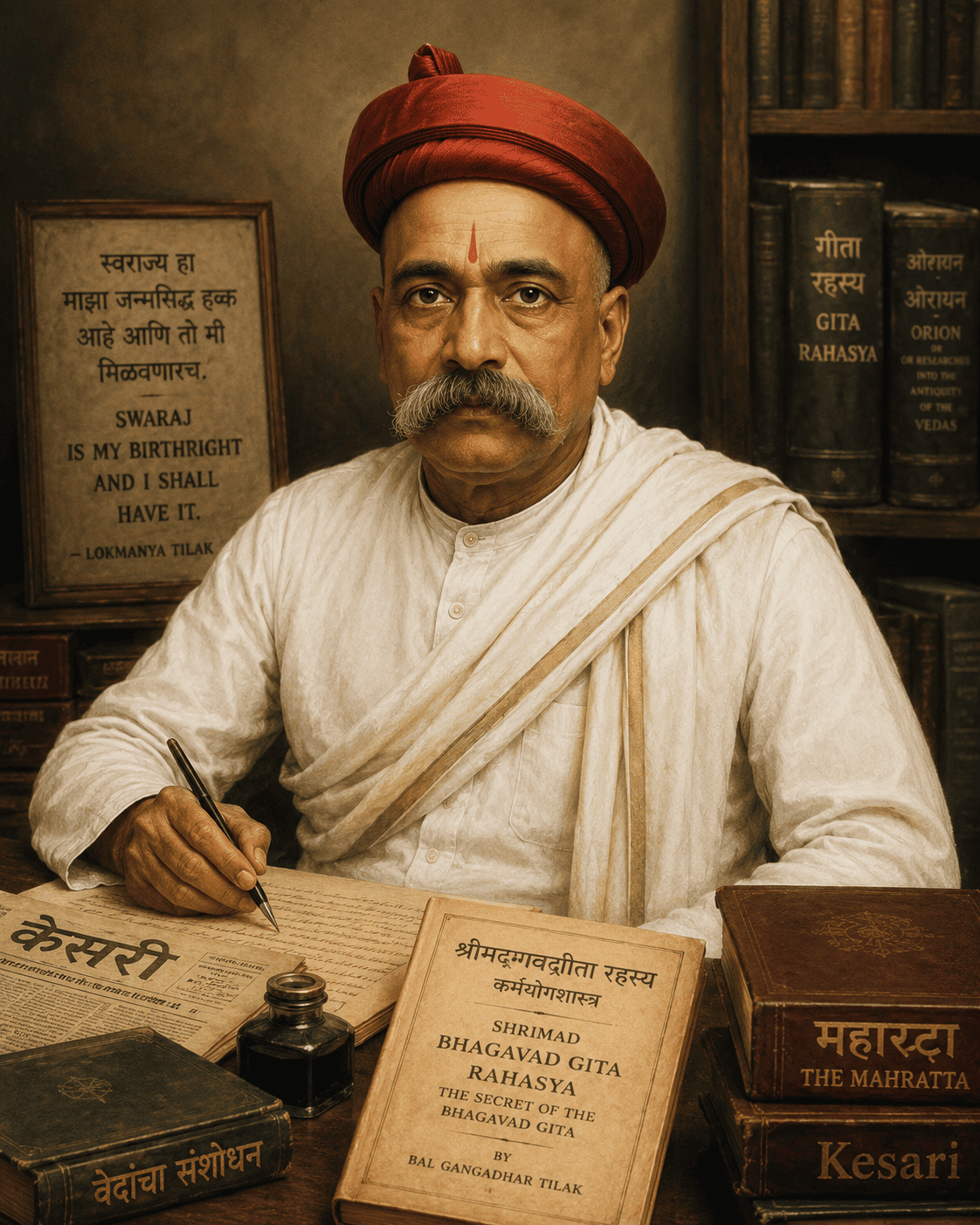
Lokmanya Bal Gangadhar Tilak was one of the foremost architects of India’s national awakening—a freedom fighter, philosopher, mathematician, educationist, journalist, historian, Sanskrit scholar, and political thinker. Revered by the people with the title “Lokmanya” (“accepted by the people”), he transformed the Indian freedom movement from an elite constitutional debate into a mass national movement rooted in civilizational consciousness.
Born on 23 July 1856 in Ratnagiri, Maharashtra, Tilak excelled in Mathematics and Sanskrit before co-founding the New English School, the Deccan Education Society, and later Fergusson College, believing that national regeneration must begin with indigenous education. Recognizing the power of journalism, he founded the Marathi newspaper Kesari and the English weekly The Mahratta, which became influential voices of Indian nationalism and political awakening.
Tilak popularized the ideas of Swaraj (self-rule), Swadeshi (economic self-reliance), Boycott, and National Education, decades before these became the central programmes of the independence movement. He also transformed the Ganesh Utsav and Shivaji Jayanti into public festivals, not merely as religious celebrations but as institutions of cultural unity, civic participation, and national consciousness.
Imprisoned in Mandalay (Burma) between 1908 and 1914, Tilak wrote his philosophical masterpiece Shrimad Bhagavad Gita Rahasya, arguing that the Bhagavad Gita is fundamentally a doctrine of Karma-Yoga—selfless action performed in accordance with one’s duty—rather than a text advocating withdrawal from worldly life. This interpretation profoundly influenced later generations of Indian political and philosophical thought.
Often called the “Father of Indian Unrest” by the British and described by Mahatma Gandhi as the “Maker of Modern India,” Tilak remains one of the foundational figures in the intellectual and political history of modern Bharat.
Major Works
Lokmanya Tilak’s writings span political philosophy, Vedic studies, history, journalism, and religious thought. His most significant works include:
- Shrimad Bhagavad Gita Rahasya (The Secret of the Bhagavad Gita)
- The Orion, or Researches into the Antiquity of the Vedas (1893)
- The Arctic Home in the Vedas (1903)
- Vedic Chronology and Vedanga Jyotisha
- Kesari (Collected Editorials and Essays)
- The Mahratta (Political Journalism)
- Letters of Lokmanya Tilak
- Selected Documents of Lokmanya Tilak (1880–1920)
Selected Quotations
On Swaraj
“Swaraj is my birthright, and I shall have it.”
Perhaps the most famous political slogan of India’s freedom movement.
Source: Speech during the Home Rule Movement (widely documented in Tilak’s political speeches).
On Karma Yoga
“The message of the Gita is not renunciation of action, but performance of one’s duty without attachment to the fruits.”
This is the central thesis of Gita Rahasya.
Source: Shrimad Bhagavad Gita Rahasya.
On National Service
“I regard India as my Motherland and my Goddess, the people in India my kith and kin, and loyal and steadfast work for their political and social emancipation my highest religion and duty.”
Source: Tilak’s collected writings and speeches.
On Education
“Education is the chief means of national regeneration.”
A recurring principle underlying his educational movement through the Deccan Education Society.
Source: Educational writings and speeches.
On Action
“Life is not for idle contemplation but for righteous action.”
Reflecting his interpretation of Karma-Yoga.
Source: Gita Rahasya.
On National Awakening
“Religion and patriotism are not antagonistic; both strengthen the character of a nation when rightly understood.”
A theme that informed his public festivals and writings.
Source: Kesari editorials and public addresses.
On Duty
“The highest religion is the faithful discharge of one’s duty.”
Derived from Tilak’s exposition of Karma-Yoga.
Source: Shrimad Bhagavad Gita Rahasya.
On Organization
“National life can flourish only when society learns to organize itself.”
A recurring theme in his political journalism.
Source: Kesari.
On Self-Reliance
“Self-government cannot be gifted; it must be earned.”
Reflecting Tilak’s conception of Swaraj as a moral and political responsibility.
Source: Home Rule speeches and writings.
On Public Life
“Public life demands courage, sacrifice, and perseverance.”
A recurring idea throughout Tilak’s speeches and political writings.
Source: Collected speeches and Kesari.
