
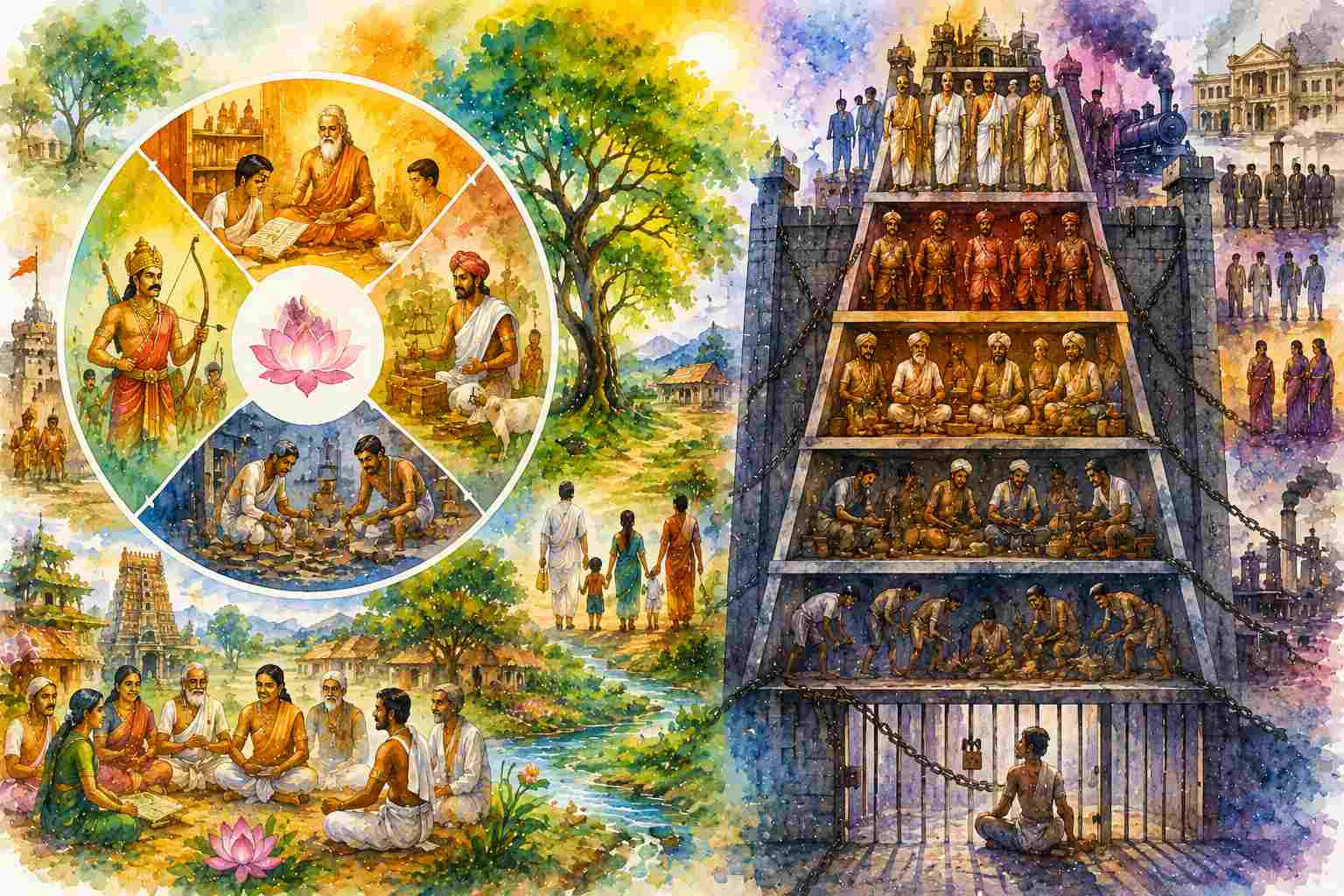
When a Sociological Category Becomes a Social Reality
There is perhaps no concept in the sociology of India that appears more self-evident than caste. Open almost any introductory textbook on Indian society and caste is likely to appear near the beginning: caste as a system of hierarchy, hereditary membership, endogamy, occupational association, purity and pollution, social distance and inequality. Students are then taught to study how caste changes under modernisation, how caste interacts with class, how caste produces political mobilisation, and how caste survives despite democracy and urbanisation.
But there is a question that should come before all of these questions:
What exactly are we calling “caste”? Is varna the same thing as jati? Is a jati the same thing as an occupation? Is an occupational community the same thing as a ritual group? Is a village hierarchy the same thing as a pan-Indian hierarchy? Is the identity recorded by a colonial census the same social identity that existed before the census officer arrived?
And perhaps the most uncomfortable question for sociology: Did the sociologist discover “caste”, or did the category through which the sociologist studied India partly create the social reality that later generations came to recognise as caste?
This does not mean that caste was invented by the British. That claim is historically indefensible. Birth-based groups, endogamous communities, occupational associations, status distinctions, forms of exclusion and hierarchical relations existed in India long before British rule. What requires examination is something more precise: colonial rule progressively gathered highly diverse forms of social organisation under one administrative and analytical category called “caste”, then made that category increasingly consequential through enumeration, law, ethnography and administration.
Nicholas Dirks makes precisely this distinction in Castes of Mind. His argument is not that the British invented every form of caste identity, but that colonial rule made “caste” into a single overarching category capable of subsuming India’s diverse social identities and organisations.
Susan Bayly similarly argues that caste was never a fixed fact of Indian life: both varna and jati were historically changing combinations of ideals and practices, shaped by regional political systems and social conditions.
That distinction should fundamentally change how sociology is taught.
The First Problem: “Caste” Is Not an Indigenous Equivalent of Jati
The word caste itself is not an Indian analytical category. It derives through European usage from the Portuguese casta, which was applied to social distinctions encountered by Europeans in South Asia. Dirks traces the emergence of the term in European descriptions of Indian society and its later consolidation through colonial knowledge practices.
But jati is a Sanskrit-derived Indic category with a much more complicated semantic history. It can refer to birth-group, kind, species, community or a group defined through common descent. It does not automatically carry the entire theoretical package that modern sociology attaches to “caste”.
And this distinction matters because once caste = jati becomes our unquestioned equation, we begin to reinterpret every jati through a theoretical structure that may have been developed elsewhere.
The result is a conceptual compression: Thousands of communities → Jati → Caste → One “Caste System”
That arrow looks innocent. It is not.
A jati could have a regional history, a particular occupation, a specific political relationship, a local deity, a marriage network, a migration history, a customary institution and a changing relationship with neighbouring groups. Another jati in another region could have an entirely different social history.
Yet the word “caste” encourages us to treat both as instances of the same system. This is where sociology can accidentally transform diversity into uniformity.
Varna Is Not the Same as Jati
Perhaps the most persistent conceptual error is treating varna and jati as interchangeable.
The classical varna framework is a fourfold normative classification—Brahmana, Kshatriya, Vaishya and Shudra—with different textual traditions elaborating its relationship to social duties and functions. The actual historical organisation of Indian society, however, involved a far larger number of jatis, occupational communities, regional groups and other social formations.
The distinction is crucial.
Varna is a classificatory/normative schema & Jati is a social formation.
The relationship between them varied historically and regionally. To treat the four varnas as if they were four giant empirical social groups and then imagine every Indian community fitting neatly underneath them is to turn a complex social world into a pyramid. And the pyramid became one of the most powerful images through which India was subsequently studied.
The Colonial State Wanted Society to Become Legible
This is where the colonial census becomes central.
The colonial state had an administrative problem: how do you govern a society whose social categories are locally variable, overlapping and difficult to standardise?
Enumeration offered an answer.
Beginning in the nineteenth century, colonial administrators increasingly attempted to classify India’s population through religious, occupational, tribal and caste categories. The British ethnographic enterprise produced handbooks and classifications of tribes and castes; Herbert Risley and William Crooke, both colonial officials, published major ethnographic handbooks in the 1890s.
This was not simply an academic exercise. To classify is to make administratively visible. Once a community receives a census category, that category can become connected with representation, recruitment, legal status, administrative policy and political mobilisation. The census therefore did not merely record society. It also participated in organising how society could be represented to the state.
And here Herbert Risley’s work becomes particularly revealing. Colonial ethnography frequently attempted to correlate caste with physical characteristics and racial classifications. The attempt to turn complex social identities into measurable anthropometric types represented an extraordinary confidence in the classificatory powers of colonial science.
But consider the methodological problem.
- Can a measuring instrument tell us what a community means to itself?
- Can a nose measurement establish the boundaries of a social identity?
- Can an occupation determine a person’s entire social location?
- Can a census category capture relationships that change from village to village?
The answer is obviously no. Yet these categories acquired authority because they were attached to the machinery of the colonial state.
The Paradox of Colonial Classification
Here lies one of the great paradoxes of colonial sociology. The British encountered a society they considered extraordinarily complex. Their solution was to simplify it. But the simplified categories then became the basis for describing India as a society that was extraordinarily rigid. The logic became almost circular:
India has caste.
Therefore Indians organise themselves through caste.
We must classify Indians according to caste.
The census reveals caste everywhere.
Therefore caste is the fundamental structure of Indian society.
And once sociology inherited these classifications, the category became even more powerful.
This is what makes Dirks’s argument important. He describes the colonial state as an “ethnographic state”, and argues that caste became increasingly central to the representation of Indian society under colonial rule. The important insight is not that British administrators invented social difference. They did not. The insight is that they transformed heterogeneous social differences into a more standardised object of knowledge. And knowledge, when attached to administration, can become power.
But Then Comes Dumont
The problem did not end with colonial administration. It entered postcolonial sociology.
The French sociologist Louis Dumont, in Homo Hierarchicus, produced perhaps the most influential theoretical interpretation of Indian caste. He placed hierarchy, particularly the opposition between purity and pollution, at the centre of his interpretation. This was an intellectually powerful intervention. It moved the study of caste beyond simply listing caste groups and attempted to identify an underlying principle of social organisation.
But it also created danger. What if the theory becomes larger than the society?
Dumont’s framework has been heavily debated because critics have argued that it privileges ritual hierarchy and risks reducing Indian social life to a single ideological principle. Later scholarship has explicitly criticised the purity-pollution model and argued for greater attention to political power, economic relations, regional variation and alternative ritual structures. but the western category was fixated on the Indian subject.
The difficulty becomes obvious when we ask a simple empirical question: Suppose a community is ritually ranked relatively low but owns most of the land in a village, controls local political institutions and possesses substantial numerical strength.
Which determines its social position? Dumont’s framework struggles to make this question central.
M. N. Srinivas did.
Srinivas: From Static Caste to Social Mobility
Srinivas’s concepts of Sanskritization and Dominant Caste represented a major ‘improvement’ because they brought movement, negotiation and local power into the study of caste. His fieldwork showed that groups could change their practices and make claims to higher status, while locally dominant groups could derive influence not simply from ritual rank but from numerical strength, landownership and political power.
This was important because it challenged the image of caste as a completely frozen hierarchy. But Srinivas’s framework also needs critical examination.
- Why should social mobility necessarily be described as Sanskritization?
- What if a community’s transformation is driven by economic change, urbanisation, migration, political mobilisation, education, military service, entrepreneurship or interaction with another community?
- Why assume that upward movement must primarily be understood as imitation of a higher-status group?
Srinivas himself broadened the concept because his research showed that groups did not always imitate Brahmins; they could emulate locally dominant groups or other cultural models. That is revealing.
It means the Indian social world was already telling the sociologist: “Your category is too narrow.”
The Jati Is Regional Before It Is National
This should become a foundational principle of a decolonised sociology of India. There is no single empirical “caste system” operating identically throughout Bharat. There are regional social orders. A community’s status can change according to geography. Its occupation can change. Its political influence can change. Its relationship with other communities can change. Its marriage networks can change. Its economic position can change. Its self-description can change. Its political identity can change. Even the meaning of a community name can change.
Susan Bayly’s historical work is particularly useful here. She emphasises that caste identities and conventions of rank were repeatedly shaped, contested and reconstituted across regions and political systems rather than simply reproduced unchanged from antiquity.
This means that a serious sociology of jati cannot begin with: “What is the caste system of India?”
It should begin with: “What forms of social organisation existed in this particular region, at this particular historical moment, and how did they relate to one another?”
That is a completely different research question.
From One Hierarchy to Multiple Axes
Perhaps the greatest conceptual mistake is imagining Indian social stratification as a single vertical ladder. Real societies are rarely organised along one axis.
Consider a hypothetical community that is:
- relatively low in ritual status,
- economically prosperous,
- numerically large,
- politically influential,
- educationally advanced,
- locally dominant,
- geographically concentrated,
- but excluded from certain ritual privileges.
Where does it sit on the “caste ladder”?
There is no single answer. It occupies different positions on different axes.
This is precisely what Srinivas’s notion of dominant caste began to expose. A group’s ritual position could differ from its economic and political power. A decolonised sociology should therefore move from:
One-dimensional hierarchy: High → Middle → Low
towards:
Multi-dimensional social location: Ritual ↔ Economic ↔ Political ↔ Occupational ↔ Educational ↔ Numerical ↔ Territorial ↔ Institutional
Now the empirical complexity of Indian society becomes visible.
What About the Indigenous Vocabulary?
The solution is not to replace “caste” with jati and declare the problem solved. That would be another simplification. We need a plural analytical vocabulary. Varna for one kind of textual classification. Jati for particular birth/community formations. Kula for lineage or kinship formations in relevant contexts. Shreni for occupational and economic organisation where historically appropriate. Sampradaya for certain religious lineages or traditions. Gotra for particular lineage categories. Biradari for community/kinship formations in later and regional contexts. Gana and sangha for particular forms of corporate or political association in appropriate historical settings. And then we need the categories of occupation, territory, ritual status, political power, economic capital, kinship, marriage, mobility and institutional authority.
Why? Because social reality is multidimensional. The word “caste” compresses too many of these into one container.
The Most Important Question: Who Is Speaking?
There is another methodological issue that sociology must confront.
When a census officer asks a person: “What is your caste?” the answer is not necessarily a transparent window into social reality.
The respondent may give:
- a traditional name,
- a Sanskritised name,
- a regional name,
- an occupational name,
- a political identity,
- a name used in official documents,
- a name intended to claim higher status,
- or a name imposed by administrative convention.
The answer is itself a social act. It can be strategic. It can be historical. It can be political. It can change. Therefore the census response is not merely data about identity. It is also evidence of identity-making.
This is one reason colonial classification could have long-term consequences. When the state repeatedly asks people to identify themselves through a particular category, that category can become increasingly salient.
The sociologist must therefore distinguish: social identity from administrative identity from political identity from analytical identity.
They are not necessarily identical.
Decolonising Sociology Does Not Mean Denying Inequality
This point is very essential to understand for analysis.
A critique of the category “caste” must not become a denial of discrimination, exclusion or inherited disadvantage. That would be intellectually dishonest. India has experienced real forms of social exclusion, untouchability, unequal access, status discrimination and violence. (and it is also important to understand that we Indians also have solution with us, not needing others to meddle into our things). These are legitimate objects of sociological inquiry.
But precisely because these problems are real, we need better categories, not weaker ones. If the only analytical category available is “caste system”, then every form of inequality is interpreted through the same framework.
- What if a contemporary inequality is primarily economic?
- What if it is political?
- What if it is regional?
- What if it emerges from urban labour markets?
- What if it is educational?
- What if it is generated by migration?
- What if caste identity has become a political coalition rather than a ritual hierarchy?
- What if the same jati experiences completely different forms of power in two different states?
The sociologist must be able to distinguish these. Otherwise the category begins explaining everything—and a category that explains everything risks explaining nothing.
The Decolonised Sociological Method
A better sociology of Indian social organisation would therefore proceed differently.
- Instead of beginning with caste, begin with social organisation.
- Instead of assuming hierarchy, investigate relationships.
- Instead of assuming fixed identity, study identity formation.
- Instead of treating jati as pan-Indian, study regional histories.
- Instead of treating census categories as transparent facts, study classification itself.
- Instead of studying only ritual rank, examine ritual, economic, political, territorial and institutional power simultaneously.
- Instead of assuming that communities merely occupy positions, examine how they make claims about those positions.
- Instead of treating tradition as static, study mobility, negotiation and adaptation.
And instead of asking: “Why has caste survived modernity?”
ask: “How have different forms of social organisation transformed under changes in economy, polity, technology, law, migration and education?”
That is a much more genuinely sociological question.
From Caste to Jati: A Change in the Question
| Conventional Sociology | Decolonised Sociology |
|---|---|
| Caste system | Forms of social organisation |
| Pan-Indian caste hierarchy | Regional social orders |
| Caste as fixed identity | Identity as negotiated and changing |
| Varna = caste | Varna ≠ automatically jati |
| Ritual hierarchy | Multiple dimensions of status and power |
| Census category as data | Census category as an object of study |
| Caste as inherited structure | Community + institution + history |
| Modernity weakens caste | Modernity transforms social identities |
| Sanskritization as primary mobility | Multiple forms of mobility and identity |
| Caste explains Indian society | Social organisation must be empirically investigated |
The intellectual movement is therefore not: Caste → Jati
as though one word can simply replace another.
It is: Caste → Question the category → Recover plurality → Study Jati historically → Compare regional institutions → Analyse changing social organisation.
That is the real decolonising move.
The Final Question for Sociology
Perhaps the most consequential mistake in the sociology of India was not that Western scholars noticed social hierarchy. They were right to notice it. The mistake was allowing one analytical category to become the presumed architecture of an entire civilization. Colonial ethnography simplified social diversity. The census stabilised classifications. Administrative categories acquired political consequences. Later sociology inherited the vocabulary.
Some Indian sociologists challenged it from within through fieldwork and concepts such as Sanskritization and dominant caste. Yet the word “caste” remains so powerful that it often precedes the empirical investigation itself. That is precisely what a decolonised sociology must reverse. We should not begin by asking: “Where does this group fit within the caste system?”
We should begin by asking: “Who are these people? How do they organise themselves? Whom do they marry? What work do they perform? What institutions do they create? What histories do they remember? What status do they claim? Who recognises that claim? What economic and political resources do they possess? How has their position changed? And what happens when they move from one region to another?”
Only then can we begin to understand jati.
And perhaps that is the deeper lesson.
India did not have one social system waiting to be discovered by sociology. It had—and continues to have—many social formations that must be studied in their own historical contexts.
The task of decolonising sociology is therefore not to erase caste from the curriculum. It is to stop caste from becoming the curriculum’s unquestioned starting point. Because when a sociological category becomes the lens through which every social fact is interpreted, eventually the category begins to look like the reality itself.
The task now is to turn the lens around.
And ask: Did we discover Indian society—or did our categories teach us what to see?
