
The Story Before the Theory
Before a kingdom went to war, could the king’s decision be subjected to a form of guidance that lay outside the throne?
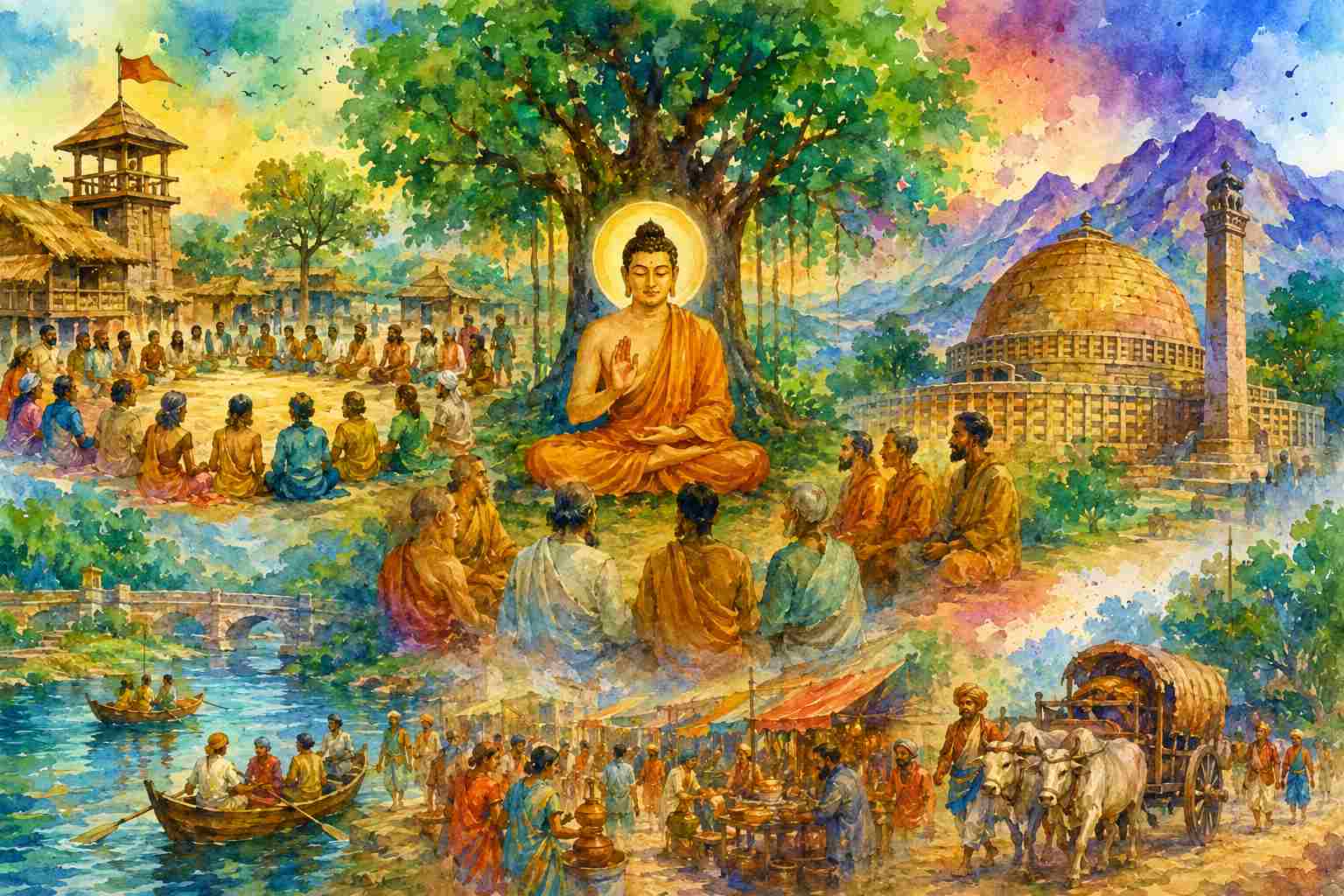
The Mahāparinibbāna Sutta preserves one of the most remarkable episodes in the political history of ancient Bharat. King Ajātasattu of Magadha intended to attack the Vajjians. He sent his chief minister, the Brahmin Vassakāra, to the Buddha. The minister conveyed the king’s intention clearly: Ajātasattu desired to attack the powerful Vajji confederacy and bring about its destruction.
The text does not say that Ajātasattu was formally asking the Buddha’s permission to wage war. We should not force such a claim onto the source. But the fact remains politically significant: before this major political action, the king’s chief minister went to a figure who possessed neither the throne nor the army.
And the Buddha’s response was even more significant.
He did not discuss the Vajji army. He did not advise Ajātasattu on strategy. He did not calculate the cost of war. He turned instead to Ānanda and began asking questions.
- Did the Vajjians assemble frequently?
- Did they meet, conduct their affairs and disperse in harmony?
- Did they preserve their established practices rather than arbitrarily overturning them?
- Did they respect their elders?
- Did they protect women and girls from abduction and violence?
- Did they honour their sacred places and preserve their established offerings?
- Did they protect worthy spiritual persons so that such people could come to their territory and live there in peace?
Ānanda confirmed that the Vajjians maintained these conditions. The Buddha’s conclusion was clear: as long as they continued to uphold them, their growth could be expected rather than their decline. Vassakāra immediately understood the political implication. He responded that if the Vajjians maintained even one such condition, they could expect prosperity; maintaining all seven made them extremely difficult to defeat. The text records his conclusion that they could not be overcome by Magadha in battle except through means such as treachery and the creation of discord.
This story is not merely about Buddhism and peace. It reveals a deeper Indic political idea: political power was not always treated as the only authority capable of interpreting political action.
Power Meets a Cultural Order
Why is this important? When one political community encounters another, the relationship is never shaped by culture alone. Power is present.
A stronger kingdom may conquer a weaker community. A powerful culture may absorb a smaller one. Groups may exchange practices and create new forms of coexistence. One may borrow from another. One may impose itself upon another. The weaker community may gradually become alienated from its own memory.
These are precisely the movements we describe through the Cultural Spectrum: assimilation, acculturation, appropriation, alienation and fragmentation.
But the crucial question is often ignored: who manages this encounter when power itself becomes the strongest force in the relationship?
If the king alone determines the answer, cultural difference can become merely a political problem. A people become subjects, territory becomes a resource and conquest becomes a sufficient justification for itself. The Indic civilizational tradition developed a different possibility. Political power could be confronted by an authority located outside political office.
The King Had Power, but Not the Final Word
The Buddha was not Ajātasattu’s minister. He was not a military commander. He was not the ruler of Vajji. Yet Vassakāra stood before him before the planned attack, and the political conversation had to pass through a different kind of authority.
The significance lies here.
The king possessed Kshatra. But knowledge, Dharma and civilizational judgment were not necessarily monopolised by Kshatra.
The same broad pattern can be seen throughout the Indic political imagination in the relationship between Raja and Rishi. The Rishi did not always govern, but neither was he simply a private religious figure whose concerns ended where politics began. The king could exercise power, yet his action remained open to a larger field of questioning.
- What will this action produce?
- Will it preserve order or destroy it?
- What holds a political community together?
- What makes a people difficult to defeat?
The Buddha answered the political question of war by examining the internal cultural conditions of Vajji. This is what makes the episode extraordinary.
Culture Is Not Decoration
The seven conditions are sometimes read simply as moral instructions. But together they reveal something larger.
Regular assemblies create participation and communication. Harmony in collective affairs creates the capacity to act together. Continuity in established practices prevents arbitrary institutional rupture. Respect for elders preserves intergenerational memory. Protection of women safeguards social order. Sacred sites preserve collective memory. The protection of worthy spiritual persons ensures that the community remains connected to its intellectual and ethical foundations.
None of these is a military weapon. Yet together they make a political community stronger.
This is the central lesson: culture is not merely what a society celebrates after it has secured political power. Culture may itself be one of the conditions through which collective political strength is produced.
The Vajjians could be strong because they were able to remain a collective.
And that is why Vassakāra understood that direct military power alone would not solve Magadha’s problem. A united community is not defeated in the same way as a fragmented one. Break the internal mechanisms of unity, however, and the political problem changes.
The battlefield may come later. The first vulnerability can begin much earlier.
The Rishi as a Civilizational Check
This brings us to a larger Indic idea of political restraint.
Modern political systems usually imagine checks and balances through institutions within the state: executive power checked by legislatures, courts, constitutions or other institutions. The Indic world certainly had its own institutional arrangements, but it also preserved another possibility: the autonomy of non-political sources of authority.
The Rishi, Acharya or Shramana did not need to possess an office within the state to influence the larger civilizational imagination within which political power operated. This should not be romanticised. Ancient Indian kings were not always restrained, and no civilization is free from conquest or conflict. Nor should we claim that every ruler was required to seek permission from a sage before going to war.
The argument is more precise.
The Indic political imagination did not necessarily assume that the king’s autonomy was absolute.
There were domains of knowledge, Dharma and civilizational authority that could stand outside the throne. A ruler could command an army, but he could still be asked a question he had not asked himself. That distinction matters enormously when cultural differences are involved.
Managing Difference Without Erasing It
Every civilization faces a dilemma. Should a larger culture absorb every smaller culture into itself? Or should every cultural difference remain permanently isolated?
Both extremes are unstable.
Total assimilation can become domination. Permanent separation can become fragmentation.
The challenge is to create a larger civilizational field capable of allowing interaction, exchange and transformation without demanding the complete disappearance of difference. This is where the Cultural Spectrum becomes essential.
Cultural interaction can move in many directions. Assimilation may occur without coercion or through it. Acculturation may produce genuine exchange. Appropriation may extract from a culture without respecting its context. Alienation can disconnect a community from its own cultural foundations. Fragmentation can follow when shared institutions and practices collapse.
The Indic question was therefore not simply, “Who is different?”
The deeper question was: “How can difference be managed without allowing power alone to determine the outcome?”
The independent moral and intellectual authority of the Rishi tradition offered one important civilizational restraint. It could introduce questions that immediate political power had no reason to ask.
Before the Sword
The story of Ajātasattu, Vassakāra and the Buddha therefore offers more than an ancient lesson in political consultation. It reveals a civilizational possibility. Before the sword, there could be a question. Before conquest, there could be an examination of consequences. Before political power determined the future of another community, there could be a voice outside the political structure capable of asking what held that community together.
Perhaps this is one of the deeper strengths of the Indic civilizational tradition: it did not place every form of authority inside the state.
The king could rule, but the civilization was larger than the king. And this may be especially important in understanding the Cultural Spectrum. When cultures meet, they do not meet in a vacuum. They meet through unequal power, competing interests, memory, fear and political ambition. Without a civilizational mechanism capable of questioning power, the spectrum can easily move towards domination and alienation.
The Buddha’s response to Vassakāra offers a different lesson. He did not begin by asking who possessed the stronger army. He asked what allowed a people to remain a people.
Perhaps the first conquest does not occur on the battlefield. It occurs when the institutions, memories and practices that hold a community together have already been broken.
