
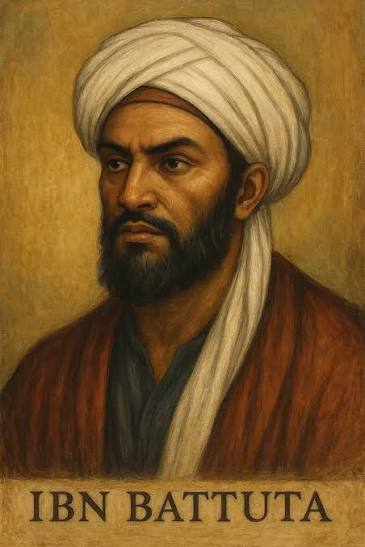
A Moroccan Jurist Inside the Delhi Sultanate
Ibn Battuta occupies a distinctive position among foreign observers of medieval Bharat because he did not merely travel through the country. He entered the political world of the Delhi Sultanate, served as a qāḍī under Sultan Muhammad bin Tughluq, travelled through different regions of the subcontinent and became an eyewitness to one of the most complex political orders of fourteenth-century India. Born in Tangier in 1304, he began his travels in 1325 and eventually crossed North Africa, West Asia, Central Asia, India, the Indian Ocean, Southeast Asia and China. His Indian journey began around 1333 and produced one of the most detailed external accounts of the Delhi Sultanate.
Unlike many earlier travellers, Ibn Battuta was both an observer and a participant. He did not simply watch the institutions of the Sultanate from outside; he became part of them. He received royal patronage, interacted with the Sultan, served as a judge and was eventually associated with a diplomatic mission towards China. This proximity gave his account remarkable detail, although it also requires us to read him critically because his observations were shaped by court politics, personal experience and his own position within the Sultanate.
Major Work
Riḥlat Ibn Baṭṭūṭa — The Travels of Ibn Battuta
Ibn Battuta’s great work is generally known as the Riḥla, formally titled Tuḥfat al-Nuẓẓār fī Gharāʾib al-Amṣār wa ʿAjāʾib al-Asfār, often translated as A Gift to Those Who Contemplate the Wonders of Cities and the Marvels of Travelling. After returning to Morocco, Ibn Battuta dictated his experiences to the scholar Ibn Juzayy, and the work was completed around 1355–1356. Its Indian sections remain among the most important surviving accounts of the Delhi Sultanate under Muhammad bin Tughluq.
The work is especially important because Ibn Battuta records not only rulers and battles but cities, roads, postal networks, courts, markets, agriculture, ports, religious communities and everyday life. His account allows us to see how a fourteenth-century Indian political world appeared to a foreign jurist who entered its institutions from within.
1. Delhi Was an Enormous Urban World
Ibn Battuta’s description of Delhi immediately emphasises its scale. He writes:
“The city of Dehli covers a wide area and has a large population.”
He also describes its defences, declaring:
“The rampart round the city is without parallel.”
According to his account, Delhi contained numerous gates, markets, grain stores, orchards, religious spaces and cemeteries. He records twenty-eight gates and describes a city capable of sustaining extensive movement of people, soldiers and horses.
The importance of this observation is that Ibn Battuta did not describe Delhi merely as a Sultan’s residence. He encountered a vast urban organism. Its political centre depended upon markets, food systems, military infrastructure, transport, labour and administration. A city of such scale could not exist through royal power alone; it required an entire network of institutions.
2. The Postal System Impressed Him Deeply
One of Ibn Battuta’s most important observations concerns communication. He writes:
“In India the post is of two kinds.”
One was a horse-post, while the other was a foot-post known as the dāwa. He was particularly impressed by the latter:
“This foot-post is quicker than the horse-post.”
He describes stations positioned at regular intervals and records that the system carried messages, goods and even water and fruit over considerable distances.
This is a crucial observation because it reveals a dimension of state capacity often ignored in conventional political history. A ruler could only govern a vast territory if information could move. The postal network connected the political centre with distant regions and allowed administration to function across space. Ibn Battuta therefore gives us not simply a description of a medieval communication system but evidence of the infrastructure behind political authority.
3. Muhammad bin Tughluq: Generosity and Terror
Perhaps the most striking feature of Ibn Battuta’s Indian account is his description of Muhammad bin Tughluq. The Sultan appears as a ruler of enormous generosity and equally enormous violence. Ibn Battuta writes:
“The Sultan is extremely generous, and is fond of giving presents.”
Yet he also states:
“The Sultan was far too free in shedding blood.”
He describes royal patronage alongside executions, punishments and the arbitrary violence of court politics.
This contradiction is historically important. Ibn Battuta’s Sultan was neither simply a patron of learning nor merely a tyrant. He could reward scholars and terrify nobles; distribute wealth and impose brutal punishments. The Riḥla therefore reveals the internal contradictions of political power more effectively than a simple classification of rulers as “good” or “bad” ever could.
4. The Forced Movement from Delhi to Daulatabad
Ibn Battuta’s most dramatic account concerns Muhammad bin Tughluq’s attempt to move the population from Delhi towards Daulatabad. He writes:
“He decided to ruin Delhi.”
He then describes the consequences in dramatic language:
“All the inhabitants of Dehli came out leaving behind their property and baggage, and the city was reduced to a desert.”
He further records that the Sultan could look out and see neither:
“fire, smoke nor lamps in the city.”
However, this is precisely where Ibn Battuta must be read critically. Modern historical evidence, including inscriptions from the period, indicates that Delhi was not literally emptied in the absolute manner suggested by his narrative. The passage remains historically important, but it cannot simply be treated as a modern demographic report.
5. The Agricultural Abundance of India
Ibn Battuta’s account repeatedly moves beyond the court towards the agricultural world that sustained cities and political institutions. He observed varied crops and productive landscapes, including regions where cultivation could occur repeatedly during the year. Wheat, rice, cotton, oilseeds and other crops formed part of the larger agricultural economy he encountered.
This is important because Ibn Battuta’s India was not merely an India of Sultans and courts. Delhi’s military, markets and political institutions depended upon agricultural production. Cities required food. Ports required goods from the interior. Armies required supply networks. His observations therefore reveal the connection between ecology, agriculture and political power.
6. The Bazaar Was an Economic and Social Institution
Ibn Battuta’s descriptions of Indian cities reveal the vitality of the bazaar. Markets contained food, textiles, animals, luxury goods, merchants, craftsmen and people from different regions.
The bazaar, therefore, cannot be understood merely as a place where commodities were exchanged. It was also a place where strangers met, information circulated and communities interacted. Economic exchange was inseparable from social and cultural exchange. The market connected people just as roads and ports connected places.
7. India Was Part of the Indian Ocean World
Ibn Battuta’s travels through Malabar and other coastal regions reveal another India beyond Delhi. He encountered major ports and travelled through the Maldives, Sri Lanka, Bengal and further into the wider Indian Ocean world. Ships connected the subcontinent with the Persian Gulf, Arabia, Southeast Asia and China.
This is one of the most important insights of the Riḥla. The Indian coast was not a peripheral edge of civilization. It was one of Bharat’s major points of connection with the wider world. Merchants, scholars, pilgrims, sailors, commodities and ideas crossed these maritime routes, and Ibn Battuta himself became part of that movement.
8. The Traveller Became a Participant
What makes Ibn Battuta fundamentally different from many foreign observers is that he became part of the political world he described. He became a qāḍī in Delhi, interacted directly with the Sultan, received gifts, participated in court life and travelled under royal protection.
This gives his account unusual immediacy. He could describe political power not simply as something seen from outside but as something experienced personally. Yet the same proximity creates a methodological challenge. The closer a traveller is to power, the more information he may gain, but the more deeply his observations may also be shaped by his own fortunes and political position.
9. The Human Being Behind the Traveller
At the beginning of his Riḥla, Ibn Battuta describes leaving Tangier as a young man. He writes:
“I set out alone, having neither fellow-traveller … nor caravan whose party I might join.”
And then:
“I forsook my home as birds forsake their nests.”
This passage is important because it reminds us that historical sources are produced by human beings. Ibn Battuta was not born as the legendary traveller we now remember. He began as a young man leaving his home, travelling through unfamiliar worlds, entering courts, surviving political danger and eventually returning after decades of movement.
10. What Ibn Battuta Allows Us to See
Taken together, the Riḥla reveals a complex fourteenth-century Bharat. It gives us Delhi as a vast city, a sophisticated postal system, agricultural abundance, active bazaars, major ports and a political order connected to the wider Afro-Eurasian world.
It also reveals contradiction. Ibn Battuta saw institutional sophistication and arbitrary violence, royal generosity and political terror, mobility and hierarchy, wealth and coercion. His account is therefore valuable precisely because it does not produce a neat or uncomplicated picture of medieval India.
Read Ibn Battuta Critically
The Riḥla contains eyewitness observation, hearsay, court information, anecdotes and marvels. Its final form was also shaped by Ibn Juzayy, who compiled Ibn Battuta’s dictated narrative after his return to Morocco. The correct question is therefore not simply: “Is Ibn Battuta reliable?” Historical sources are rarely so simple. The better questions are: What did he personally witness? What did he hear? What did his position allow him to see? What was shaped by literary convention? What do other sources confirm or contradict?
That is particularly important in cases such as his account of Delhi’s evacuation, where his dramatic narrative must be compared with inscriptional evidence.
Why Ibn Battuta Matters
Ibn Battuta matters because he provides something rare: the account of a foreign traveller who entered the machinery of one of medieval India’s most powerful political systems. He allows us to see the relationship between law, administration, communication, agriculture, markets, ports, religion and political authority.
A Moroccan jurist could travel to Delhi, become a judge, move through the Deccan and Malabar, cross the Indian Ocean and eventually continue towards China. His journey itself demonstrates that fourteenth-century Bharat was deeply connected to wider networks of movement.
Ibn Battuta should therefore be remembered not merely as a man who travelled through India. He should be read as a traveller who entered the institutions of the Delhi Sultanate and left behind an extraordinary record of how power, people, cities, communication and everyday life interacted inside medieval Bharat.
The standard English edition is H. A. R. Gibb’s Travels in Asia and Africa, 1325–1354, while the fuller scholarly translation of the Riḥla was published by the Hakluyt Society.
