A Chinese Scholar’s Journey into the Intellectual Life of Seventh-Century Bharat
In 671 CE, a Chinese Buddhist monk named Yijing left China with a very particular purpose. He wanted to go to India to learn. He was not travelling simply to see the places associated with the Buddha, nor was his principal purpose to describe foreign kingdoms. He wanted texts, teachers, languages and knowledge. His journey eventually lasted about twenty-five years. He travelled through the maritime world of Southeast Asia, spent time in Śrīvijaya, reached India, studied Sanskrit and Buddhist literature, spent years in the great monastic centres of the subcontinent and finally returned to China in 695 CE with manuscripts and the knowledge required to translate them. The work he later produced, A Record of the Buddhist Religion as Practised in India and the Malay Archipelago, is therefore unusual among early accounts of India. It is less interested in monuments than in the discipline through which knowledge was transmitted.
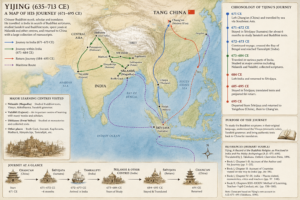
The historical setting is important. Yijing lived during the Tang period, when Buddhist intellectual exchange connected China with India and the wider maritime world. His route itself tells us something about this network. Before reaching India, he spent time in Śrīvijaya, and after his Indian studies he returned there before going back to China. The movement was therefore not simply China–India–China. Southeast Asia was part of the same intellectual geography. The surviving 1896 edition preserves a map of his route and describes his travels between 671 and 695 CE.
This is one reason Yijing deserves attention in Indic Cultural and Social Studies. His account allows us to ask a question that is larger than whether ancient India possessed famous centres of learning. How did learning actually happen? What did a student have to know before he could read a difficult text? What was expected of him? What was the relationship between teacher and student? How were large communities of scholars fed and housed? How did manuscripts move from one civilization to another? What happened to knowledge when a student crossed the sea to acquire it?
Yijing gives us fragments of answers to all of these questions.
The Student Had to Learn the Language Before Entering the Knowledge
One of the most revealing passages occurs when Yijing discusses students from China who wished to study in India. His advice is strikingly practical:
“learn these grammatical works”
and he warns that otherwise they would merely “waste their labor.”
The point is not simply that Sanskrit grammar was difficult. Yijing understood that the language itself was part of the intellectual discipline. He recommends the study of grammatical works associated with the Indian tradition, including Pāṇinian grammar, before proceeding to more advanced subjects. He also stresses memorisation and sustained study.
This tells us something that modern discussions of Indian knowledge often overlook. We sometimes imagine that knowledge exists independently of the language in which it is expressed and that translation simply transfers it from one linguistic container into another. Yijing’s experience suggests otherwise. If a Chinese student wanted to understand the Indian śāstras, he first had to acquire the linguistic tools through which those texts made sense.
This was not an insignificant preliminary exercise. Sanskrit grammatical traditions had developed their own technical vocabulary and methods of analysis. The student therefore had to enter an intellectual system before he could fully participate in its literature. Yijing’s advice is especially revealing because he himself was a foreign learner. He knew from experience that translation could not substitute entirely for learning.
That should make us cautious when we speak today about “studying Indian knowledge” without asking how much of the original conceptual structure survives translation.
Learning Was Not a Short Visit to a Famous Institution
Yijing’s description of Nālandā is often remembered because of its scale. He writes that the monastery had more than three thousand monks and describes eight halls and three hundred apartments.
Those figures are important, but their real significance lies elsewhere.
A community of that size could not exist simply because a ruler decided to build a large monastery. It required food, water, accommodation, teachers, students, rules, property, land and a system of administration. The institution had to reproduce itself year after year.
The 1896 edition is revealing precisely because its contents move between subjects that modern historians tend to place in different categories. Yijing discusses food, water, clothing, bathing, exercise, medicine, ordination, sleeping and resting, teacher–pupil relations and the management of monastic life.
What appears at first to be a collection of mundane details is therefore historically important. Yijing is showing us that intellectual life existed inside an organised social environment. The student needed somewhere to sleep, something to eat, clean water, medical care and a teacher. The manuscript needed someone to preserve and transmit it. The institution needed resources. We tend to remember the philosophical text and forget the social world that allowed the text to survive.
Yijing does not allow us to forget it.
The Discipline of Learning
Yijing’s description of study is particularly interesting because it does not present learning as the accumulation of information alone. He describes the student as acquiring new knowledge while continually returning to what has already been learned. In his words, the student:
“acquires new knowledge day by day”
The sentence is simple, but the educational principle behind it is not.
Learning involves both acquisition and revisiting. New knowledge does not simply replace old knowledge. The student returns to earlier material, deepens it and brings it into relationship with what he has learned subsequently.
This is particularly interesting when placed beside the Indian traditions of svādhyāya, recitation and memorisation. We should be careful not to collapse Yijing’s Buddhist institutional experience into every form of Indian education, but his description gives us a historical example of an educational culture in which repetition was not considered the opposite of intellectual development. It was part of the process by which knowledge became internalised.
The student was expected to work. That seems obvious, but it is actually one of the most important things Yijing tells us. Knowledge was not treated as something that could be acquired merely by possessing a book. It required time, discipline and repeated engagement.
The Teacher and the Student
Yijing also devotes a separate section to the behaviour between teacher and pupil.
That detail is historically significant. If education were merely a transfer of information, there would be little reason for the relationship between teacher and student to require such detailed regulation. But in the world Yijing describes, education was embedded in a relationship.
The teacher was not simply an instructor standing outside the student’s life. The student entered an institutional and ethical relationship with the teacher. Conduct, respect, discipline and responsibility were part of the process through which learning occurred. This also helps us understand why the category of ācārya has such importance across Indian intellectual traditions. The teacher does not merely possess information. The teacher represents a tradition, interprets it and transmits it through a living relationship.
The text may survive in manuscript form, but the tradition survives through people. Yijing’s account makes that distinction visible.
Nālandā Was Part of a Larger Geography of Learning
It would be easy to read Yijing and imagine that all serious learning was concentrated at Nālandā. His account does not support such a simple picture. He also refers to Valabhī as an important centre of learning and describes the movement of students between centres.
This matters because it changes our understanding of the geography of Indian knowledge.
The intellectual world was not organised around one institution. Students could travel. Teachers had reputations that extended beyond their immediate locality. Different centres developed different specialisations and intellectual communities.
The political geography of the period and the intellectual geography of the period were therefore not identical.
This is particularly important for the study of Bharat because later histories often search for a single “centre” of Indian civilisation. Yijing instead gives us glimpses of a network of centres. Nālandā was important, but it existed within a wider world of institutions, teachers and travelling students.
The idea of a polycentric knowledge tradition is therefore not merely a modern theoretical construction. Yijing’s travels give us historical evidence for it.
The Sea Was Also a Route of Knowledge
Yijing’s stay in Śrīvijaya is equally important. Before reaching India, he spent time there learning Sanskrit and Buddhist traditions. After his Indian studies he again returned to Śrīvijaya, where he continued his work before eventually going back to China.
This gives us a very different picture of the relationship between India and Southeast Asia.
Knowledge did not move only along overland routes. The maritime world was also an intellectual space. Monks, merchants, manuscripts and ideas travelled through the same broad networks.
Yijing’s own life demonstrates this. He was a Chinese scholar who learned in a Southeast Asian centre, travelled to India, studied there, returned to Southeast Asia and eventually carried texts and knowledge back to China.
The intellectual geography of seventh-century Asia was therefore much larger than the territory of any individual kingdom.
And India was not isolated within that network. It was one of its major intellectual centres.
Why Does Yijing Talk About Food, Water and Bathing?
This may actually be the most interesting part of his work.
The surviving edition contains discussions of pure and impure food, cleansing after meals, storing water, inspecting water for insects, tooth-wood, clothing, bathing, sleeping, exercise, medicine and illness.
A modern reader might skip these passages in search of something more intellectually impressive. We should do the opposite.
These details allow us to see the everyday life behind the intellectual institution.
A monastery does not survive because of philosophical debate alone. People have to eat. Water has to be stored and used. Illness has to be treated. Clothing has to be maintained. Sleeping arrangements have to be organised. Common property has to be regulated. Yijing’s account therefore tells us something about the material foundations of learning. This is where history becomes more interesting than nostalgia. It is easy to say that Nālandā was a great centre of knowledge. It is harder, and much more useful, to ask what social arrangements made such knowledge possible.
Yijing helps us begin asking that question.
Knowledge Was International, But It Was Not Placeless
There is a paradox at the heart of Yijing’s journey. The knowledge he sought was international in its circulation, but learning itself remained deeply rooted in particular cultural and institutional practices.
A Chinese student could travel thousands of kilometres to study Indian Buddhism. But once he arrived, he had to learn Sanskrit. He had to study Indian grammar. He had to follow the discipline of the institution. He had to learn from teachers. He had to adapt to practices that were not necessarily familiar to him.
Knowledge could travel. But understanding required participation.
This is an important distinction for contemporary civilizational studies. Global circulation does not mean that knowledge becomes independent of the civilization from which it emerged. A concept carries its history with it. A technical term carries distinctions that may disappear when translated. A text carries assumptions about authority, method and evidence that may not be obvious to an outside reader.
Yijing discovered this not as a theory but as a student.
We Should Not Turn Yijing into a Propaganda Witness
There is also a danger in reading such sources too enthusiastically.
Because Yijing describes a sophisticated world of learning, we might be tempted to use him simply to prove that ancient India had a great educational system. That would actually diminish the historical value of his testimony.
Yijing was primarily interested in Buddhist monastic life. His account therefore does not represent the whole of Indian society. He was observing particular institutions and communities and writing for readers in another intellectual world.
His numbers also need historical criticism. Different travellers give different figures for Nālandā, and premodern numerical descriptions cannot automatically be treated as modern statistical records. But none of this makes the source useless.
It tells us how to read it.
We should ask what Yijing could actually see, what his interests were, what communities gave him information, which practices he describes directly and which he records as rules or prescriptions. We should compare his account with Xuanzang, with Buddhist Vinaya literature, with archaeological evidence and, where possible, with Indian textual sources.
That is how a civilizational source should be read. Not as a certificate. Not as a condemnation. Not as a piece of propaganda. As evidence.
What Yijing Allows Us to See
The importance of Yijing lies ultimately in the scale at which he observes Indian intellectual life. He does not give us only the great institution or the famous teacher. He allows us to move from the institution to the student, from the student to the teacher, from the teacher to the text and from the text to the routines that allowed the institution to survive.
His account contains grammar because the student needed language. It contains teacher–pupil conduct because learning depended upon relationships. It contains food and medicine because scholars were embodied human beings. It contains property and institutional rules because knowledge required material support. It contains Nālandā and Valabhī because learning had a geography. It contains Śrīvijaya and the journey to China because knowledge travelled across political and cultural boundaries.
This is why Yijing is so valuable for Indic Cultural and Social Studies.
He does not merely tell us that India had knowledge.
He gives us glimpses of the social world in which knowledge was learned, practised, transmitted and preserved.
And that is a much harder question.
We can recover a manuscript from an excavation. We can translate a Sanskrit text. We can identify a famous scholar. But if we want to understand a civilization’s knowledge tradition, we must also ask how students learned those texts, how teachers transmitted them, how institutions survived, how resources were organised and how knowledge travelled beyond the place where it was first produced.
Yijing’s journey from China through Śrīvijaya to India and back again is itself an answer to part of that question. He crossed seas because knowledge mattered enough to travel for. He learned another language because translation alone was insufficient. He lived within institutions because intellectual knowledge required discipline. And he returned with texts because the purpose of the journey was not simply to see India but to carry learning across civilizations.
Perhaps, then, the most useful way to remember Yijing is not simply as the Chinese monk who visited Nālandā.
He was a student who crossed civilizations in order to learn.
And his record leaves us with a question that remains relevant to anyone attempting to study Indic knowledge today: when we say that we are recovering an Indian knowledge tradition, are we merely recovering its surviving texts, or are we also trying to understand the languages, teachers, disciplines, institutions and social practices that once made those texts a living tradition?
Yijing’s account suggests that the second task is considerably more difficult.
It is also where the real history begins.
