
The Idea of Bharat: Geography, Culture and Civilizational Unity
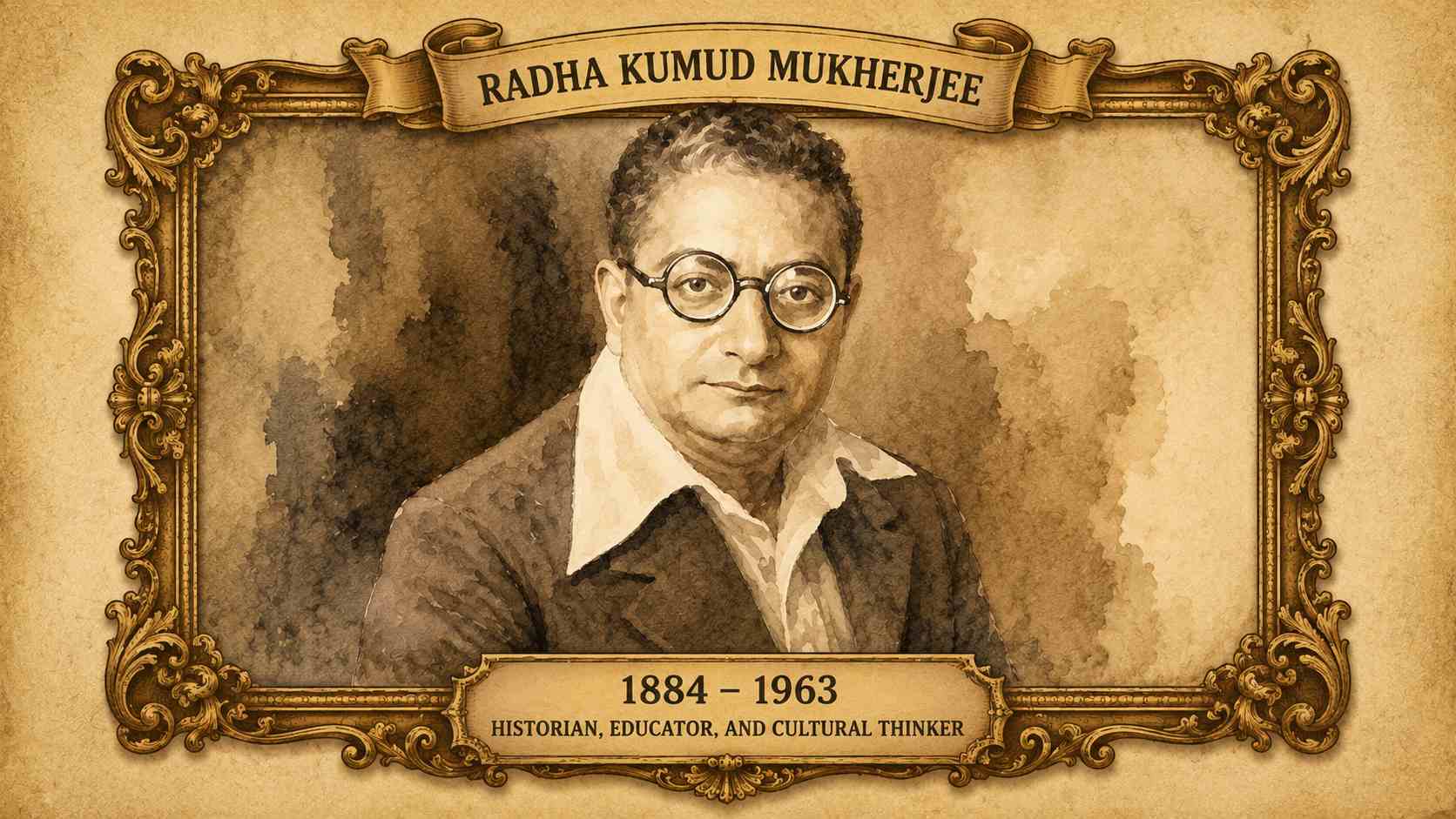
A Short Biography
Radhakumud Mukherjee, often rendered as Radhakumud Mookerji, was one of the major historians of early twentieth-century India whose scholarship sought to reconstruct Indian history through indigenous literary traditions, inscriptions, archaeology and other historical evidence. Born in 1884, he taught history at several institutions, including the University of Calcutta and the University of Lucknow, and was associated with the development of historical scholarship in Bengal and northern India. He belonged to a generation of Indian scholars who were writing history at a time when colonial interpretations frequently questioned the existence of a meaningful political or cultural unity in India. His response was not simply to write nationalist history, but to investigate the historical institutions and cultural processes through which that unity could be understood.
Mukherjee wrote extensively on Indian political institutions, local government, education, maritime activity, Ashoka, Hindu civilisation, pilgrimage and the geographical consciousness of India. Among his major works are The Fundamental Unity of India, Local Government in Ancient India, Ancient Indian Education, Indian Shipping, Indian Shipping and Maritime Activity, The History of Indian Shipping, Asoka, and Nationalism in Hindu Culture. His work is particularly valuable for Civilizational Studies because he did not treat India merely as a political territory; he attempted to understand the institutions, networks and cultural practices through which a larger sense of India developed across historical periods.
Major Works
- The Fundamental Unity of India from Hindu Sources (1914)
- Local Government in Ancient India (1919)
- Ancient Indian Education: Brahmanical and Buddhist (1919)
- Nationalism in Hindu Culture (1921)
- Indian Shipping: A History of the Seaborne Trade and Maritime Activity of the Indians (1912)
- Indian Shipping and Maritime Activity / related studies on India’s maritime history
- Asoka (1928)
- The Culture and Art of India
- Studies on Indian political institutions, society and cultural history.
Some Important Insights
“Beneath the manifold diversity of physical and social type, language, custom and religion … there can still be discerned a certain ‘underlying uniformity of life from the Himalayas to Cape Comorin.’”
— Radhakumud Mookerji, The Fundamental Unity of India, p. 12.
This sentence captures the central problem that occupied much of Mukherjee’s civilizational thinking: how should we understand unity in a civilization that is visibly diverse? His argument was not that India lacked differences; rather, the question was whether beneath those differences there existed deeper cultural relationships that connected its regions and communities.
This is important for an Indic approach because unity need not mean uniformity. A civilization may contain different languages, customs, sects, regions and political systems while still possessing a wider cultural grammar through which these differences become intelligible as parts of a larger whole. Mukherjee’s work therefore invites us to study the relationships that create civilizational unity rather than searching only for political centralisation.
“The institution of pilgrimage is undeniably a most powerful instrument for developing the geographical sense in the people which enables them to think and feel that India is not a mere congeries of geographical fragments, but a single, though immense, organism, filled with the tide of one strong pulsating life from end to end.”
— Radhakumud Mookerji, Nationalism in Hindu Culture, chapter “The Hindu Institution of Pilgrimage,” p. 39.
This is one of Mukherjee’s most useful insights for Civilizational Analytics. He does not treat pilgrimage merely as a religious practice; he asks what social and geographical work it performs. When people travel repeatedly between distant sacred places, they do more than worship—they encounter other regions, communities, languages and traditions, while simultaneously developing an awareness that these geographically distant places belong to a shared cultural landscape.
In this sense, pilgrimage becomes a civilizational network. This is precisely the sort of question that distinguishes Civilizational Studies from a narrow history of religion: What happens to a civilization when millions of ordinary people repeatedly move through the same sacred geography across generations?
“A common fatherland is preliminary to all national development.”
— Radhakumud Mookerji, Nationalism in Hindu Culture, chapter “Pilgrimage as Fostering Patriotism,” p. 49.
Mukherjee’s argument here is particularly relevant to the question of how territorial consciousness develops. For him, geography is not simply physical space; over time, it becomes filled with associations, memories, traditions, sacred places, literature and collective experience. Territory becomes homeland through the meanings attached to it. This allows us to make an important distinction between geographical territory and civilizational geography. A map tells us where places are. A civilization tells us why particular places matter.
The Village and the State
Mukherjee’s Local Government in Ancient India provides another important dimension to his thought. His study examined village communities, guilds, corporations, local administration, municipal functions, judicial arrangements and institutions of collective life, drawing upon literary, inscriptional and legal sources.
One of the striking formulations in the work is:
“India presents the rare and remarkable phenomenon of the State and the society co-existing apart from, and in some degree of independence of each other.”
— Radhakumud Mookerji, Local Government in Ancient India, Introduction.
This is extremely significant for your Centre’s framework because it allows us to question the assumption that society is simply an extension of the state. Mukherjee’s argument was that Indian society possessed institutions of collective life that had their own structures and functions, including village communities, guilds and other corporations, and that these institutions could maintain significant elements of social organisation even when political regimes changed. His study therefore directs attention towards the institutional life below the state, something that becomes central to any serious study of civilizational continuity.
The point is not to romanticise the village as a perfectly autonomous “little republic”—an image inherited partly from colonial administrators and subsequently debated by historians—but to ask a more productive question: what institutional capacities existed within Indian society outside the immediate machinery of the state?
Civilization and Maritime Activity
Mukherjee also challenged another narrow image of ancient India: that India was primarily an inward-looking land civilization with little significant maritime activity.
His extensive studies of Indian shipping examined India’s maritime trade, shipbuilding, ports and commercial connections with regions beyond the subcontinent. His scholarship sought to demonstrate that Indian communities participated actively in maritime networks and that the sea was not necessarily a civilizational boundary separating India from the wider world.
This is important because civilizational geography should not be confused with geographical isolation.
A civilization can possess a strong sense of place and still be deeply connected to the wider world.
Indeed, this gives us another useful research question: how did India’s civilizational identity interact with trade, migration, cultural exchange and maritime networks? Mukherjee’s maritime studies provide an important starting point for that inquiry.
Reading Mukherjee
Mukherjee was writing during the nationalist period, and his scholarship sometimes consciously responded to colonial interpretations of Indian history. His emphasis on India’s cultural unity and historical achievements can therefore occasionally lead towards a celebratory interpretation, and contemporary researchers should learn from him the formulation of Indian unity as a historical event.
In fact, it makes him particularly valuable for researchers.
His work forces us to ask questions that remain central to Civilizational Studies: How does geographical diversity become civilizational unity? How do people develop a sense of shared homeland? How do pilgrimage and cultural networks connect distant regions? How do local institutions coexist with political authority? How does a civilization remain connected to the wider world without losing its sense of place?
Perhaps Mukherjee’s most enduring contribution is that he teaches us to look for unity not necessarily in political uniformity, but in relationships—between geography and memory, pilgrimage and identity, village and state, education and culture, trade and civilization, local institutions and wider collective life.
That makes him especially relevant to an Indic approach to Civilizational Studies. The question he leaves us with is not simply “Was India united?” It is much more interesting: How did people across such an enormous and diverse land come to experience it as one civilizational space?
