Making Vedic Knowledge a Living Intellectual Practice
A Short Biography
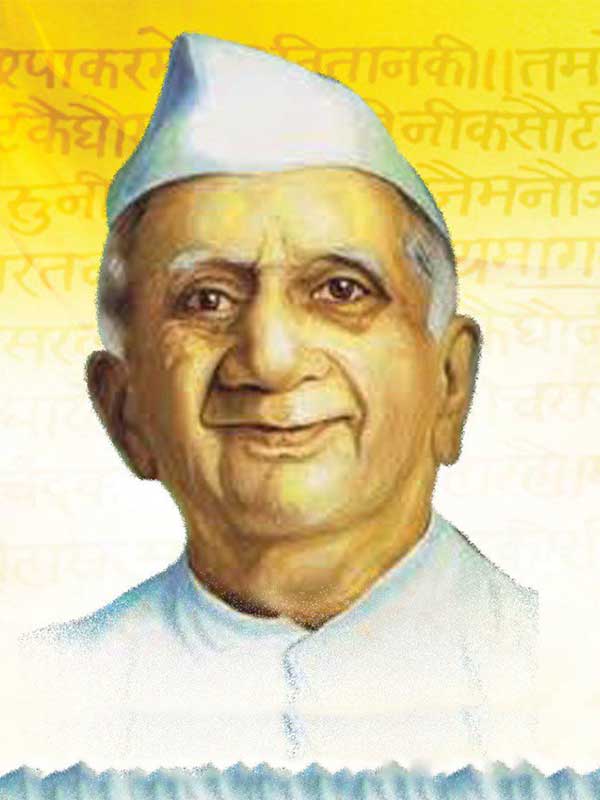
Pandit Shripad Damodar Satwalekar was one of the remarkable polymaths of modern Bharat whose life moved across seemingly different worlds—painting, Sanskrit, Vedic scholarship, Yoga, Ayurveda, education, social work and public life—without treating them as isolated pursuits. Born in 1867 in the Sawantwadi region of Maharashtra, he trained in art at the Sir J. J. School of Art in Bombay and began his career as a painter, eventually establishing himself in Lahore and Hyderabad, but his intellectual interests increasingly turned towards Sanskrit and the Vedic corpus. His engagement with Vedic study eventually became the central work of his life, and in 1918 he established the Swadhyay Mandal, a Vedic research institution at Pardi in Gujarat, through which he worked for decades to make Vedic literature accessible to wider audiences.
Satwalekar’s importance lies not simply in the enormous quantity of material he produced, but in his conviction that Vedic learning should not remain the preserve of a small circle of specialists. He edited and interpreted the Vedas, wrote extensively on Sanskrit and Yoga, translated and commented upon the Mahabharata and Bhagavad Gita, produced Sanskrit Swayam Shikshak for self-directed learning, and published journals including Vedic Dharma and Purushartha. His writings reportedly extended to hundreds of books and tens of thousands of pages of manuscripts, while his Vedic commentaries became among his most important intellectual contributions.
His life also demonstrates that Vedic scholarship, in his understanding, was not meant to be separated from social practice. He worked on public education, village institutions, handloom and spinning, Panchayati Raj, Yoga and public health, while also participating in the intellectual and political life of his time. He received the Padma Bhushan in 1968, shortly before his death at the age of one hundred.
Major Works
Among his extensive body of writings are:
- Ṛgveda kā Subodha Bhāṣya
- Yajurveda kā Subodha Bhāṣya
- Atharvaveda kā Subodha Bhāṣya
- Sāmaveda kā Subodha Anuvāda
- Vaidika Dharma
- Vaidika Svarājya kī Mahimā
- Vaidika Yajña Saṃsthā
- Puruṣārtha-Bodhinī Bhāṣā-Ṭīkā on the Bhagavad Gītā
- Mahābhārata kī Samālocanā
- Saṃskṛta Svayaṃśikṣaka
- Veda Paricaya
- Vaidika Vyākhyāna-Mālā
- writings on Yoga, Ayurveda and Vedic social thought.
Some Important Insights
“नाम के अक्षरों का जपना, उसके अर्थ का मनन करना, इस अर्थ-भाव को ध्यान में धारण करना, इसको जीवन में ढालना, तदनुरूप जीवन में कर्म करना और तदनुसार होने वाला जीवन अपना स्वाभाविक जीवन बनाना।”
Satwalekar describes japa not simply as repetition of a name, but as a movement from word to meaning, meaning to contemplation, contemplation to conduct, and conduct to a transformed way of living. This passage is recorded in his writings and reproduced by Hindwi under his quotations.
This is particularly interesting from the perspective of Indic Cultural and Social Studies because it captures something larger than a religious practice: knowledge, for Satwalekar, becomes meaningful when it enters life. The distance between knowing an idea and living an idea is therefore not a minor pedagogical issue; it is central to his understanding of intellectual and personal development.
One of Satwalekar’s recurring concerns was the accessibility of Sanskrit and Vedic learning. His Sanskrit Swayam Shikshak was deliberately constructed as a self-learning text, beginning with basic vocabulary and grammar and gradually taking the learner towards more advanced Sanskrit. His introductory instructions repeatedly warn the student against rushing ahead without properly understanding the earlier lessons, emphasising patient and systematic study.
This is perhaps one of the most practical aspects of Satwalekar’s intellectual legacy. He did not merely ask people to “respect Sanskrit”; he attempted to build a pathway through which an ordinary learner could begin studying it. His Sanskrit Swayam Shikshak subsequently became widely used as a self-learning resource and was also taken up by educational institutions.
Veda as Study, Not Merely Inheritance
Satwalekar’s establishment of the Swadhyay Mandal is perhaps more significant than any single book. The very idea of svādhyāya—systematic self-study—became central to the institution’s work, and the Mandal functioned as a space for Vedic research, publication, Sanskrit learning and intellectual dissemination. His extensive commentaries on the four Vedas were an attempt to make the corpus accessible through Hindi and other Indian languages rather than leaving it locked within specialised Sanskrit scholarship.
His intellectual project therefore raises an important question for contemporary knowledge systems: what happens when a civilization’s foundational texts become objects of reverence but cease to become objects of study? Satwalekar’s answer was not to complain about the loss of knowledge, but to build institutions, write commentaries, teach Sanskrit and create learning materials through which study could actually take place.
Why Satwalekar Matters for Indic Cultural and Social Studies
Satwalekar is important to the Centre not merely because he wrote extensively on the Vedas, but because his life represents a particular model of knowledge as civilizational practice. He moved from art to Vedic scholarship, from scholarship to education, from education to social work, and from textual study to institutions that could sustain further study. His approach suggests that the recovery of Indic knowledge cannot be accomplished simply by collecting old texts; it requires learners, teachers, institutions, languages, methods of interpretation and a willingness to make knowledge part of lived intellectual life.
There is also an important methodological lesson here. Satwalekar should be read as a twentieth-century interpreter of the Vedic corpus, not simply as though his interpretations were identical with the Vedic texts themselves. His commentaries represent a particular intellectual tradition and historical moment, and researchers should therefore distinguish carefully between the primary source and Satwalekar’s interpretation of that source. That distinction does not diminish his importance; it makes his work more valuable for serious scholarship because it allows us to study both the Vedic text and the modern Indian intellectual attempt to recover it.
Perhaps Satwalekar’s greatest relevance today lies in this question: Can a civilization recover its intellectual traditions without turning them into museum pieces? His answer, expressed through a lifetime of scholarship and institution-building, was remarkably practical: study them, learn their language, interpret them, teach them, debate them, and allow them to enter life.
That is why Satwalekar belongs in the intellectual conversation of Indic Cultural and Social Studies.
