Power, Representation and the Making of the “Other”
When a culture is described, who gets to decide what that culture means? This appears to be a question of description, but Cultural Studies has taught us that representation is never entirely innocent. To represent is also to select, classify, frame and give meaning. The person who describes a community decides, consciously or otherwise, what becomes visible and what remains invisible.
Modern Cultural Studies has itself developed through a critique of this problem. Edward Said demonstrated how Orientalist knowledge produced representations of the “East” through a Western intellectual and political framework; Stuart Hall placed representation at the centre of cultural power, arguing that meaning is constructed through systems of language and representation; and Gayatri Spivak famously asked whether the subaltern can speak when the institutions through which speech becomes authoritative are themselves structured by power. These interventions are indispensable. Yet there is an irony worth confronting: even our critique of representation is frequently taught through Western categories, Western intellectual histories and Western examples.
So we arrive at a peculiar situation. We teach students to question the colonial gaze—but often teach them the history of that gaze almost entirely through Western theorists.
That itself requires decolonisation.
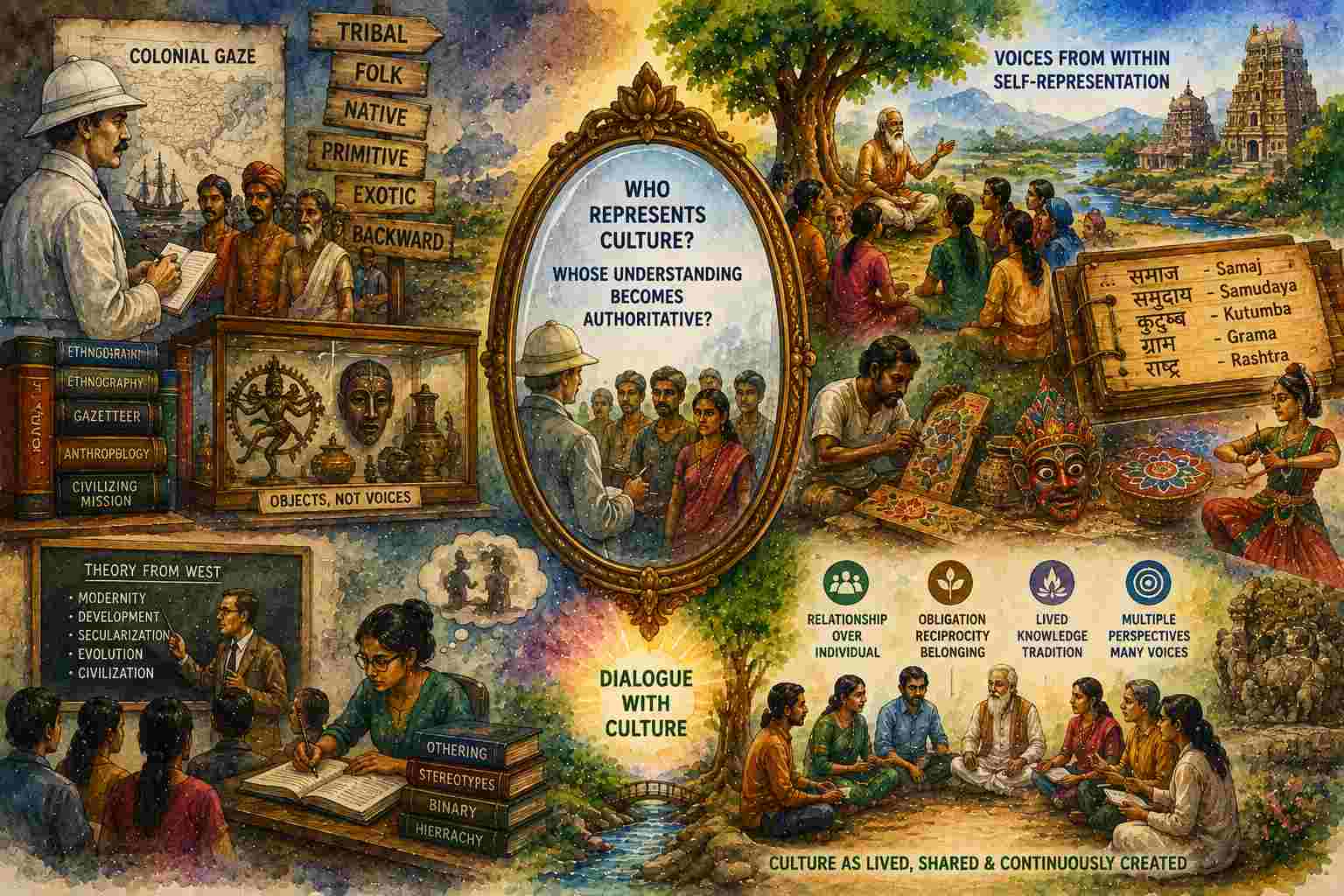
The colonial encounter did not merely govern territories. It produced knowledge about the people being governed. Colonial ethnography classified populations as “tribes”, “castes”, “natives”, “criminal tribes”, “civilized” and “primitive”; museums separated objects from the communities that produced them; administrative reports converted living traditions into descriptions; and anthropology frequently positioned the European observer as the knowing subject and the colonised community as the object of knowledge.
The problem was not simply that some descriptions were inaccurate. The deeper problem was who possessed the authority to define reality.
Once a community was described as “primitive”, its own explanation of itself could easily be dismissed as folklore. Once a tradition was classified as “religion”, its philosophical reasoning could disappear behind ritual description. Once a community became “tribal”, its political institutions, ecological knowledge and historical agency could be reduced to ethnographic characteristics.
The category became more powerful than the people it supposedly described.
The Western Curriculum and the Problem of the “Other”
Much of Cultural Studies is organised around concepts such as self/other, representation, discourse, hegemony, identity, power and gaze. These are useful analytical tools. But the curriculum can inadvertently reproduce the very binary it teaches students to criticise.
The Western intellectual tradition becomes the theory. The non-Western society becomes the case study.
Europe produces concepts. Bharat provides examples. Africa becomes a site of fieldwork. Asia becomes an object of representation.
The question is rarely asked: what if the society being studied possesses its own conceptual categories through which it understands itself? This is where an Indic approach can contribute something deeper than simply “adding Indian culture” to the syllabus.
From Representation to Self-Understanding
Indic civilization possesses long traditions of self-description. Itihasa, Purana, Kavya, Smriti, Sthala-Purana, temple traditions, oral traditions, philosophical darshanas, regional chronicles, genealogies, artistic traditions and parampara all contain ways through which communities have remembered, interpreted and transmitted themselves.
These sources should not be treated as automatically objective descriptions. They contain memory, interpretation, mythology, normative claims and political purposes. But neither should they be dismissed merely because they do not resemble the modern ethnographic monograph.
That is the methodological point.
If a community has produced its own categories of identity, history, sacred geography, social order and memory, those categories are themselves primary cultural data.
Why should the sociologist begin by translating them immediately into Western categories? If Dharma becomes “religion”, something disappears. If parampara becomes “tradition”, something disappears. If darshana becomes merely “philosophy”, something disappears. If samaj becomes simply “society”, something disappears. If shastra becomes merely “text”, something disappears.
Translation is necessary for comparative scholarship—but translation should not become conceptual replacement.
Representation vs Dialogue
| Conventional cultural study | Indic/decolonised possibility |
|---|---|
| Researcher studies community | Researcher enters a dialogue with community |
| Culture as object | Culture as lived knowledge |
| External categories first | Indigenous categories first, then comparison |
| Observer vs observed | Researcher as situated participant |
| Representation | Self-representation + interpretation |
| Tradition as data | Tradition as knowledge system |
| Community described | Community voices and internal categories examined |
| Museum preserves culture | Community remains an active cultural agent |
This does not mean that “insiders” automatically possess the only correct interpretation. That would create another methodological problem. Communities contain disagreement, hierarchy and competing interpretations. A researcher may sometimes see patterns that participants do not consciously recognise. But the opposite assumption is equally problematic: that the academic observer automatically understands the culture better than the people who inhabit it.
The correct answer is therefore not insider versus outsider. It is dialogue between perspectives.
Who Has the Right to Name?
The most powerful form of representation may be naming.
- Who decided that one group is “tribal”?
- Who decided that another is “folk”?
- Who decided that a practice is “superstition” rather than a knowledge tradition?
- Who decided that one form of knowledge is “scientific” while another is “indigenous knowledge”?
- Who decided that an institution is “traditional” simply because it predates European modernity?
These are not merely linguistic questions.
Names organise reality.
Colonial knowledge often operated through precisely this process of classification. Contemporary scholarship on colonial India has demonstrated how ethnographic and administrative categories did not simply describe social identities but interacted with the institutions of colonial governance and helped reshape how those identities became legible. The work of scholars such as Bernard Cohn and Nicholas Dirks is particularly important here.
The challenge for Cultural Studies is therefore to study not only culture, but also the production of knowledge about culture.
The Indic Question
An Indic Cultural Studies curriculum should therefore add another layer to the familiar questions of representation.
Not only: Who represents whom?
But: How does a civilization represent itself?
Not only: Who has the power to speak?
But: What institutions transmit that speech across generations?
Not only: How does the West represent the East?
But: How have Bharatiya communities represented themselves to themselves?
Not only: What has colonialism done to cultural identity?
But: What survived, adapted, transformed and regenerated despite colonial classification?
This changes the student’s position completely.
Bharat is no longer merely an object waiting to be interpreted through Said, Foucault, Bhabha or Hall. Those thinkers remain important—but now they become comparative interlocutors rather than intellectual gatekeepers. And this is the real meaning of decolonising Cultural Studies. It is not to stop studying Western theories. It is to stop assuming that theory must always come from the West and culture must always come from somewhere else.
The community can produce concepts. The tradition can produce theory. The practitioner can produce knowledge. The text can be an argument, not merely an artifact. The oral tradition can be an archive. And the people being studied can be subjects of knowledge rather than merely objects of representation.
Perhaps, then, the most important question in Cultural Studies is not: “How is culture represented?”
It is: “Who has the authority to decide what counts as an adequate representation of culture?”
And once we ask that question, the classroom itself becomes part of the inquiry.
- Who selected the categories we use to study culture?
- Who wrote the textbooks?
- Whose concepts became universal?
- Whose concepts became “local”?
That is where Cultural Studies becomes genuinely decolonial—not when the West disappears from the syllabus, but when no civilization is allowed to monopolise the right to explain everyone else.
