Beyond Customs, Festivals and Folklore
What do we mean when we say “culture”? In much of the Cultural Studies curriculum, the answer has become surprisingly complicated. Students are taught that culture is not simply language, food, dress, festivals, art or customs, but a system through which meaning is produced. They encounter concepts such as discourse, power, representation, identity, hegemony, gender, race, class, othering, resistance and deconstruction. Thinkers such as Stuart Hall, Raymond Williams, Michel Foucault, Edward Said and Pierre Bourdieu have enormously expanded the study of culture. The problem is not that these ideas are irrelevant. The problem is what happens when critique becomes the primary purpose of cultural understanding.
A student can gradually learn to look at almost every cultural practice as a manifestation of power: a festival becomes an instrument of social control, a family becomes a site of patriarchy, tradition becomes inherited domination, religion becomes discourse, identity becomes construction, language becomes power, and social norms become mechanisms of oppression. At some point an important distinction disappears: the difference between understanding a culture critically and assuming that the culture must be criticised.
This is one of the problems that a decolonised Cultural Studies curriculum must confront.
Modern Cultural Studies emerged partly as a reaction against the older idea that culture was simply “high culture”—great literature, classical art, philosophy and refined taste. Raymond Williams’s famous formulation that culture is “ordinary” opened the field towards everyday life, popular culture and lived experience. Stuart Hall further demonstrated how cultural meanings are produced through representation and power. These were important intellectual developments because they taught students to look beyond monuments and texts towards the structures through which meaning is created.
But the curriculum sometimes moved from “culture contains power” to “culture is fundamentally about power.”
That is a significant shift.
If students are trained primarily through this lens, they can become exceptionally good at asking, Who benefits? Who is excluded? Who has power? Who is represented? Who is silenced? These are valuable questions. But where are the equally important questions: What does this practice mean to the people who live it? What does it preserve? What relationships does it create? What knowledge does it transmit? Why has it survived? What does the community itself consider valuable?
Without these questions, criticism becomes easier than understanding.
The problem becomes particularly serious when postmodernist assumptions enter the curriculum without sufficient intellectual balance. The idea that truth, identity and knowledge are always constructed through language and power can be a useful corrective to naïve objectivity. But if students begin to believe that every claim to truth is merely a claim to power, then the capacity to distinguish between a justified criticism and ideological suspicion begins to weaken. If every tradition is treated as a “narrative”, every institution as a “discourse”, and every value as socially constructed, students may become sceptical of inherited knowledge without necessarily developing the intellectual tools required to evaluate what should replace it.
That is not critical thinking.
Critical thinking requires the ability to criticise one’s own criticism.
This is where the Indic perspective can offer something different. Indian intellectual traditions have never lacked debate. Darshana itself means a way of seeing, and the classical traditions developed elaborate methods of argument, inference, debate and refutation. Purva-paksha requires understanding an opposing position before responding to it. The purpose is not to destroy tradition through suspicion; it is to understand, examine and establish what is valid.
This creates a different pedagogical possibility. Instead of teaching a student to ask only whether a cultural practice reproduces power, we can teach the student to examine it through several questions: What is its meaning? What is its history? What function does it perform? What values does it transmit? Who participates in it? Who does not? Has it changed? What criticisms have emerged from within the tradition itself? What should be preserved, what should be reformed, and on what grounds?
This is a much richer Cultural Studies.
It also prevents another common mistake: treating culture as internally uniform. There is no single “Indian culture” that every Indian experiences identically. There are regional, linguistic, occupational, philosophical, religious and historical variations. But acknowledging diversity does not require abandoning the possibility of civilizational continuity. A culture can contain disagreement and still possess a memory, vocabulary and shared civilizational framework.
The modern curriculum sometimes creates another false choice: tradition versus agency. Tradition is portrayed as something imposed upon individuals, while resistance becomes the principal evidence of freedom. But human beings also exercise agency by choosing to inherit. A young person learning classical music, observing a festival, speaking a mother tongue, practising yoga or participating in a family ritual is not necessarily an unconscious victim of tradition. They may be actively interpreting and renewing it.
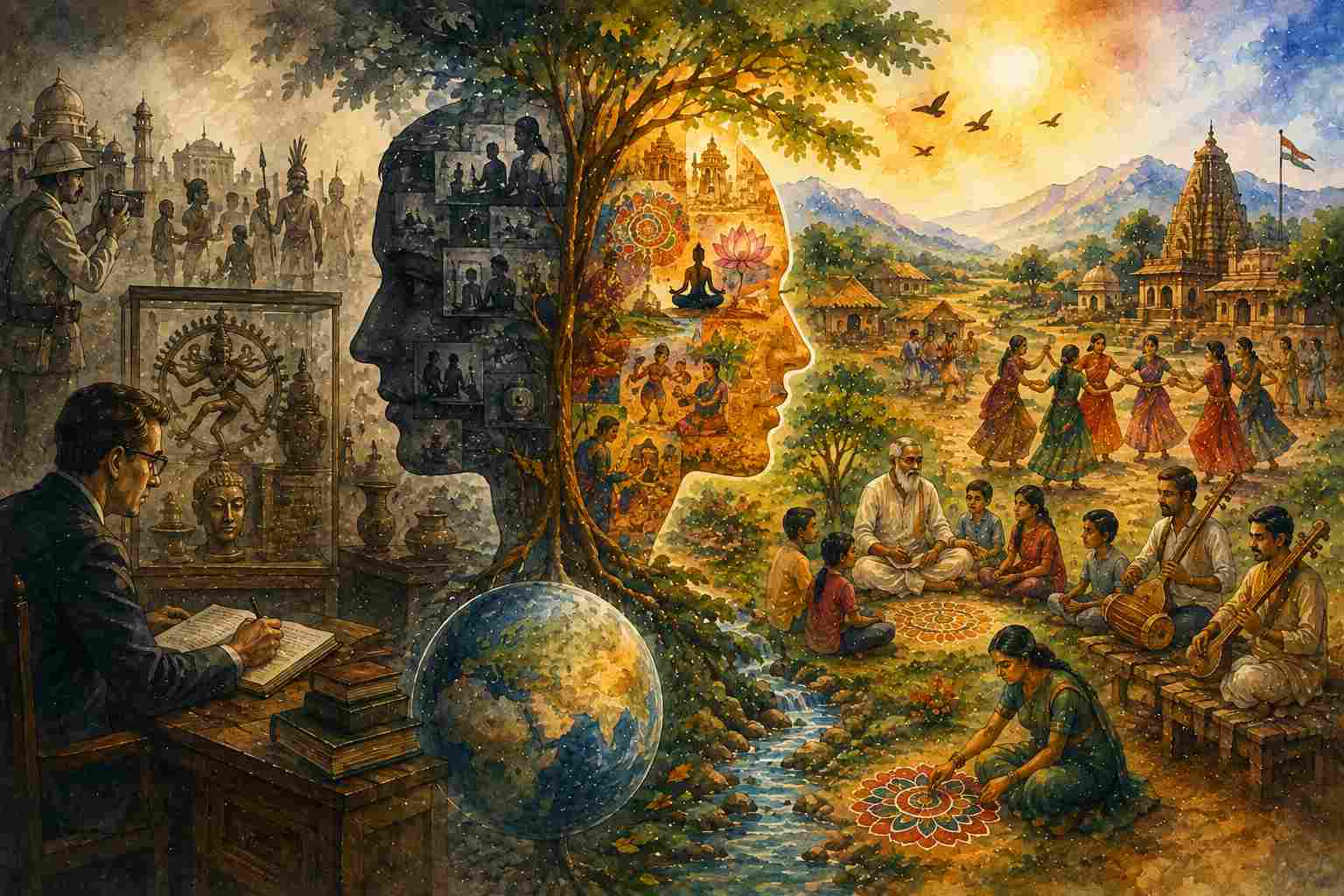
Culture, therefore, is neither a museum nor merely a battlefield.
It is a living process of inheritance, interpretation, participation and transformation.
This is where Cultural Studies in Bharat needs a methodological correction. Students should certainly learn Said, Hall, Foucault and postmodern critiques. But they should also encounter parampara, dharma, achara, samaj, rasa, darshana and lokachara as analytical concepts rather than merely as cultural objects. They should study how communities understand themselves, not only how external theorists have represented them.
The objective should not be to produce students who blindly defend tradition. Nor should it be to produce students who reflexively distrust it.
The objective should be to produce students capable of understanding before judging.
Perhaps the central question of Cultural Studies should therefore be reframed: Is culture merely something we should learn to deconstruct, or is it also something we must learn to understand from within?
A genuinely decolonised Cultural Studies would retain critique but restore discernment.
Because a generation trained only to ask “Where is the power?” may eventually learn to see power everywhere—but fail to see meaning, belonging, beauty, continuity, responsibility and knowledge. And that would be a strange failure for a discipline whose subject is culture itself.
