
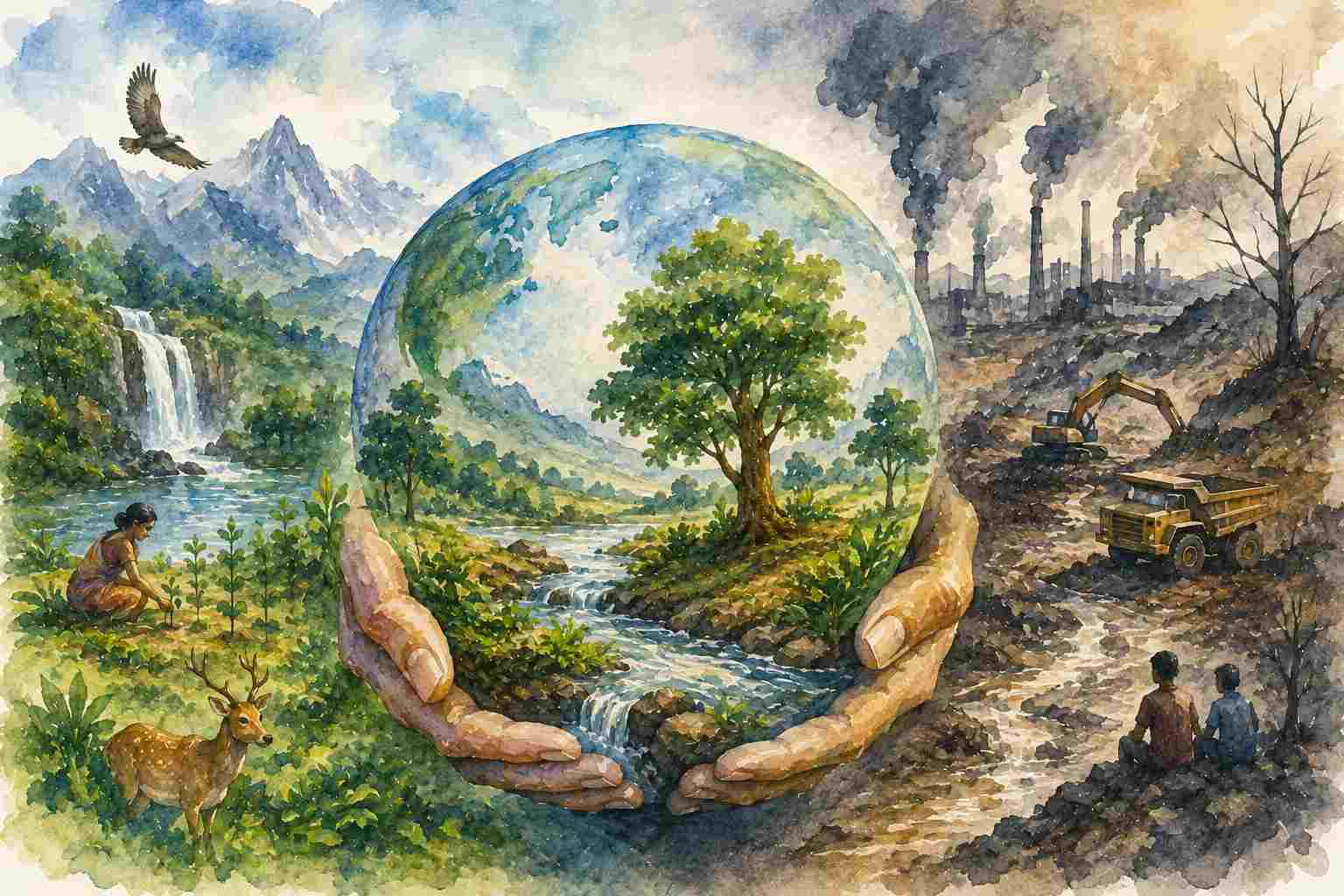
From Extraction to Ecological Responsibility
Environmental Studies usually introduces resources through a seemingly simple classification. Natural resources are renewable or non-renewable, actual or potential, biotic or abiotic. Land, water, forests, minerals and energy are identified, measured and then discussed in terms of availability, distribution, utilisation and conservation. This framework appears entirely reasonable, but it contains an assumption that is rarely examined: that nature becomes intellectually meaningful primarily when it becomes useful to human beings. A forest becomes a forest resource, a river becomes a water resource, land becomes a land resource and mineral deposits become natural wealth. The language itself does not necessarily cause ecological destruction, but it shapes the way the student learns to see the natural world. Nature appears first as something available for human use; responsibility enters the discussion later as a limitation upon that use.
This sequence deserves to be reversed.
The problem with the idea of a resource is not that human beings use nature. No society can exist without transforming its surroundings. Agriculture changes ecosystems, settlements alter landscapes and every economy depends upon material and biological processes. The real problem emerges when the usefulness of something becomes the principal basis on which its value is understood. A forest then becomes timber, minerals, medicinal plants, carbon storage and economic potential. Each of these descriptions may be correct, yet together they can still miss what a forest actually is: a complex system of soil, water, vegetation, microorganisms, animals, climate and human relationships. Modern education often divides this whole into separate categories because categories make administration and measurement easier. But ecosystems do not function as separate departmental units. Water policy cannot be entirely separated from forests, agriculture cannot be separated from soil health, and urban development cannot be separated from the wider ecological systems upon which a city depends.
The curriculum therefore faces a deeper conceptual problem. It often teaches the environment as something that surrounds human society rather than as the larger ecological field within which human society itself exists. There is “human development” on one side and “the environment” on the other. The task of policy then becomes balancing the two. But this distinction is already misleading. Human development does not occur outside ecological systems. Food production depends upon soil and water; cities depend upon watersheds beyond their boundaries; industries depend upon minerals and energy; public health depends upon air, water and biological systems. The human being is not an external manager attempting to balance society against nature. Human society is itself one part of a larger ecological relationship.
This is why the modern idea of resource management can become inadequate. It asks how efficiently a resource can be used, but efficiency does not necessarily answer the question of ecological continuity. A society may become more efficient at extracting groundwater while simultaneously depleting the aquifer on which it depends. A mining operation may reduce waste per tonne while expanding the total area under extraction. Agriculture may produce greater yields while steadily weakening the soil’s capacity to produce in the future. The language of efficiency can therefore create an illusion of responsibility while leaving the fundamental relationship untouched.
Perhaps the first question should not be, “How much of this resource do we possess?” but “What system produces the conditions that make this resource available to us?”
This is where the curriculum requires a more ecological understanding of resources. Water is not simply an object stored in a reservoir or pumped from the ground. Its availability depends upon rainfall, vegetation, soil absorption, wetlands, drainage systems, groundwater recharge and patterns of human use. If we protect the quantity of water while destroying the systems that replenish it, we have not managed the resource sustainably; we have merely consumed its accumulated inheritance. The same principle applies to forests, fisheries, soils and even minerals. The object of policy cannot simply be the material that is extracted. It must include the wider system within which that material exists.
This shift also brings the question of power into the study of resources. Something becomes economically significant as a resource when a particular society possesses the knowledge and technology to use it. New technologies can therefore continuously convert previously untouched parts of nature into objects of extraction. The deeper human problem is not only scarcity. It is also the expanding capacity to discover new things that can be taken.
Who decides what is worth extracting?
Who decides what is worth extracting? Who receives its benefits? Who bears the costs? Who is displaced when a forest is converted into a mine or a river into an industrial resource? Environmental Studies often discusses these questions separately under environmental justice or sustainable development, but they should be central to the concept of a resource itself. A resource is never merely a thing found in nature. It exists within a social and political relationship involving knowledge, technology, law, ownership and power.
An Indic approach can contribute here, not by claiming that ancient societies never exploited nature, but by bringing dependence and restraint back into the conceptual centre. The idea of parigraha, and particularly the critique of excessive possession developed in several Indic traditions, raises a question that modern resource economics often postpones: how much is enough? Modern systems are remarkably capable of asking how resources can be allocated, priced and extracted. They are much less comfortable asking whether the scale of possession itself should be limited.
This question becomes even more important when resources are treated as inheritance. The soil being depleted today was not created by the present generation. Groundwater accumulated through processes that preceded modern industry. Forest ecosystems developed across periods far longer than any economic plan. Yet contemporary societies can legally convert these long-term ecological inheritances into short-term economic gains. Ownership may give the present generation authority over a resource, but does it give the present generation the moral right to exhaust what it did not create?
This is where the distinction between use, exploitation, stewardship and regeneration becomes important. Use means drawing from nature to sustain life. Exploitation begins when extraction ignores the wider conditions that make renewal possible. Stewardship introduces responsibility, while regeneration goes further by asking whether human activity can restore the ecological capacity of the system itself. These are not interchangeable ideas, and the curriculum should teach students to recognise the difference.
A more serious Environmental Studies curriculum would therefore begin by questioning its own vocabulary. Before students classify resources, they should ask how and why nature has been classified as a resource. Before discussing conservation, they should understand what is being conserved and for whom. Before celebrating efficiency, they should examine whether efficiency is reducing pressure on nature or merely enabling greater total consumption. Before speaking of ownership, they should examine dependence.
The central ecological question then changes. Nature is no longer imagined primarily as something humanity possesses and must manage wisely. It is understood as the network of systems upon which human civilisation depends but which human civilisation did not create.
That does not make human beings passive. We must cultivate, build, innovate and produce. But we must do so with the recognition that our technological capacity to use the Earth has grown far faster than our intellectual capacity to understand the consequences of treating every part of it as usable.
Perhaps that is the most important lesson hidden behind the simple word “resource.” The Earth does not become important because we have discovered a use for it. Rather, our very ability to discover, extract and use depends upon ecological systems that were already sustaining life long before human beings learned to call them resources.
