
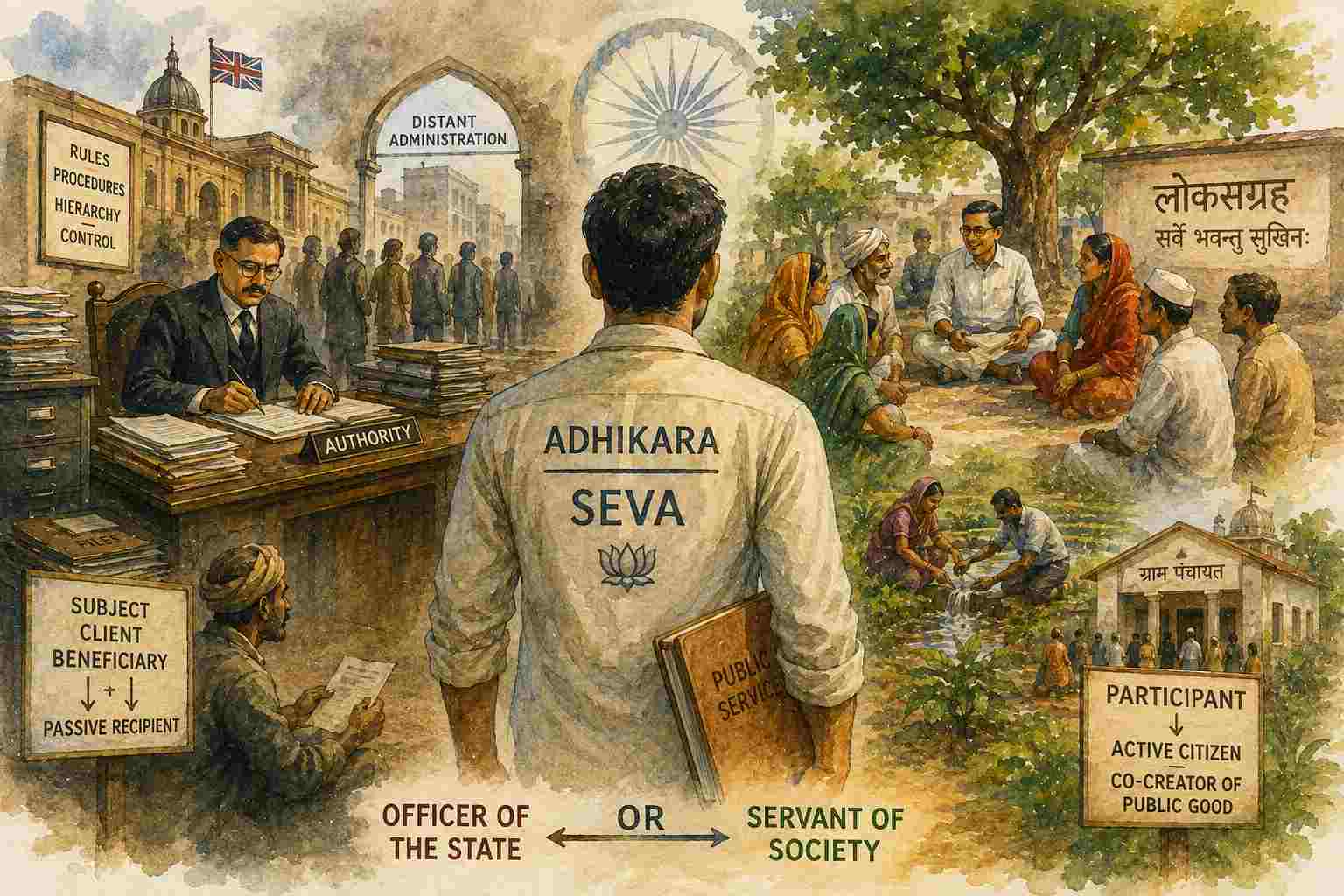
From Bureaucrat to Sevak
One of the most revealing features of Public Administration is the language through which it introduces the person who governs. The curriculum speaks of the civil servant, bureaucrat, public official, administrator and executive. Each term refers to a person occupying an office, exercising authority delegated by the state and carrying out decisions through rules and institutions. This is necessary. A modern state cannot function without trained officials who possess defined responsibilities and legal authority. Yet there is a deeper question that the curriculum often leaves insufficiently explored: what is the moral relationship between the person who administers and the people who are administered?
The answer matters particularly in Bharat because our administrative vocabulary contains a striking contradiction. Officials are described as public servants, but citizens often experience the relationship in the reverse direction, as if the public exists to serve the administrative machinery. A person seeking a certificate, permission, benefit or service may encounter procedures, offices and hierarchies whose primary concern appears to be the preservation of the institution rather than the purpose for which the institution exists. The problem is not merely corruption or inefficiency. It is also conceptual. If the administrator possesses legal authority, who or what is that authority ultimately for?
The Bureaucrat and the Logic of Office
Modern Public Administration inherited much from the bureaucratic model associated with Max Weber. The bureaucrat occupies an office rather than exercising personal authority. Decisions are meant to follow rules rather than personal preference; recruitment is based on qualification; offices are organised hierarchically; records provide continuity; and administrative power belongs, in principle, to the institution rather than to the individual who temporarily occupies a position.
This was an important historical achievement. The bureaucratic model sought to restrain arbitrary power and make administration predictable. The problem, however, is that bureaucracy can gradually develop a moral world of its own. The official may begin to understand responsibility primarily in terms of compliance with procedure. If the rule has been followed, the administrator believes the duty has been completed, even when the larger purpose of public service has been defeated.
This raises a distinction that the curriculum should examine more seriously: can a public servant act correctly according to the rules and still fail the public?
Consider a welfare application rejected because of a procedural defect that could have been clarified, a citizen made to visit multiple offices because departments refuse coordination, or an official decision delayed indefinitely because responsibility has been divided among several desks. No individual officer may have technically violated a rule. Yet the system as a whole may have failed in its purpose. A curriculum centred only on organisation and procedure may therefore produce technically competent administrators without adequately examining the ethical purpose of administration.
The Colonial Inheritance: Administration Above Society
This question becomes more complicated in Bharat because the modern administrative system was significantly shaped by colonial governance. The Indian Civil Service was designed primarily to maintain order, collect revenue and preserve imperial authority. Administrative knowledge was therefore closely connected with control: populations had to be classified, territories surveyed and communities rendered governable. The district officer became a powerful representative of a state that was structurally distant from the people over whom it exercised authority.
Independent India retained much of this administrative machinery because a large and complex country required institutional continuity. That continuity was not itself a mistake. But the curriculum must ask whether institutions designed partly around governing subjects can be completely transformed merely by replacing the colonial state with a democratic one.
The answer is not obvious.
A democratic Constitution can change the source of sovereignty, but administrative culture may take much longer to change. The citizen may formally become the sovereign while continuing to encounter an administration organised around control, procedure and hierarchy. The deeper decolonising question is therefore not whether Bharat should reject bureaucracy. It is whether the purpose of bureaucracy has been sufficiently rethought after political independence.
The Citizen Is Not a Client
New Public Management introduced an important challenge to traditional bureaucracy by focusing on efficiency, performance and service delivery. Citizens increasingly came to be discussed as users or customers of public services. This language improved attention to responsiveness in some areas, but it also introduced another limitation. A citizen is not simply a consumer of government services.
A customer chooses between products. A citizen participates in a political community.
This distinction is crucial. If public service is reduced to customer satisfaction, administration may become faster and more efficient without becoming more democratic. The relationship between state and society cannot be understood merely as that between a service provider and a client. Citizens possess rights, obligations, knowledge and the capacity to participate in collective life. They are not simply the final recipients of administrative output.
A decolonised curriculum should therefore ask students to move beyond the three familiar images of the person before the state: subject, client and beneficiary. A fourth possibility is essential: participant.
Administration does not merely deliver something to society; in many areas, it must work with society.
From Adhikara to Seva
An Indic approach introduces a useful distinction between adhikara and seva. Authority, or adhikara, is necessary for administration. Without defined authority, responsibility becomes unclear and collective action becomes difficult. But authority does not explain the purpose for which it should be exercised.
The idea of seva offers a different moral orientation. It does not mean that the administrator should become passive, subordinate to every demand or incapable of enforcing law. Nor should seva be turned into a decorative cultural word attached to the existing administrative system. Its deeper implication is that authority carries an obligation toward the larger purpose it has been entrusted to serve.
This changes the meaning of office. The office is not merely a position from which authority flows downward; it is a responsibility temporarily entrusted to a person. The administrator is therefore neither a ruler nor merely an employee. He or she occupies a public trust.
This insight has resonances in Kautilya’s conception of kingship, where political authority was not treated as personal enjoyment but as connected with the security and welfare of the people. But the contemporary application should not be confined to kings and ancient texts. The question is institutional: can the logic of public office be reconstructed around trusteeship rather than merely command?
An administrator exercising authority over land, welfare, policing or public resources is acting with power that does not personally belong to him or her. The source of authority may be the Constitution and the institution, but its consequences are experienced by society.
Neutrality Is Not Moral Indifference
Public Administration also teaches neutrality as a core value of civil service. This principle is important because public officials should not administer the law according to personal political loyalties. Yet neutrality can become problematic when it is misunderstood as moral distance.
An administrator should be politically neutral. But should an administrator be socially indifferent?
The distinction matters. If neutrality means treating every person according to the same legal standards, it protects fairness. If it means refusing to recognise different social circumstances because “the rule is the same for everyone”, it can become a mechanism through which unequal realities remain unaddressed. A genuinely impartial administrator must sometimes understand context precisely in order to apply public responsibility fairly.
This is where the idea of the sevak becomes more demanding than the image of the bureaucrat. The bureaucrat may ask, “Have I followed the procedure?” The sevak must also ask, “Have I understood the responsibility?”
A Different Curriculum for Public Service
Decolonising Public Administration does not mean replacing Weber, Wilson or modern organisation theory with Sanskrit terminology. That would simply reproduce the old curriculum with a different vocabulary. It means questioning the underlying assumptions through which the discipline understands the public servant.
Why is the administrator taught primarily as an official within a hierarchy rather than as a person situated between the state and society? Why do curricula devote extensive attention to structures and procedures but relatively less to the lived experience of citizens encountering those structures? Why is public participation often treated as a separate topic rather than as part of understanding what administration itself should be?
A more comprehensive curriculum would study bureaucracy, constitutional responsibility, administrative ethics and accountability alongside traditions of seva, trusteeship, lokasangraha and public responsibility. It would also examine Bharat’s colonial administrative inheritance without assuming that everything inherited must either be rejected or accepted. The objective would be to produce neither an obedient bureaucrat nor a sentimental sevak, but a public official capable of exercising authority while remaining conscious of the social purpose that justifies that authority.
The central question therefore remains deceptively simple: is the administrator merely an officer of the state, or a servant of society?
Perhaps the answer is that a public servant must be both—but in the correct order of meaning. The administrator is an officer because the office gives authority; but the office exists because society requires public functions to be performed. Once the first relationship becomes more important than the second, administration begins serving itself.
The office gives the administrator power. Public responsibility gives that power its purpose.
