
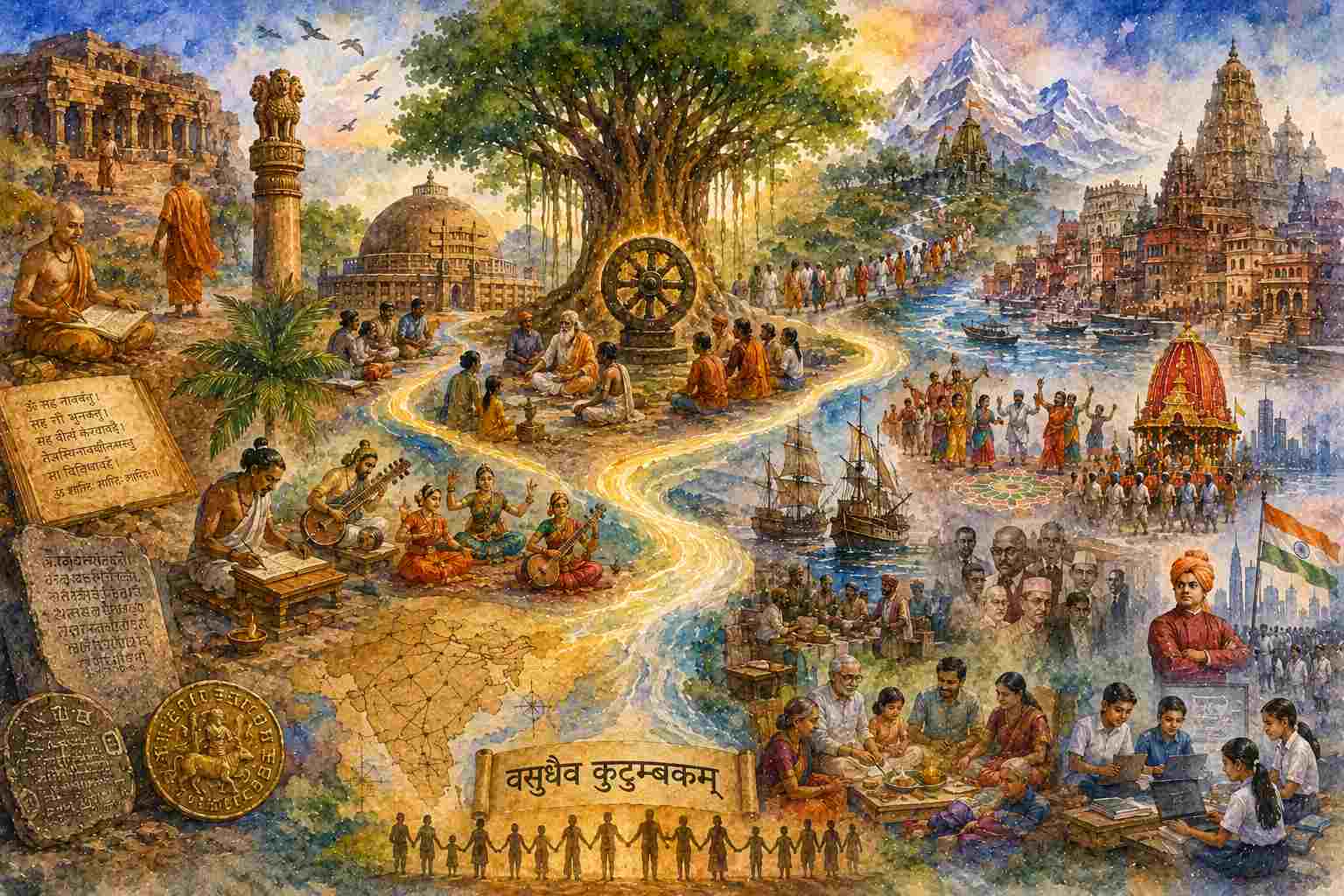
Reading History Beyond Rise and Fall
History is often taught through a dramatic rhythm: kingdoms rise, empires expand, rulers conquer, institutions weaken and political orders eventually collapse. Students move from the Mauryas to the Guptas, from the Delhi Sultanate to the Mughals, from the Mughals to the British, as if the disappearance of one political order naturally marks the disappearance of the historical world that preceded it. This method is useful for studying political change, but it can also produce a serious misunderstanding. A state can collapse without a civilization collapsing with it.
The disappearance of the Western Roman Empire did not erase Latin languages, Roman law, Christianity or the memory of Rome. Ancient Greece lost its independent political world, yet Greek philosophy, language and intellectual traditions continued to shape civilizations far beyond the Greek city-state. The Jewish people lost political sovereignty more than once and experienced dispersion across continents, yet religious practice, textual traditions, collective memory and ritual enabled a remarkable continuity. China repeatedly witnessed dynastic collapse, foreign conquest and political fragmentation, but Chinese civilization retained powerful continuities of language, bureaucracy, philosophical traditions and cultural memory.
These examples force us to ask a question that conventional political history often leaves unanswered: what exactly dies when an empire dies?
The ruler disappears. The administration may collapse. Borders are redrawn. The official language may change. Yet people continue to marry, raise children, cultivate land, worship, travel, exchange knowledge and preserve memory. If these deeper networks survive, the political order may vanish while the civilization continues.
This distinction is essential for understanding Bharat.
The State Is Not the Civilization
Modern political thought often makes the state the primary unit through which collective life is understood. History therefore becomes a succession of states and governments. Civilizational history demands a wider field of vision. It asks what lies beneath and beyond political power.
A civilization survives through what may be called its carriers of continuity. These include language, family structures, systems of learning, sacred geography, pilgrimage, rituals, festivals, artistic traditions, occupational knowledge, institutions of transmission and shared categories through which people interpret the world.
These carriers are not static. They change continuously. Sanskrit did not remain the sole intellectual and literary language of the subcontinent. Tamil, Kannada, Telugu, Marathi, Bengali, Assamese, Punjabi, Gujarati, Odia, Malayalam and numerous other languages developed rich traditions. This was not necessarily a rupture with civilizational continuity. It was often one of the mechanisms through which that continuity expanded.
The Ramayana is an excellent example. Valmiki’s Sanskrit text did not survive only as a manuscript in one library. The narrative travelled into Tamil through Kamban, into Awadhi through Tulsidas, into Bengali, Telugu, Kannada, Assamese and numerous regional traditions. It entered performance, theatre, music, ritual and pilgrimage. No central state ordered this entire process. There was no Ministry of Civilizational Continuity issuing circulars to every village. Yet the narrative survived precisely because it could be remembered, translated and reinterpreted.
This is an important historical insight: continuity is not sameness.
A civilization that survives unchanged may actually be a civilization that has stopped living. Living traditions survive because they can absorb change without losing every connection to their inherited world.
Bharat Survived Through Distributed Institutions
One of the remarkable features of Indian civilizational continuity is that knowledge and social life were never preserved exclusively by a centralized state. Political authority was important, but it was not the sole carrier of culture.
The family transmitted language, ritual and memory. The gurukula and other systems of learning transmitted knowledge. Temples were centres of worship, art, learning and, in many cases, local economic networks. Monastic institutions and mathas created networks of intellectual and spiritual transmission. Pilgrimage connected distant regions. Merchant communities maintained commercial networks across political boundaries. Occupational groups preserved specialized skills across generations. Village and community institutions mediated forms of local collective life.
The consequences of this distributed structure were historically significant.
The Mauryan Empire collapsed, but Bharatiya civilization did not disappear. The Gupta political order weakened, but philosophical traditions, religious institutions and regional societies continued. Powerful kingdoms in the South developed during periods when North India experienced political fragmentation. The fall of Vijayanagara was a major political rupture, but it did not erase the languages, temples, intellectual traditions and social worlds that existed within and around its civilization.
Political unity and civilizational unity are therefore not the same thing.
This distinction is also important for understanding periods of foreign conquest. Conquest could destroy cities, institutions and populations. It would be historically irresponsible to deny those ruptures. Yet political conquest did not necessarily create total civilizational replacement. Conquerors governed a society that already possessed its own languages, institutions, sacred geography and social networks.
A new ruler could occupy Delhi. But could Delhi become the only place through which Bharat understood itself? Could the state command every pilgrim route, every village tradition, every local memory and every intellectual lineage? Political power was immense, but civilization was distributed.
The Geography of Continuity
Bharat’s civilizational continuity was also geographical.
A tirtha is not merely a religious location. Pilgrimage transformed geography into a network of movement and memory. A person from one region could travel to another region, encounter unfamiliar languages and ecological worlds, yet remain within a recognizable civilizational landscape. The Ganga, Kaveri, Narmada, Godavari, Krishna and other rivers carried meanings beyond their physical geography. Mountains, forests and sacred sites connected ecology with memory.
The Char Dham is particularly significant. A network connecting distant geographical directions creates a civilizational map that is different from an administrative map. The Jyotirlinga traditions similarly connected places separated by hundreds or thousands of kilometres. Such networks helped produce relationships across political boundaries.
An empire requires administrative control to remain united.
A civilizational network can remain connected even when political control disappears.
This is one reason why the history of Bharat cannot be adequately described only through the rise and fall of states.
Continuity Under Colonial Disruption
Colonialism presented a different challenge because it did not merely replace one dynasty with another. The colonial state attempted to reorganize knowledge, law, education and social classification according to its own categories. The disruption therefore operated at a deeper level.
Colonial historiography divided Indian history into Hindu, Muslim and British periods, encouraging people to imagine a civilizational past primarily through successive political-religious blocks. Census operations attempted to classify fluid social identities into increasingly rigid administrative categories. Colonial ethnography interpreted communities through racial, tribal and caste frameworks that often became more influential because they were reproduced through state institutions. English education created new intellectual elites who increasingly encountered their own civilization through European categories of religion, race, society and progress.
The most profound disruption, however, concerned historical consciousness.
Bharat increasingly came to know itself through questions generated elsewhere: Was India a nation? Did India have feudalism? Was caste a race? Was religion merely ideology? Was Indian civilization irrational? Was modernity possible only through Westernization?
Some of these questions produced important scholarship. The problem was not that they were asked. The problem was that they increasingly became the principal intellectual framework through which Bharat was expected to explain itself.
Colonial power did not succeed in erasing Indian civilization. But it altered the terms through which Indians could understand that civilization.
This disruption continued in different ways after colonialism. Certain Marxist approaches, while making important contributions to economic and social history, often interpreted continuity primarily through class, production and material relations. Civilizational institutions could be reduced to economic functions, and indigenous categories could be treated as ideological expressions of underlying structures. The result was that continuity itself sometimes became intellectually suspect. To speak about a long civilizational inheritance could be dismissed as essentialism, while imported theoretical categories were treated as critical analysis.
This requires a counter-question: why should continuity be considered intellectually dangerous, while rupture is automatically considered progressive?
What Actually Makes a Civilization Resilient?
A civilization survives when continuity is carried by many institutions rather than one. This is perhaps the most important lesson of history.
If all cultural memory is concentrated in the state, the collapse of the state can produce civilizational catastrophe. But if memory exists simultaneously in families, texts, temples, languages, festivals, artistic traditions, local communities, landscapes and networks of learning, destruction in one sphere does not necessarily destroy everything.
This does not mean every inherited institution is perfect or should be preserved unchanged. Civilizational continuity is not a defence of social injustice, nor is every tradition automatically sacred. A civilization must possess the ability to reform itself.
But reform and civilizational amnesia are not the same thing.
The Indian intellectual challenge is therefore not to return to an imagined frozen past. It is to understand the mechanisms through which continuity survived change. Why did the Mahabharata continue across languages? Why did pilgrimage networks remain meaningful across political boundaries? How did families and communities transmit cultural practices? How did intellectual traditions survive the destruction of particular institutions? How did local knowledge remain alive when centralized power changed?
These are historical questions of enormous importance.
Perhaps we should therefore stop asking only why empires fell.
We should also ask why civilizations survived them.
The Mauryan state disappeared. The Gupta political order disappeared. Vijayanagara fell. The Mughal Empire fragmented. British rule ended. Yet Bharat did not emerge in 1947 as a society without memory. Something continued across these transformations—not as an unchanging object, but as a vast network of remembered relationships, languages, institutions, journeys, knowledge and cultural practices.
That is continuity.
A kingdom can survive without becoming a civilization. An empire can dominate enormous territories and leave little living inheritance. But when political structures disappear and people continue to remember, reinterpret, transmit and live within a shared civilizational world, history reveals something deeper than political endurance.
A civilization survives when its memory is not held by one throne, one archive or one generation, but is distributed across the life of its people.
And perhaps this is the real question for Bharat today: after centuries of political conquest, colonial classification and intellectual disruption, do we still know which institutions, memories and relationships carried our civilization through the past—and if we do not, can we understand how to carry them into the future?
