
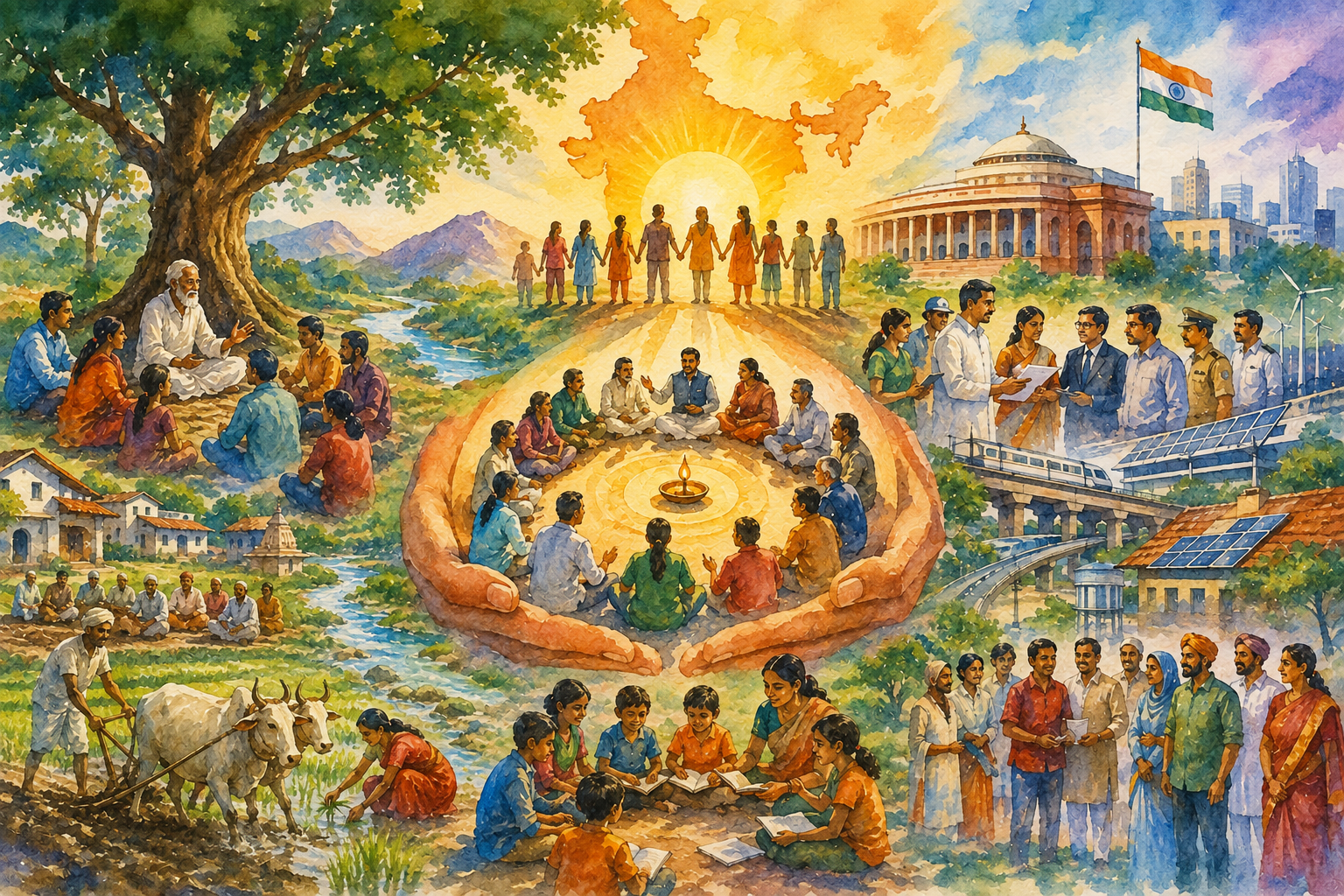
Beyond Administration, Towards the Welfare of the Whole
We have become accustomed to judging governance through numbers: how quickly a service is delivered, how efficiently a department functions, how much revenue is collected, how high the gross domestic product rises, how many roads are built, how many schemes reach their beneficiaries, and how effectively a government converts resources into measurable outputs. All of these matter, but a government can be remarkably efficient and still produce a society that is fragmented, distrustful, culturally uprooted and increasingly incapable of acting together. This raises a more fundamental question: what makes governance good—not merely effective? Perhaps the problem lies partly in the question with which we begin. If governance is understood primarily as administration, then efficiency becomes its highest virtue; if governance is understood as the organisation of collective life, then efficiency becomes only one of its conditions.
The Indic idea of Lokasangraha offers a different starting point.
The expression appears explicitly in the Bhagavad Gita 3.20 and 3.25, where Krishna connects action with the holding together, protection and welfare of the loka.
In 3.20, Krishna points to Janaka and others, who attained perfection through action while keeping Lokasangraha in view: “लोकसंग्रहमेवापि सम्पश्यन् कर्तुमर्हसि”—one should act with the welfare or holding together of the world in view.
The significance of this is easily missed if Lokasangraha is reduced to the modern phrase “public welfare”. The idea is not simply that government should provide benefits to people; it concerns the maintenance of the conditions through which the social world remains capable of functioning as a connected whole.
This interpretation becomes even more interesting when we turn to the commentators. Shankaracharya, commenting on Gita 3.25, explains the action of the wise in relation to Lokasangraha as preventing people from going astray, while Ramanujacharya connects the conduct of the accomplished person with lokarakshana and with establishing clarity about right conduct through one’s own example. Here governance acquires a dimension that modern administrative theory often finds difficult to measure: example itself is a form of governance. Institutions do not merely regulate behaviour through rules; those who occupy positions of influence establish standards that others observe and imitate. This is why the preceding verse, Gita 3.21, states that whatever the श्रेष्ठ person does, others follow, and whatever standard he establishes, the world pursues.
This has a remarkable implication for contemporary governance. We often evaluate public institutions by what they produce, but perhaps we should also ask what kind of behaviour they normalise. Does administration encourage responsibility or dependency? Does public policy strengthen the capacity of communities to solve problems, or does it gradually make every problem dependent upon the state? Does leadership cultivate trust, restraint and public responsibility, or does it communicate that rules exist for everyone except those who make them? A government may achieve impressive numerical targets while simultaneously weakening the habits of cooperation that make those targets sustainable. Lokasangraha therefore introduces the question of social consequences beyond administrative outputs.
This is also why Lokasangraha should not be confused with an unlimited welfare state. The concept does not say that the state must perform every function of society. Indeed, its deeper implication can be almost the opposite: good governance should preserve the capacity of the social world to organise itself. If every responsibility is absorbed into administration, communities may become recipients rather than participants. The question is not simply how much the government can do, but whether governance leaves society stronger, more capable and more responsible after it has acted.
Sri Aurobindo offers a particularly valuable modern interpretation of this idea, describing Lokasangraha as action for maintaining people in their Dharma and supporting their growth along their different paths. This is important because it moves us beyond the assumption that good governance necessarily means making everyone conform to one administrative model. A society is not a machine whose components must all become identical for it to function. Governance must sometimes protect plurality without allowing plurality to become fragmentation. The challenge is therefore not uniformity, but coordination.
This gives us a different way of thinking about development as well. What happens when economic growth destroys the institutions of community? What happens when urbanisation produces prosperity but eliminates social networks that once provided care? What happens when educational expansion increases credentials but weakens the transmission of responsibility between generations? What happens when administration becomes more sophisticated while citizens become less capable of collective action? These cannot be answered by gross domestic product or service-delivery statistics alone because they concern the quality of the social relationships that sustain collective life.
Lokasangraha consequently asks governance to look beyond the immediate beneficiary and beyond the immediate electoral cycle. A policy may be efficient today and destructive tomorrow; another may produce slower visible results while strengthening institutional capacity for generations. Good governance therefore requires a temporal imagination: what kind of society is today’s administration leaving behind?
This is also where the Indic idea offers a useful corrective to a curriculum that often treats governance through the categories of efficiency, bureaucracy, accountability and service delivery while leaving the deeper question of social purpose relatively underdeveloped. Efficiency asks whether an institution achieves its objective with minimum waste. Accountability asks whether power can be questioned. Effectiveness asks whether a policy works. These are necessary questions, but Lokasangraha asks another: does what works also contribute to holding together the larger social order?
That does not mean that every inherited social arrangement should be preserved. A society can hold together unjustly, and cohesion by itself cannot become the highest political virtue. This is precisely why Lokasangraha must be read alongside Dharma, rather than treated as a slogan for social stability at any cost. The task is not simply to preserve whatever exists, but to sustain conditions in which people and communities can pursue a just and meaningful social life.
Perhaps, then, good governance should not be measured only by how efficiently government delivers, but also by what kind of society its actions produce.
- Does it strengthen trust?
- Does it cultivate responsibility?
- Does it preserve plurality?
- Does it increase the capacity of communities?
- Does it protect the conditions of future prosperity?
- Does it allow society to govern aspects of its own life?
And most importantly, does governance leave the loka more capable of holding itself together than it was before? That is the deeper challenge of Lokasangraha. Governance is not good merely because the machinery works. It is good when the machinery works in such a way that society itself remains alive, capable, responsible and connected.
