
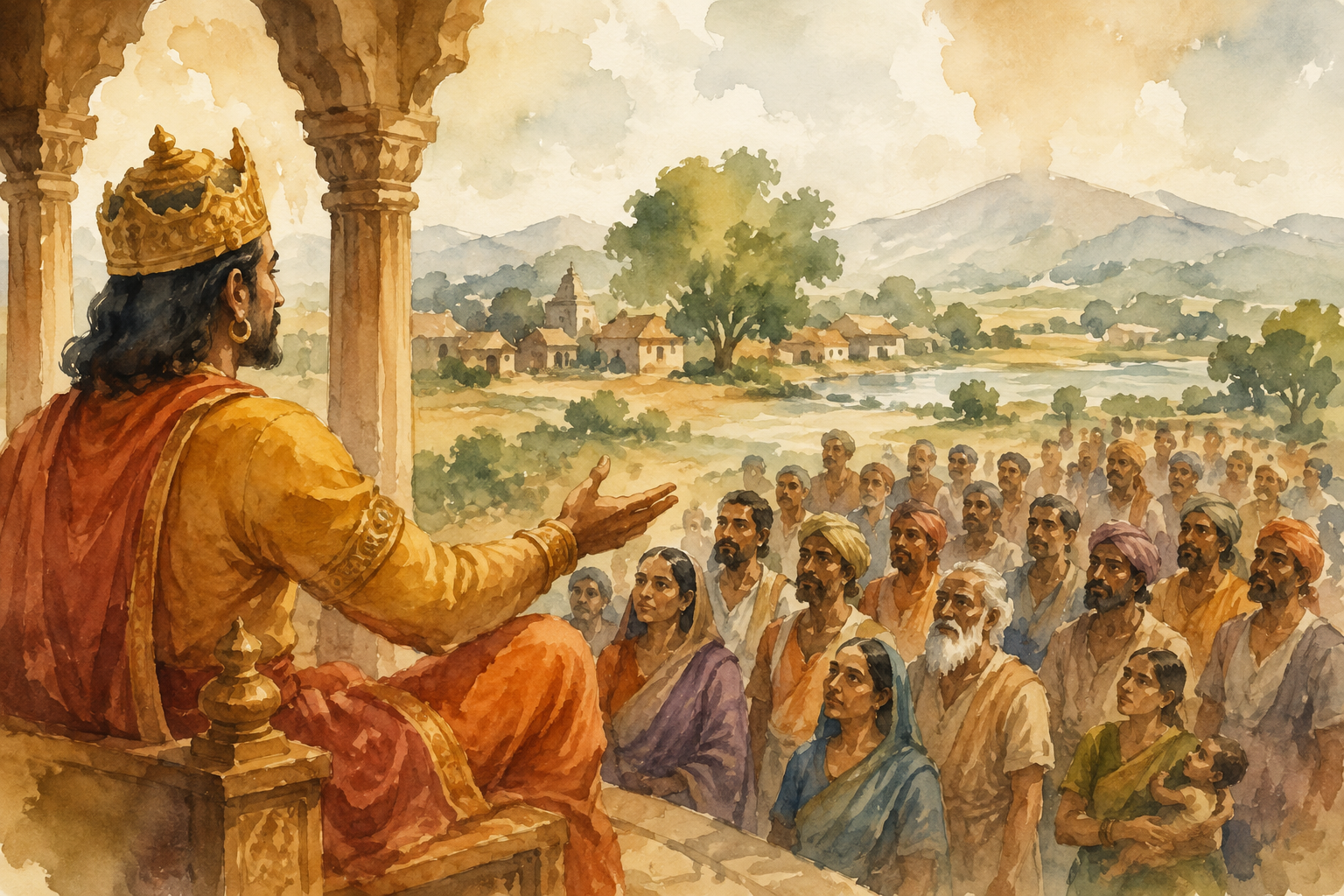
If a person has the power to govern, what exactly does that power oblige him to do? This question sounds almost too obvious, and yet it is one of the questions that political theory repeatedly struggles to answer, because it is easy to describe the powers of a ruler, the institutions of government, the limits imposed by a constitution, or the procedures through which authority is acquired, while it is much harder to explain the moral debt created by power itself. Why should the person who commands the army, controls taxation, appoints officials and administers justice be under a greater obligation than an ordinary citizen? The Indic idea of Rajadharma begins from precisely this uncomfortable premise: power does not merely give the ruler rights; it creates duties, and the greater the capacity to affect the lives of others, the greater the responsibility attached to that capacity.
This is why Rajadharma should not be translated too quickly as simply “the duties of a king”. That translation is correct, but insufficient. Dharma here points towards an order of responsibility within which political authority has to operate. The ruler is not merely an individual who happens to occupy an office; he becomes the bearer of obligations towards praja, and his personal preferences cannot become the measure of public good. This is visible in the Ramayana in a particularly interesting way, because the ideal of kingship is not presented only through Rama’s conduct but through the expectations placed upon the institution of kingship itself. When the elders of Ayodhya discuss the consequences of the absence of a ruler after Dasharatha’s death, they do not merely say that government has become inconvenient; they describe the disappearance of protection as a condition in which trade becomes insecure, wealth becomes vulnerable, agriculture suffers, social duties weaken and disorder spreads (Valmiki Ramayana, Ayodhya Kanda, 2.67). The implication is profound: the ruler exists because social life requires protection, and political authority is justified by the conditions it creates for society.
The same idea becomes even more concrete when Rama speaks to Bharata about the responsibilities of ruling Ayodhya. He does not ask merely whether Bharata is maintaining the army or treasury; he asks whether the city remains prosperous, whether its people are secure, whether its different communities are performing their occupations, whether learned people are flourishing, and whether the city is being properly protected. The description of Ayodhya in Ayodhya Kanda 2.100.40–42 is therefore worth reading carefully: Rama asks whether Bharata is protecting a prosperous city inhabited by people engaged in their respective occupations, learned persons and members of different social groups. What is striking here is the breadth of the political responsibility: good government is visible in the condition of society, not merely in the efficiency of the palace.
And this takes us to perhaps one of the most important aspects of Rajadharma: the ruler’s responsibility extends even to protecting people from the ruler’s own machinery. This is a remarkably modern-sounding problem, but it is explicitly recognised in the Manusmriti, where the king is warned that officials appointed to protect the people may themselves become corrupt and appropriate the property of others, and therefore the king must protect the praja even from those officials (Manusmriti 7.123). The insight here deserves more attention than it usually receives. The state does not become legitimate merely because its officials are acting in the name of the ruler; the ruler remains responsible for what his agents do. Delegation does not erase responsibility.
This becomes especially important when we think about modern bureaucracy. We often separate political leadership from administrative failure by saying that an officer acted wrongly, a department failed, or an institution malfunctioned. The Indic question would push us further: if the ruler is responsible for the protection of the people, how far can responsibility be delegated before accountability itself becomes meaningless? The ancient texts were not discussing the modern administrative state, but the underlying problem remains remarkably familiar. Authority creates a chain of responsibility, and someone at the top cannot simply claim innocence because the harm was carried out by someone lower down.
Rajadharma also places a striking limit upon taxation. The ruler requires resources because protection and administration require resources, but taxation cannot become an appetite without restraint. In the Shanti Parva, Bhishma compares the proper extraction of revenue to taking milk from a cow without destroying the calf, and elsewhere warns that excessive taxation can weaken the productive capacity of the kingdom itself (Mahabharata, Shanti Parva, 87). This is more than an argument for “low taxes”. It represents an understanding of state capacity and social capacity as mutually dependent. The ruler consumes from the productive system, but if he consumes beyond what that system can sustain, he destroys the very source from which his own power is maintained.
The same passage extends this responsibility to agriculture, cattle-rearing and trade, arguing that the king should ensure that people engaged in productive activity feel secure and that their productive capacities increase. This gives Rajadharma an economic dimension that is often overlooked. The ruler does not merely collect revenue from the economy; he is responsible for maintaining the conditions in which economic life can flourish. Security, justice and prosperity are therefore not separate policy departments. They are connected responsibilities of political authority.
There is another distinction here that is crucial: Rajadharma does not mean that the ruler must be personally perfect before he can govern. That would make political order impossible because rulers are human beings, with ambition, anger, weakness and attachment. The more interesting demand is that personal limitations should not be allowed to become public arbitrariness. A ruler may possess preferences, but justice requires him to restrain them; he may have allies, but justice requires impartial adjudication; he may desire wealth, but his desire cannot become unlimited extraction. In the Shanti Parva, Bhishma explicitly connects kingship with the impartial administration of disputes, stating that although the king should regard his subjects as his own children, he should not allow personal compassion to distort judicial decisions (Mahabharata, Shanti Parva, 69). Compassion and impartiality therefore have to coexist.
This is where Rajadharma becomes more demanding than a simple morality of “good rulers”. It asks us to construct institutions and habits capable of restraining the ruler’s own impulses. The ruler must protect the weak, restrain predatory officials, maintain productive activity, administer justice, collect revenue without destroying prosperity and preserve the conditions of social life. In other words, the ruler is not merely accountable for what he intends; he is accountable for the order his power produces.
Modern constitutionalism approaches some of these concerns through separation of powers, judicial review, elections, fundamental rights and administrative accountability. These are indispensable institutional mechanisms, but Rajadharma introduces another dimension: the internal disposition and duty of the person exercising authority. A constitution can define what an office permits; it cannot by itself produce wisdom in the person occupying that office. Law can restrain certain actions; it cannot automatically create a sense of responsibility towards generations yet unborn. Political institutions therefore require not only rules but also a conception of what political power is for.
Perhaps that is why Rajadharma remains relevant as an analytical category rather than merely as an ancient ideal. It allows us to ask questions that are uncomfortable for every political system: Who protects the people from the protectors? Who protects productive society from excessive extraction? Who protects justice from personal preference? Who holds the ruler responsible when the machinery of government itself becomes predatory? And what happens when those who possess authority begin to regard public power as personal entitlement?
The answer offered by the Indic tradition is not that power should disappear. It is that power must be disciplined by Dharma.
And perhaps this is the most important insight of Rajadharma: the ruler does not become great because he possesses greater power; he becomes worthy of power by accepting greater responsibility.
The real measure of kingship, therefore, is not how much a ruler can command, how much revenue he can extract, how many enemies he can defeat, or how magnificent his court appears.
It is much simpler—and much harder: When the ruler possesses the power to affect everyone’s life, does he remember that their lives are not his possession?
