Beyond Power and Elections
When we hear the word politics, we immediately think of elections, political parties, parliaments, governments, leaders, campaigns and the competition for power, as though politics begins when people enter an election and ends when a government is formed. But is that really politics? What happens to the politics of a village where people decide how a common resource will be used, to the politics of a community negotiating its internal differences, to the politics of an assembly deciding a shared course of action, or even to the political question of how different groups live together without destroying the social order that connects them? Before Political Science asks who governs, we must first ask what political life itself means.
The modern academic study of politics has been enormously influenced by the experience of the modern European state, and this has given Political Science a powerful vocabulary of sovereignty, territory, state, government, parties, elections, representation, citizenship and institutions. These concepts are useful, but the problem begins when they are treated as the universal grammar of political life. A society that does not organise itself primarily through the modern nation-state can then appear incomplete, traditional or politically underdeveloped, simply because it does not fit the categories through which it is being examined. This is one of the deeper problems of the conventional curriculum: it often begins with the state and then tries to understand society, whereas an Indic approach can begin with society and ask why political authority emerges within it at all.
This does not mean rejecting Western political thought. Hobbes, Locke, Rousseau, Machiavelli, Tocqueville, Marx, Weber and the enormous body of modern political theory have asked questions that remain indispensable. The issue is different: why should these questions constitute the entire starting point for Political Science in Bharat? If the discipline begins with the assumption that politics is fundamentally about acquiring and exercising power, then political life naturally becomes a competition between interests. If it begins with the assumption that politics is about the organisation of the state, then society gradually becomes an object to be governed. But what if politics begins somewhere else—with the problem of collective life?
The Indic intellectual tradition gives us a very different entry point. The Rig Veda speaks of Sabha, Samiti and Vidatha, indicating forms of collective gathering, deliberation and social organisation, while the famous concluding hymn of the Rig Veda presents an extraordinary image of collective political life:
“संगच्छध्वं संवदध्वं सं वो मनांसि जानताम्” — “Come together, speak together, let your minds be in accord” (Rig Veda 10.191.2).
The following mantra speaks of a common assembly (samitiḥ samānī), a shared deliberative purpose and common intention (Rig Veda 10.191.3).
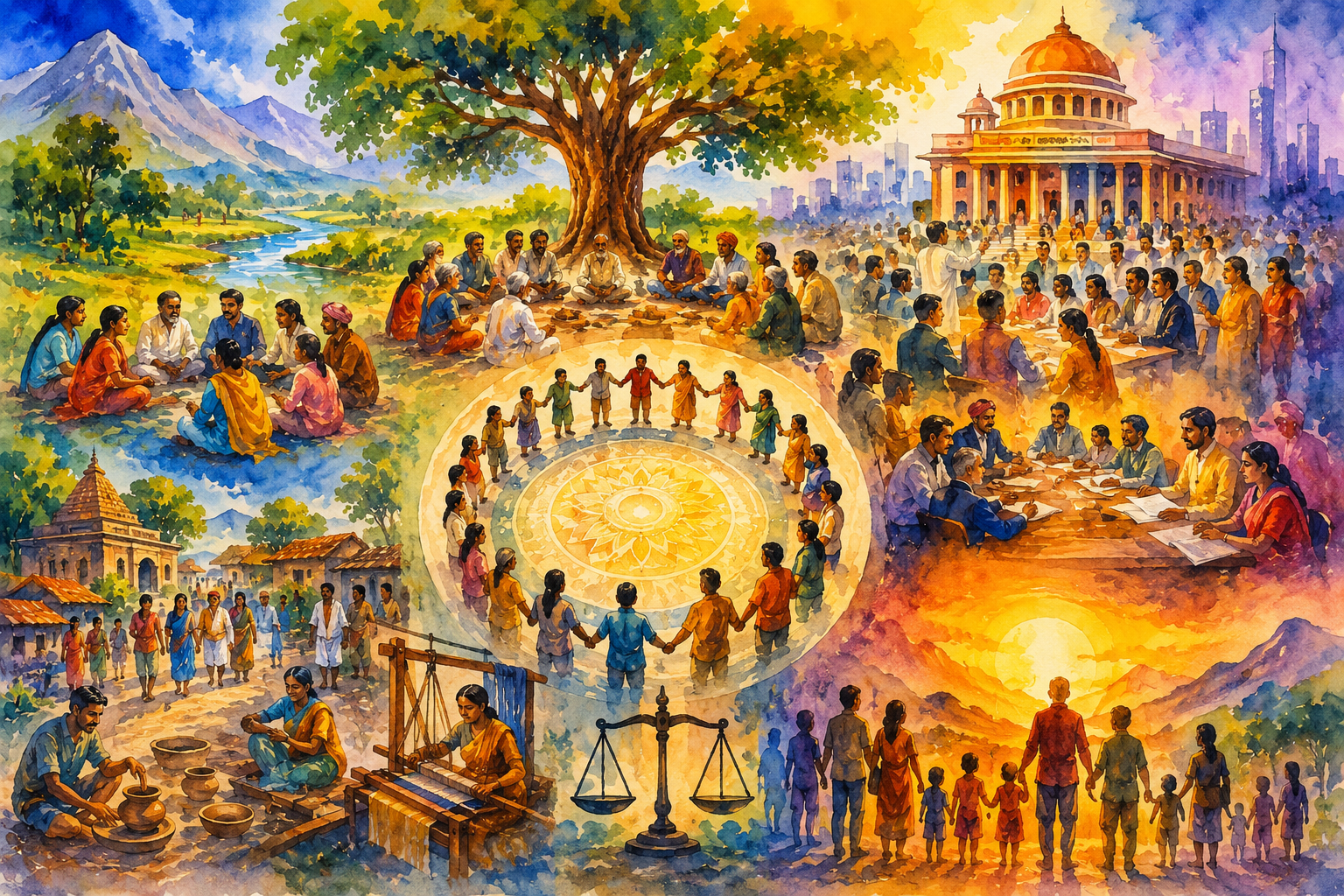
Notice what is happening here. Politics is not being described first as competition for power. It begins with the problem of how people can come together, speak, deliberate and pursue a shared purpose. This does not mean that disagreement disappears; nor should we project modern democracy backwards onto the Vedic corpus. It means that the political question can be framed differently. Instead of asking only “Who gets power?”, we can ask “How does a community arrive at collective action?”
This distinction is fundamental. Politics exists because human beings have different interests, aspirations, identities and understandings of what ought to be done, yet they must still live together. Politics therefore involves conflict, certainly, but it also involves negotiation, cooperation, persuasion, coordination, obligation and collective purpose. If conflict is the only thing we see, we will understand politics as a permanent struggle. If consensus is the only thing we see, we will misunderstand the reality of political life. The deeper question is how a society manages difference without allowing difference itself to destroy the possibility of collective existence.
This is where the Indic category of Samiti becomes intellectually interesting. The word should not be casually translated as “parliament” or “democratic assembly”, because the historical contexts are different, but it allows us to recognise something that the modern curriculum can sometimes obscure: political organisation can exist within a wider social order and need not be synonymous with the state. Families, communities, guilds, assemblies, local institutions and other collective formations can possess capacities for decision-making and coordination. Politics therefore does not begin and end at the doors of the state.
The question of Rajya consequently follows rather than precedes the question of society. Why does political authority become necessary? What does it protect? What does it coordinate? What should it leave to society? What happens when authority becomes excessive? And what happens when political order becomes too weak to protect social life? These are political questions, but they become visible only when we stop treating the state as the natural starting point of every inquiry.
This also changes our understanding of power. Power is certainly present in politics, but power is not the purpose of politics. Political authority becomes meaningful only when we ask what it is supposed to accomplish. The Indic vocabulary of Rajadharma, Dandaniti, Lokasangraha and Rajya therefore allows us to study political authority through responsibility, order, protection and social flourishing, rather than through power alone. The political question becomes not merely “Who controls the state?”, but “What kind of political order allows society to remain capable of governing itself, resolving conflict, pursuing prosperity and sustaining its larger purposes?”
This is why decolonising Political Science cannot mean replacing a few Western thinkers with a few Sanskrit quotations and declaring the curriculum Indian. That would be intellectual tokenism, not reconstruction. The deeper task is to reconsider the questions themselves. If the curriculum asks only about sovereignty, can we also ask about Rajadharma? If it asks about the state, can we also study Samaja and Janapada? If it asks about power, can we ask about Dharma? If it studies representation, can it also examine Sabha and Samiti? If it studies political conflict, can it examine the civilizational mechanisms through which differences are negotiated and social cohesion maintained?
Perhaps, therefore, the most important question with which Political Science should begin is not “Who has power?”
It is:
“How do human beings organise themselves to live together, make collective decisions, manage differences, protect their social order, and pursue purposes larger than individual interest?”
Once we begin there, politics becomes much larger than elections, parties and governments. It becomes the study of collective life itself—and the many ways in which a society creates, limits, distributes and gives meaning to political authority.
