
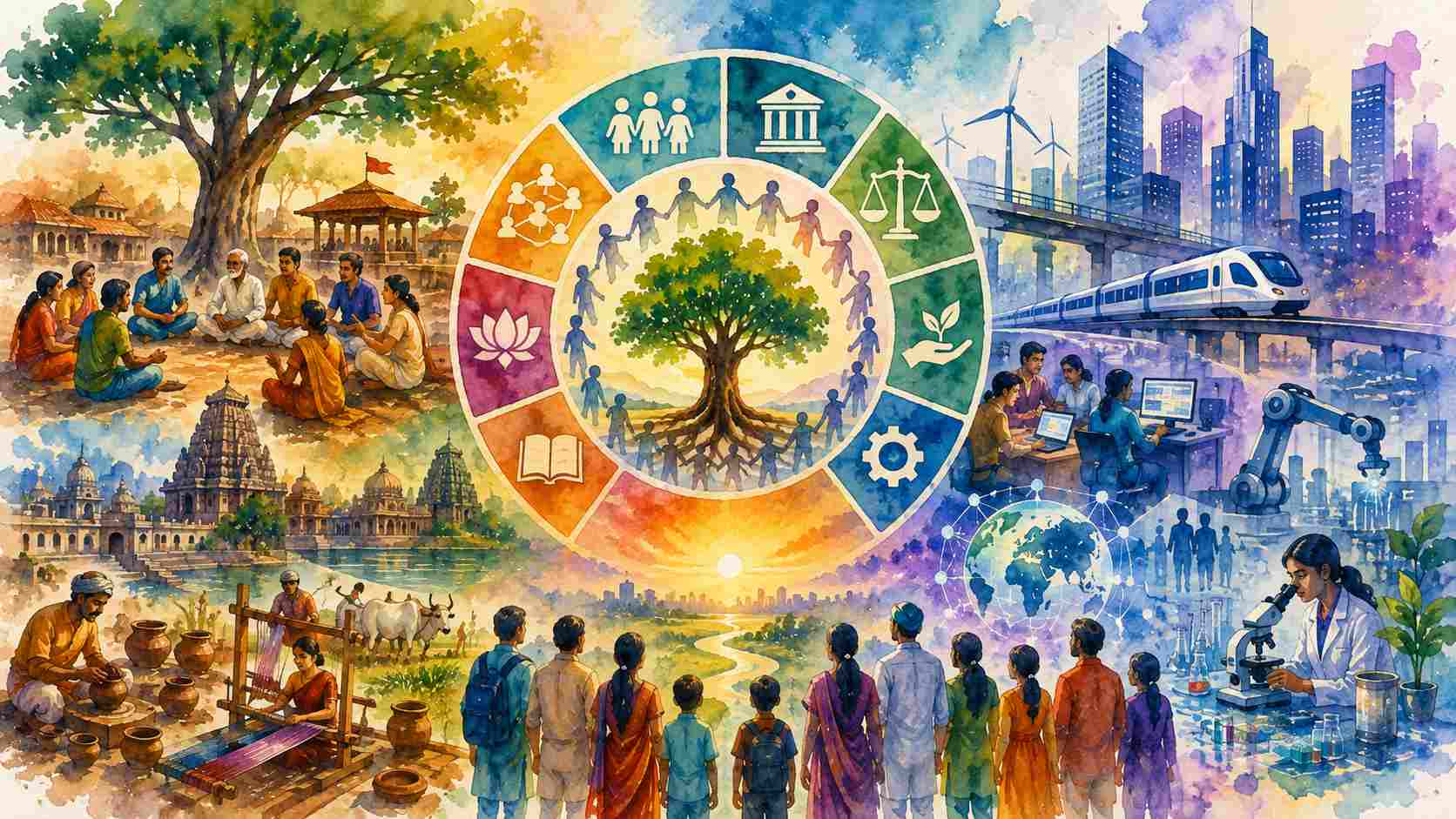
Rethinking Social Change in Bharat
One of the most influential assumptions embedded within the modern study of society is that societies move through identifiable stages of development, from the “traditional” towards the “modern”, from Gemeinschaft to Gesellschaft, from mechanical to organic solidarity, from agrarian to industrial, from religious to secular, and from inherited institutions towards rational and bureaucratic organisation. The names are familiar: Ferdinand Tönnies, Émile Durkheim, Max Weber, Karl Marx, Talcott Parsons and Walt Rostow, among others, gave sociology and related disciplines powerful conceptual tools for understanding social transformation. Their contributions cannot simply be dismissed; they help us understand industrialisation, capitalism, urbanisation, bureaucracy, differentiation and changing social relationships. But a serious question remains: when these categories become the default curriculum through which every society is expected to understand its own transformation, whose historical experience has become the model of modernity?
- Tönnies’ distinction between Gemeinschaft and Gesellschaft, for instance, contrasts intimate, customary community relationships with the more impersonal relationships of modern society;
- Durkheim’s movement from mechanical to organic solidarity links social transformation with increasing differentiation and interdependence;
- Weber’s account of rationalisation places bureaucracy, calculability and formal rationality at the centre of modern social organisation;
- Marx interprets historical transformation through material production and changing relations of class and property; and
- Parsons later conceptualises modernisation through processes such as differentiation, adaptation and institutional specialisation.
These frameworks emerged from particular historical transformations in Europe, yet their categories gradually became something larger than historical interpretations: they became templates against which other societies were measured. The problem begins when a society is described as “traditional” simply because its institutions do not resemble the European path to modernity.
The Indian Context
This becomes particularly problematic in the Indian context, because Bharat did not enter modernity from a condition of social emptiness. Family, community, occupation, religious institutions, local governance, pilgrimage networks, educational traditions and customary practices had already evolved mechanisms through which society adapted to changing circumstances. Indian social institutions were not necessarily static structures waiting for modernisation; many were capable of absorbing, negotiating and transforming new influences while retaining continuity with inherited principles. The very category of “tradition” therefore requires interrogation. Is a tradition traditional because it is old, or can something remain civilizationally continuous while changing its institutional form?
The Indic intellectual tradition offers a much more dynamic understanding of this problem because it does not necessarily place continuity and change in opposition. The Bhagavad Gita itself presents a remarkable conception of action, responsibility and adaptation through the relationship between Dharma, Karma and Lokasangraha. Krishna does not ask Arjuna to escape the changing world in order to preserve an imagined past; he asks him to act appropriately within a changing and morally complex situation. The famous idea of “Yadā yadā hi dharmasya glānir bhavati” (Gita 4.7) is not merely a theological statement when examined sociologically; it suggests that when an existing order becomes incapable of sustaining Dharma, renewal becomes necessary. Civilizational continuity, therefore, need not mean institutional immobility.
This gives us another way of understanding social change. A society can change without becoming something else entirely. A family may transform while retaining the principle of intergenerational responsibility; a village institution may change its structure while retaining collective functions; a festival may acquire new forms while continuing to transmit memory; an occupational community may enter a modern economy without abandoning its social identity; a pilgrimage may move from a physical journey towards a technologically mediated experience without necessarily losing its sacred meaning. Change, in such cases, is not simply replacement. It is adaptation, reinterpretation and renewal.
This is precisely where the conventional sociology curriculum needs expansion. If students are repeatedly taught to understand social change through binaries such as traditional versus modern, religious versus secular, community versus individual, rural versus urban, and customary versus rational, they may unconsciously begin to assume that one side of each binary represents the past and the other the future. But what if these oppositions are themselves historically specific? What if societies can be simultaneously traditional and innovative, communal and individual, religious and rational, local and global? What if the real sociological question is not “How does society become modern?”, but “How does society transform while deciding what it is unwilling to lose?”
This is where Indic categories become analytically useful rather than merely culturally decorative. Dharma allows us to examine continuity through responsibility rather than mere institutional preservation; Samskara directs attention towards the transmission of values across generations; Purushartha recognises that human aspirations are multiple rather than reducible to economic productivity; Yuga provides a civilizational vocabulary for thinking about historical transformation; and Lokasangraha raises the question of whether change strengthens or fragments the social whole. These categories do not provide ready-made sociological answers, nor should they be treated as such. Their importance lies in allowing us to ask different questions about change itself.
The objective, therefore, is not to replace Weber with an Indian Weber, Parsons with an Indian Parsons, or modernisation theory with a Sanskritised version of the same theory. That would change the vocabulary without changing the intellectual structure. Decolonising sociology requires something deeper: allowing Bharatiya categories, historical experiences and social realities to participate in theory formation itself. Bharat should not merely be the field site where European theories are tested; Indian social experience should also be allowed to challenge, refine, reject or expand those theories.
Perhaps the most important question is therefore not “How modern is Bharat?”
It is:
“Who decided what modernity looks like, and why must every society become modern in the same way?”
Social change does not have to be a journey from inherited civilization towards an imported destination. It can also be the capacity of a civilization to adapt without amnesia, reform without self-rejection, and renew itself without severing its civilizational continuity.
That is not a rejection of modernity. It is a more fundamental question: Can Bharat become modern without first being asked to become someone else?
