
Re-examining the Sociological Imagination
Before sociology asks why people behave in certain ways, why institutions change, or why inequality persists, it should ask a much more fundamental question: what exactly do we mean by “society”?
The question appears elementary because every introductory sociology textbook uses the word. Yet the answer is far from universal. Modern sociology emerged largely from the European experience of industrialisation, urbanisation, secularisation, capitalism and political revolution, and its foundational thinkers were consequently trying to explain a particular historical transformation. Durkheim was concerned with the changing forms of social solidarity; Marx with capitalism and class relations; Weber with rationalisation, authority and modernity; Tönnies with the movement from Gemeinschaft to Gesellschaft. Their theories remain enormously valuable. But should the conceptual architecture produced by European social transformation automatically become the universal grammar through which every society is understood?
Even the contemporary Indian sociology curriculum acknowledges that sociology emerged in a predominantly Western historical context with global consequences. The problem, therefore, is not that Western sociology is “wrong”. The problem is that its historical experience can become invisible precisely because its categories have become universalised.
Consider the individual. Modern sociology frequently constructs its central problem around the relationship between individual and society. Durkheim famously argued that social facts possess a reality external to individuals and exert constraint upon them. Weber, from another direction, began with meaningful social action. And C. Wright Mills later attempted to reconnect biography with history through the idea of the sociological imagination—the ability to understand personal troubles in relation to wider public issues and social structures. This was an important corrective to excessive individualism: unemployment, poverty or loneliness cannot always be explained through individual choices when millions experience the same condition.
Yet notice the architecture: individual ↔ society.
What if that binary is itself incomplete?
What if the individual does not first exist as an autonomous unit and then enter society? What if the person is constituted through relationships from the beginning—through family, lineage, locality, community, occupation, language, memory, institutions and inherited obligations?
This is where the Indic vocabulary becomes sociologically interesting. Kutumba, Kula, Samaj, Samudaya, Grama and Rashtra are not merely alternative translations for the word “society”. They point towards different scales and forms of collective life. Kutumba directs attention towards the household and intergenerational relations; samudaya towards a community; grama towards a territorial and institutional locality; samaj towards organised social relations; and rashtra towards a larger civilizational-political community. The important point is not that these words form a ready-made Indic theory of sociology. They don’t. Their value is that they prevent us from assuming that “society” must have one universal sociological meaning.
The methodological consequences are substantial. If we begin with the autonomous individual, society can easily become the “external environment” acting upon that individual. Culture becomes something the individual acquires. Institutions become structures that constrain behaviour. Community becomes another social variable. The researcher then studies the individual from outside, often treating the community as an object to be observed, classified and explained.
This produces what we might call the “Other” problem.
The sociologist says: I am studying them.
But who exactly is “I”? And who exactly is “them”?
Anthropology and sociology have spent decades confronting this problem through reflexivity, positionality and critiques of the colonial gaze. Yet the methodological problem runs deeper. If the categories used by the researcher come from an intellectual tradition different from the community being studied, the researcher may inadvertently force social reality into pre-existing boxes. The community becomes “data”; the researcher becomes the knower; the theory becomes the neutral instrument.
But is it neutral? Suppose a researcher enters a Bharatiya village looking for “individualism versus collectivism”. The village will almost certainly produce data for that binary. If the researcher instead investigates relationships of obligation, reciprocity, kinship, locality, ritual, occupation and institutional authority, a different society becomes visible.
The method does not merely discover reality.
The method determines what becomes visible as reality.
This is particularly important because sociology is supposed to produce the sociological imagination. Mills wanted students to connect biography and history, and the idea remains central to introductory sociology. But perhaps the next step is to ask whether students themselves have been taught to imagine society primarily through the categories of the modern individual. If so, sociology can paradoxically become very good at explaining society while making students increasingly detached from the societies they actually inhabit.
This may explain an uncomfortable phenomenon: why can a student study sociology for years and still fail to understand the society around them?
They may know Durkheim’s mechanical and organic solidarity, Marx’s class, Weber’s rationalisation, Parsons’ pattern variables and Mills’ sociological imagination. But can they explain how their own family sustains itself? How their neighbourhood creates trust? How local institutions resolve disputes? How communities transmit knowledge? Why certain relationships generate obligation without contracts? Why people continue practices even when they cannot explain them in the language of textbooks?
The problem may not be that students lack sociological knowledge. They may have been taught to look at society primarily as an object rather than as a lived world of which they are themselves participants.
That distinction is fundamental.
A genuinely sociological education should produce reflexivity: I am not outside society looking at it. I am situated within the very social world I am studying. The observer is also socially formed.
This is where an Indic approach can expand rather than reject the sociological imagination. Instead of only asking how society shapes the individual, we can ask how relationships constitute the person, how persons sustain institutions, and how institutions reproduce or transform the larger social order.
From the Individual–Society Binary to a Relational Sociology
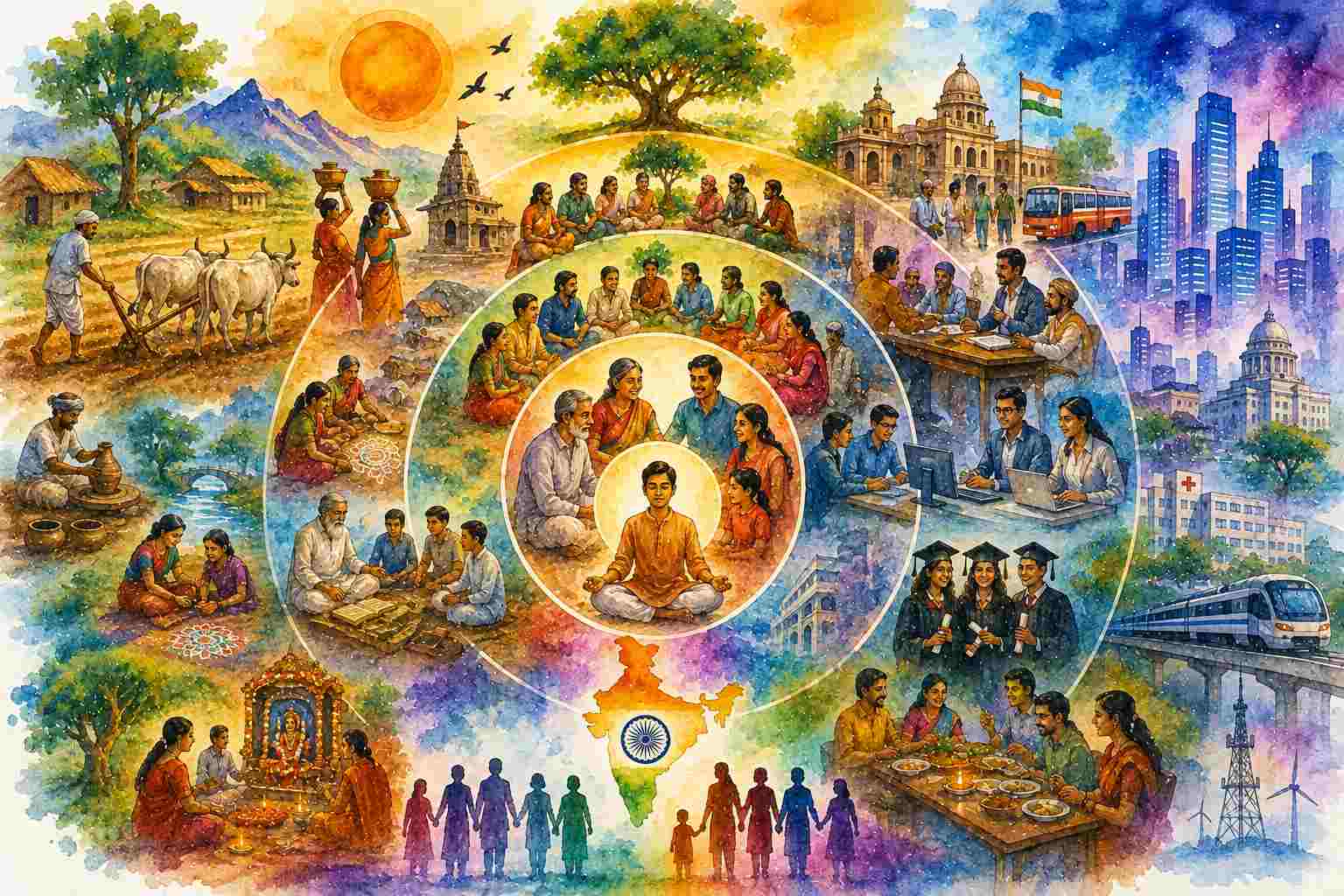
Pind / Person → Kutumba → Samudaya → Samaj → Grama → Institutions → Rashtra → Civilizational Order
This is not a hierarchy in which one level is more important than another. It is a relational field. A person’s behaviour can affect the family; the family shapes community life; communities sustain institutions; institutions shape the village; villages participate in larger political and civilizational formations. Causality moves in multiple directions.
This also changes the meaning of social change. Instead of asking whether “society” constrains an individual, we can ask how relationships, institutions and communities change together.
And this is precisely where decolonising sociology should begin—not by removing Durkheim, Marx, Weber or Mills from the classroom, but by refusing to treat their categories as the final vocabulary of social reality.
Students should know Weber. But they should also be asked: what does rationalisation look like in a society where social obligations are not reducible to formal contracts?
They should know Durkheim. But they should also ask: can solidarity exist through categories other than his historical European trajectory?
They should know Marx. But they should ask: is every social relationship adequately explained through production and class?
They should know Mills. But they should go one step further: Can I develop a sociological imagination that begins not merely with the individual and society, but with the relationships through which the individual becomes a social person?
That is the larger methodological challenge.
The purpose of decolonising sociology is therefore not to replace “Western individualism” with an imagined “Indian collectivism”. That would create another stereotype. Bharat contains individuals, communities, conflicts, aspirations, inequalities, institutions and competing interests. The point is to expand the unit of sociological analysis.
Perhaps “society” is not a thing standing outside the individual. Perhaps it is a living network of relationships through which individuals, families, communities and institutions continuously constitute one another.
And if that is so, then the first question of sociology should not simply be:
“How does society shape the individual?”
It should be:
“What forms of relationship make collective life possible—and how do those relationships create the kind of person, community and society that we eventually call ‘society’?”
That is where the sociological imagination becomes something more than a method. It becomes a way of seeing ourselves not as isolated individuals studying society, but as participants in the very social world we are trying to understand.
