
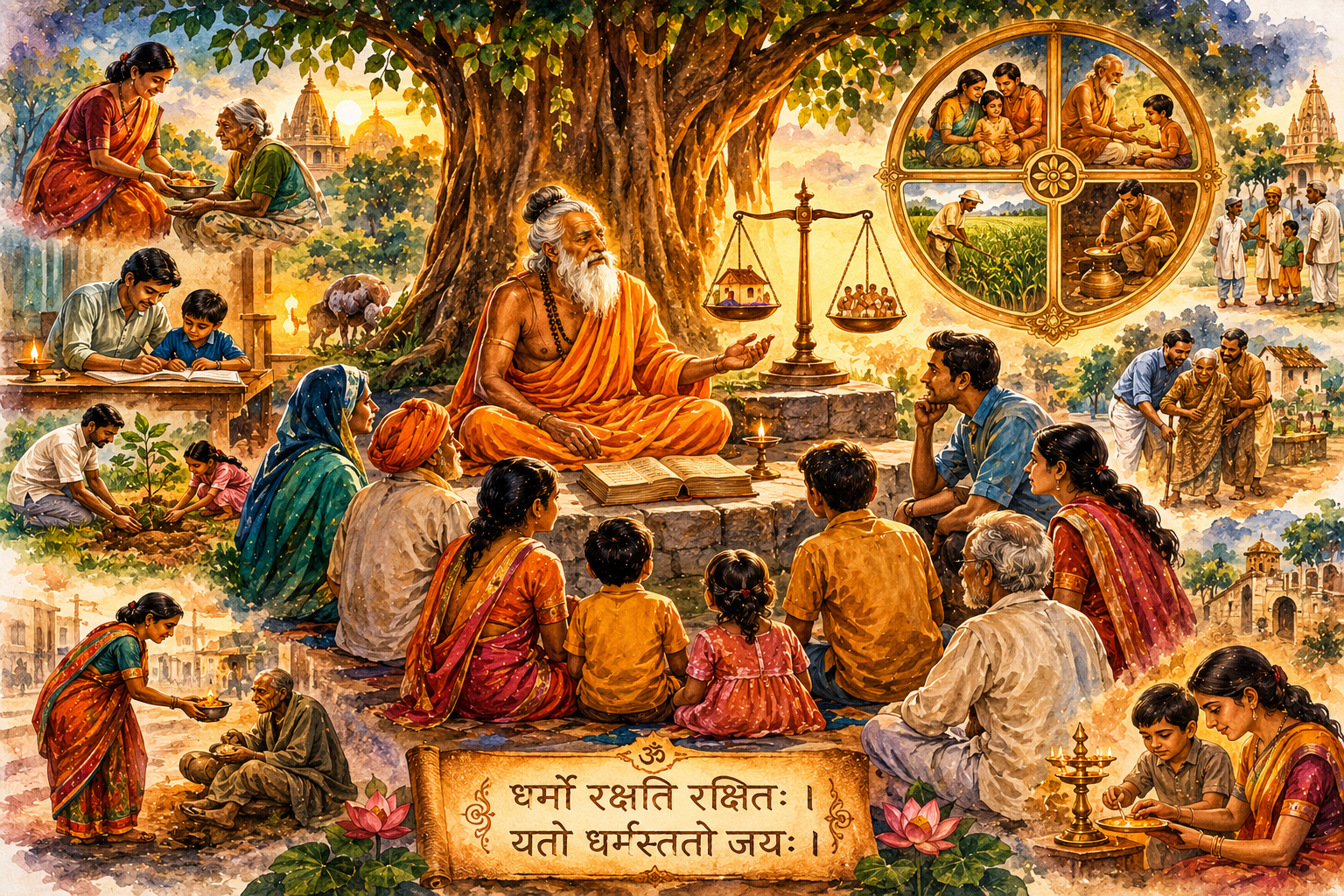
How Do Communities Sustain Collective Life?
Every society faces the same basic problem: how do people live together without constantly coercing one another? Anthropology has offered several answers. Norms regulate behaviour. Institutions create expectations. Authority establishes rules. Sanctions discourage violations. Socialization teaches individuals what their community considers appropriate. But there is another possibility.
What if social order depends not only upon what people are forced to do, but upon what they believe they ought to do?
This is where the Indic concept of Dharma becomes anthropologically significant. The difficulty begins with translation. Dharma is often translated as “religion,” “law,” “duty,” “righteousness” or “morality.” Each captures something, but none exhausts the concept. In different Indic traditions, Dharma can refer to normative order, appropriate conduct, obligation, justice and the principles that sustain relationships and social life.
The Taittirīya Upaniṣad gives us an unusually direct formulation:
सत्यं वद । धर्मं चर । स्वाध्यायान्मा प्रमदः ।
Satyaṃ vada, dharmaṃ cara, svādhyāyān mā pramadaḥ.
“Speak truth. Practise dharma. Do not neglect self-study.”
Notice something important. The instruction is not simply “obey the law.”
It is “dharmaṃ cara” — practise Dharma. Dharma here is something that must be lived.
From Regulation to Responsibility
This distinction is important for anthropology. A legal system can prohibit theft because the state threatens punishment. But a functioning society requires something more than fear of punishment. People return borrowed objects. Parents care for children. Teachers teach. Communities maintain shared spaces. Professionals observe standards even when nobody is watching. Not every social action is produced by surveillance.
Much of social life depends upon internalized responsibility. This is where kartavya becomes important—the sense of what one is obligated to do. Similarly, ācāra refers to established conduct and customary practice.
Manusmṛti 2.12 famously identifies several sources through which Dharma becomes recognizable:
वेदः स्मृतिः सदाचारः स्वस्य च प्रियमात्मनः ।
एतच्चतुर्विधं प्राहुः साक्षाद् धर्मस्य लक्षणम् ॥
The verse identifies Veda, Smṛti, sadācāra and what is agreeable to the self as four indicators of Dharma. Whatever one’s position on the text itself, the sociological implication is fascinating: normative order is not imagined exclusively as legislation imposed by a sovereign authority. It is also connected with tradition, established conduct and lived practice.
This moves us from rule-following to social cultivation.
Dharma and the Web of Relationships
The Indic conception becomes even more interesting when applied to relationships.
- A parent has obligations toward a child.
- A child has obligations toward parents.
- A teacher has obligations toward students.
- A student has obligations toward the teacher.
- A ruler has Rājadharma.
- A householder has responsibilities toward family, guests and society.
These relationships do not function merely because a central authority constantly supervises them. They work because people recognize reciprocal expectations. This is why Dharma can be studied as an anthropology of social order.
It asks not simply:
“What rules govern society?”
but:
“What makes people voluntarily recognize obligations toward one another?”
The Self-Regulating Society
The famous formulation from Manusmṛti 8.15 makes the principle even sharper:
धर्म एव हतो हन्ति धर्मो रक्षति रक्षितः ।
तस्माद् धर्मो न हन्तव्यो मा नो धर्मो हतोऽवधीत् ॥
Dharma, when violated, destroys; Dharma, when protected, protects. Therefore Dharma should not be violated. (siva.sh)
This is not merely a moral slogan. It can be read as a theory of institutional feedback.
- If trust is destroyed, relationships become expensive.
- If obligations disappear, contracts multiply.
- If social restraint weakens, surveillance expands.
- If families cease to care for dependants, institutions of welfare must grow.
- If public responsibility declines, the state must compensate through greater regulation.
In other words: When internal responsibility declines, external enforcement becomes more necessary.
That is an important hypothesis for social science.
Dharma Is Not Simply Obedience
There is another crucial distinction. Dharma does not mean blind obedience to every existing social practice. The Mahābhārata itself is filled with situations in which competing duties collide. Arjuna’s dilemma in the Bhagavad Gītā is precisely a crisis of competing obligations.
Kṛṣṇa tells him:
श्रेयान्स्वधर्मो विगुणः परधर्मात्स्वनुष्ठितात् ।
स्वधर्मे निधनं श्रेयः परधर्मो भयावहः ॥
Śreyān svadharmo viguṇaḥ paradharmāt svanuṣṭhitāt.
The point is not simply that everyone should mechanically perform an assigned role. The larger problem is the relationship between action, responsibility, context and one’s appropriate duty.
Dharma therefore requires judgment. And this makes it particularly interesting anthropologically.
A society governed entirely by rules asks:
“What does the rule say?”
A Dharma-oriented society must also ask:
“What is appropriate here?”
From Power to Moral Authority
This provides an alternative to theories of social order that begin primarily with coercion. Power matters. Institutions matter. Law matters. Punishment matters. But they are not the whole story. A society in which every interaction requires surveillance would be practically impossible.
Civilization depends upon millions of acts that occur without enforcement.
- The shopkeeper trusts the customer.
- The teacher prepares the lesson.
- The neighbour helps during a crisis.
- The family cares for an elderly member.
- The citizen follows a queue even when nobody is watching.
These ordinary acts are almost invisible to political theory because they are precisely the acts that require no political intervention. Yet they are the infrastructure of social order.
The Mahābhārata captures this relationship through the well-known formulation:
यतो धर्मस्ततो जयः
Yato dharmas tato jayaḥ — “Where there is Dharma, there is victory.”
The deeper meaning need not be reduced to military victory. It can be read as the proposition that durable success depends upon maintaining the normative order that makes collective life possible.
Toward an Anthropology of Responsibility
This opens an important research direction. Anthropology has extensively studied norms, sanctions, institutions, authority and social control. An Indic anthropology can add another question:
How is responsibility cultivated before coercion becomes necessary?
That requires studying Dharma alongside kartavya, ācāra, ṛṇa, yajña, seva and reciprocity. It requires examining family life, occupational communities, temples, village institutions, educational traditions and political authority not merely as structures of control but as systems for cultivating responsibility.
And it also requires intellectual caution. Dharma cannot simply be romanticized as a perfect historical system. Indian society, like every historical society, contained conflict, hierarchy, exclusion and violations of its own normative ideals. But precisely because societies can violate their ideals, the ideals themselves become analytically important. The central insight is therefore not that Dharma eliminates power.
It is that power is not sufficient to explain social order.
A civilization survives not merely because people are prevented from harming one another. It survives because people learn to ask:
- What do I owe?
- To whom am I responsible?
- What is appropriate here?
- What should I do even when nobody is watching?
That is the anthropological significance of Dharma. Social order begins where external compulsion ends—and responsibility begins.
