
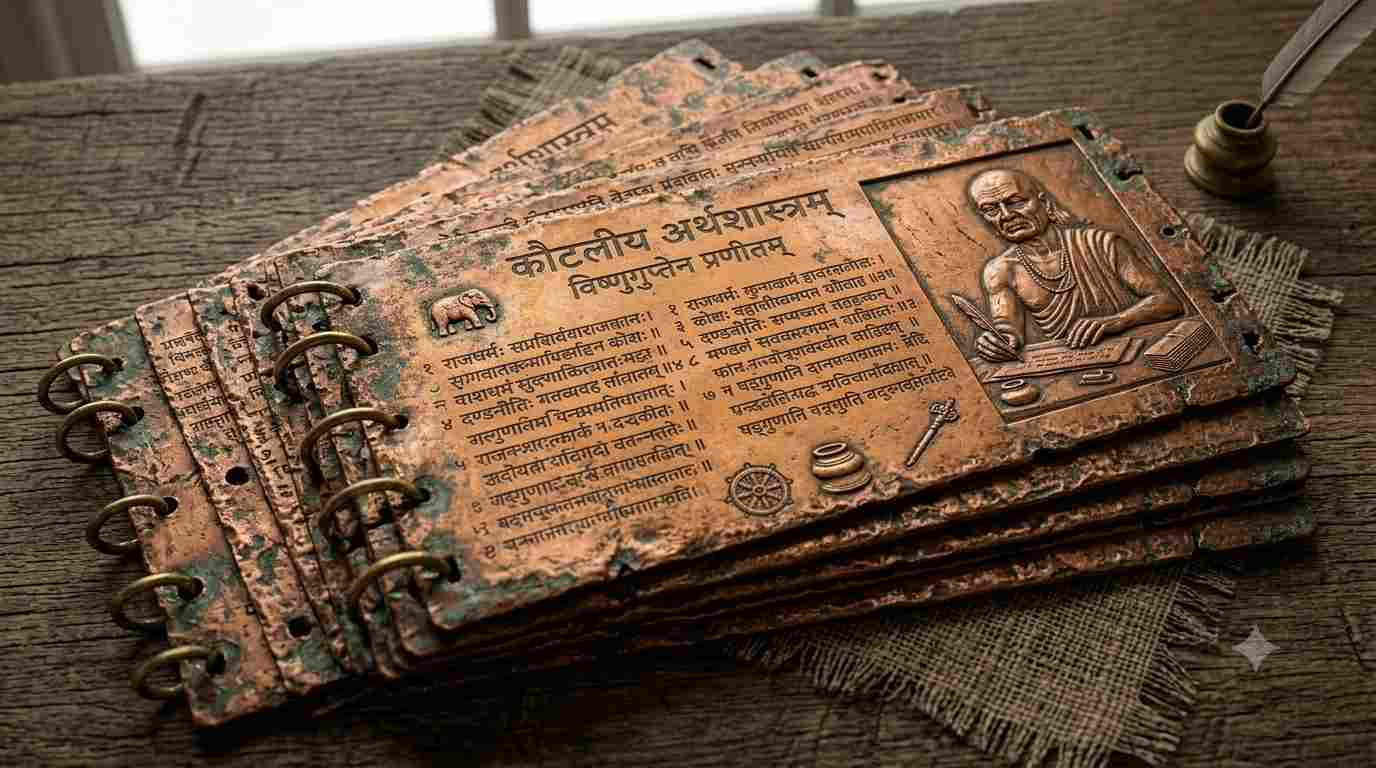
The Journey of the Arthaśāstra: The Book That Shaped an Empire and Disappeared
There is a particular kind of wonder I feel when I think about the Arthaśāstra. It is not simply the wonder of discovering an old book. It is the wonder of discovering that a book which had once belonged to one of the great intellectual traditions of India could almost disappear from our knowledge altogether. Think about that for a moment. A text dealing with kingship, administration, taxation, law, espionage, diplomacy, war and the management of a state disappears from the intellectual field for centuries. People know that such a work once existed. Later writers refer to it. Its name survives. But the complete text itself is no longer available.
Then, in 1905, a Sanskrit scholar and librarian named R. Shamasastry came across a manuscript of the Arthaśāstra at the Oriental Research Institute in Mysore, then the Mysore Oriental Library. The manuscript had come into the collection from the Tanjore region and was lying among manuscripts that had not yet been properly identified. Shamasastry recognised what he had found, transcribed the fragile palm-leaf manuscript and began the work that would eventually bring Kautilya’s Arthaśāstra back into the world of scholarship. The Sanskrit edition appeared in 1909, followed by his English translation in 1915.
Whenever I read this story, I find myself wondering what it must have felt like to realise that the manuscript in front of you was not merely another Sanskrit text in a library collection. It was a work whose very existence had been known largely through references elsewhere. The manuscript itself, written in Grantha script, is associated with a much later period than the composition of the work. In other words, the manuscript Shamasastry found was not the Mauryan original. It was a surviving copy of a much older intellectual tradition.
That distinction is essential. What was rediscovered in 1905 was not the world of Kautilya itself. What was rediscovered was the textual doorway through which we could once again enter that world.
What is the Arthaśāstra?
The first difficulty comes with the name.
Arthaśāstra is often translated as the “Science of Economics”. I find that translation far too narrow. Artha certainly includes wealth and material prosperity, but its meaning is considerably wider. It concerns the material foundations of life: livelihood, resources, security, political power and the conditions necessary for an ordered and prosperous society. It is one of the four puruṣārthas, alongside dharma, kāma and mokṣa.
The Arthaśāstra, therefore, is not an economics textbook in the modern sense. It is much closer to a comprehensive science of statecraft.
It asks how a king should be educated, how ministers should be selected, how officials should be supervised, how agriculture and trade should be organised, how revenue should be collected, how courts should function, how crime should be controlled, how spies should operate, how alliances should be formed and how war should be prepared and conducted.
The breadth of the subject is one of the things that first surprised me. I had encountered the Arthaśāstra initially through its reputation as a book of political cunning and espionage. But the more closely I read about the work, the more that image seemed inadequate. The text is just as concerned with irrigation, agriculture, mines, forests, weights and measures, urban administration and the functioning of officials as it is with spies and enemies.
It is a book about making a state work.
Kautilya, Chanakya or Vishnugupta?
Then comes the question everyone asks: Who wrote it?
The traditional answer is familiar. Kautilya, Chanakya and Vishnugupta are generally identified with one another, and Chanakya is remembered as the celebrated adviser associated with Chandragupta Maurya and the establishment of Mauryan power. That tradition cannot simply be ignored. It is deeply embedded in the Indian memory of the text.
But neither can we treat it as an established historical fact without qualification. Modern scholarship has raised substantial questions about the authorship and dating of the surviving Arthaśāstra. The work itself refers to earlier teachers and traditions of statecraft, and scholars have identified differences in style, terminology and conceptual layers. Patrick Olivelle’s study, for example, argues that the surviving work represents a complex history of transmission and compilation rather than the straightforward product of one author writing at one moment. The form in which we have the text is generally placed in the early centuries CE, even though parts of the material may preserve much earlier traditions.
This creates an interesting problem for me as a reader. If I insist that every sentence must have been written personally by Chanakya during the time of Chandragupta, I may actually reduce the importance of the text. I turn a long intellectual tradition into the achievement of a single extraordinary individual.
I find it more productive to think of the Arthaśāstra as a layered tradition of political knowledge, with older material incorporated, reorganised and transmitted over time. There may well be a Mauryan core. There may also be substantial later material. The final redaction appears to belong considerably later than the Mauryan period. The exact boundaries between these layers remain a matter of scholarly debate.
And this changes the way I read the book. I no longer ask only, “What did Chanakya think?” I ask: What kind of political knowledge had accumulated in India to make a work like this possible? That, to me, is the much larger question.
The Political World Behind the Text
The Arthaśāstra becomes easier to understand once I place it against the political landscape of early historic India.
This was not a world of one unified Indian state. The age of the mahājanapadas was marked by numerous competing political formations. The traditional list of sixteen mahājanapadas gives us a sense of this plural political landscape. Among them, Magadha gradually became the most formidable power. Kingdoms competed with other kingdoms, while gaṇasaṅghas and oligarchic political communities followed different institutional arrangements. Control over territory, agriculture, trade routes, resources and strategic locations mattered enormously.
Then came the upheavals associated with Alexander’s invasion of northwestern India and the political changes that followed. When I look at this world, the Arthaśāstra begins to make much more sense. This was a competitive political environment. A ruler could not afford to think only about his own court. He had to understand neighbouring powers, allies, enemies, potential enemies, internal factions and shifting relationships.
This is the world behind the famous maṇḍala theory, the “circle of kings”, and the doctrine of the six measures of foreign policy. These ideas are sometimes presented as clever tricks of diplomacy. But I see something more systematic in them. The text is trying to understand interstate politics as a field governed by changing interests and circumstances. The political world is not static. Friend and enemy are not necessarily permanent categories. Geography matters. Relative strength matters. Timing matters.
Once I see that, the Arthaśāstra stops looking like a strange catalogue of political tricks and starts looking like a systematic attempt to understand a competitive interstate order.
The Making of the Text
The dating remains debated, but I find it safest to think in terms of layers rather than a single date.
Some of the material may preserve traditions going back to the late fourth century BCE and the Mauryan age. The text in its surviving form, however, is generally dated by modern scholarship to the early centuries CE. Olivelle’s work has been particularly influential in emphasising that the received text reflects multiple stages of composition and transmission.
The structure of the work is itself extraordinary. The Arthaśāstra tells us that it consists of 15 books, 150 chapters, 180 topics and 6,000 ślokas.
The first book deals with the training of the king and the foundations of government. The second turns heavily towards the activities of superintendents and the administration of the economic and productive life of the state. The third deals with law. The fourth concerns the suppression of crime. The fifth discusses the conduct of courtiers and internal political management.
Then the focus widens. Book Six introduces the circle of states. Book Seven develops the six measures of foreign policy. Later books turn towards calamities, military preparation, war, relations with confederacies, powerful enemies, siege warfare and secret means. And finally, the fifteenth book turns back upon the work itself and explains its organisation as a śāstra. When I look at this structure, one thing becomes clear: this is not a loose collection of advice to kings. It is an attempt to organise political knowledge systematically.
That systematisation may itself be one of the greatest achievements of the text.
How Could Such a Book Disappear?
This is perhaps the part of the story that fascinates me most. How does a work of this scale simply vanish? The answer may be less mysterious than it first appears. Indian manuscripts were often written on palm leaves. Palm leaves are remarkably beautiful, but they are not immortal. They are vulnerable to humidity, insects, handling and decay. They need to be preserved and, crucially, copied periodically.
A text survives not because its first manuscript survives forever, but because somebody keeps making another manuscript. That requires scribes, teachers, libraries, patrons and institutions. When those networks weaken, technical texts can disappear surprisingly quickly.
The Arthaśāstra was also a specialised work. It was not a devotional text meant for widespread ritual recitation. It belonged to a particular intellectual field concerned with governance and statecraft. If institutions stopped teaching or copying it, its manuscript tradition could become fragile. But “lost” does not necessarily mean “forgotten”.
This distinction matters enormously. The complete text disappeared from view, but knowledge associated with nīti, kingship, diplomacy, administration and political conduct continued in other forms. Later Sanskrit literature preserved fragments of older political traditions, and political ideas circulated through nīti texts, kāvya, narrative literature and other intellectual traditions.
A book can disappear while some of its ideas continue to live. That possibility has changed the way I think about intellectual history itself. We tend to imagine influence through surviving books. But traditions can survive through fragments, quotations, adaptations, practices and memories.
1905: The Book Returns
And then comes that extraordinary moment in 1905.
R. Shamasastry was working at the Oriental Research Institute in Mysore, examining and cataloguing Sanskrit manuscripts. Among the manuscripts that had not yet been properly identified was a palm-leaf manuscript of the Arthaśāstra. He recognised it, transcribed it and began preparing it for publication.
In 1909, the Sanskrit text was published.
Six years later, in 1915, Shamasastry’s English translation appeared.
The effect was enormous. Until then, scholars had known of the Arthaśāstra largely through references and quotations scattered across other works. Suddenly there was a substantial treatise that could actually be read, edited, translated and compared. The discovery did not merely add another Sanskrit manuscript to a library. It changed the possibilities of writing the history of Indian political thought.
And I find myself returning to this point again and again. The rediscovery happened in the twentieth century, but the intellectual shock it produced concerned a much older India. For a long time, European scholarship had often treated Indian political thought as secondary, derivative or primarily religious in character. The Arthaśāstra complicated that picture dramatically. Here was a work concerned with administration, public finance, intelligence networks, diplomacy, military organisation, law and the practical functioning of government.
Whatever one thinks of its individual prescriptions, it was impossible to dismiss this as a civilisation that had thought only about metaphysics and renunciation.
Why the Rediscovery Matters
The comparison with Machiavelli’s The Prince was almost inevitable. Both works deal seriously with power, rulers, political calculation and the difficult realities of governing. But the comparison can also become misleading if it is pushed too far.
The Arthaśāstra is vastly broader in scope. Machiavelli asks penetrating questions about political power and the survival of states and rulers. Kautilya’s text, as we have it, goes much further into the machinery of government itself: taxation, agriculture, mines, trade, courts, officials, urban management, espionage, military organisation, diplomacy and the economy of the state.
That breadth is what makes the work so important to me. The Arthaśāstra does not merely ask how a ruler acquires power. It asks what a state must do with power once it has it. That is a different question. And perhaps this is where the rediscovery becomes relevant to our own understanding of India.
When we speak of Indian intellectual heritage, the conversation often moves quickly towards philosophy, spirituality, metaphysics, yoga and religious thought. Those are undoubtedly major parts of the tradition. But India also produced an extraordinarily sophisticated literature on political organisation and statecraft.
The Arthaśāstra reminds me that these two histories should never have been separated so completely. A civilisation that debated dharma also debated artha. A civilisation that thought deeply about liberation also thought about revenue, administration and war. A civilisation that produced philosophical systems also produced theories of intelligence, diplomacy and political strategy.
That is why the story of the Arthaśāstra is not merely the story of a lost manuscript. It is the story of a lost intellectual possibility—and of its recovery. I began with the mystery of how such a book could disappear. I end with an even more interesting mystery: how much political knowledge can disappear from memory while the civilisation that produced it continues to evolve?
The rediscovery of the Arthaśāstra in 1905 gave us one answer. The manuscript returned, and with it returned an entire vocabulary for thinking about the Indian state. But what exactly was inside this book that fascinated scholars across the world? Why did generations of political thinkers continue to echo ideas that had survived even when the original text itself had vanished?
That is where I want to go next. (Part two)
