
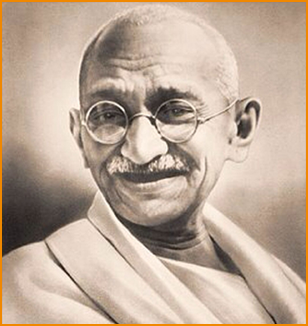
Who was Mahatma Gandhi?
Mohandas Karamchand Gandhi, widely known as Mahatma Gandhi, was one of the twentieth century’s most influential political leaders, moral philosophers, social reformers, educationists, and civilizational thinkers. Born on 2 October 1869 in Porbandar, Gujarat, Gandhi transformed India’s struggle for independence by grounding political action in ethics, truth, non-violence, and self-discipline. His influence, however, extends far beyond politics into education, economics, village development, environmental thought, religion, law, and human civilization.
Educated in law in London and shaped by his experiences in South Africa, Gandhi developed the principles of Satyagraha (Truth-Force) and Ahimsa (Non-violence) as instruments for resisting injustice. Returning to India in 1915, he led mass movements including the Champaran Satyagraha, Non-Cooperation Movement, Salt March, Civil Disobedience Movement, and Quit India Movement, mobilizing millions through disciplined non-violent action.
Yet Gandhi regarded politics as only one dimension of a much larger civilizational project. He believed that true Swaraj was not merely political independence from colonial rule but the cultivation of self-governing individuals, self-reliant villages, ethical institutions, and a society rooted in truth, restraint, and service. His vision challenged both colonial domination and the excesses of industrial modernity, arguing that civilization should be judged by moral and human development rather than material accumulation alone.
His philosophy of Sarvodaya (the welfare of all), Trusteeship, Gram Swaraj, Nai Talim (Basic Education), and constructive social work sought to build a decentralized society where economic life, political authority, and social relationships were grounded in responsibility rather than exploitation.
Through his writings in Young India, Harijan, Navajivan, and his seminal work Hind Swaraj, Gandhi articulated a comprehensive critique of modern civilization while proposing an alternative model centered on ethical living, local economies, participatory democracy, and spiritual freedom.
Although his ideas continue to inspire movements for civil rights, peace, sustainability, and social justice across the world, they also remain the subject of critical debate, particularly regarding caste, industrialization, political strategy, and social reform. This ongoing engagement reflects the enduring significance of Gandhi as one of modern India’s most influential and widely studied thinkers.
Major Works
Gandhi’s writings cover politics, ethics, education, economics, religion, health, village development, and civilization. His most significant works include:
- Hind Swaraj (Indian Home Rule) (1909)
- An Autobiography: The Story of My Experiments with Truth
- Constructive Programme: Its Meaning and Place
- Satyagraha in South Africa
- Key to Health
- Village Swaraj
- The Science of Satyagraha
- My Religion
- India of My Dreams
- Collected Works of Mahatma Gandhi (100 Volumes)
- Thousands of articles published in Young India, Harijan, Indian Opinion, and Navajivan
Areas of Thought
- Swaraj and Self-Rule
- Satyagraha
- Ahimsa
- Gram Swaraj
- Trusteeship
- Sarvodaya
- Nai Talim (Basic Education)
- Ethics and Politics
- Decentralized Economy
- Sustainable Living
- Religion and Public Life
- Social Reform
- Civilizational Critique
- Leadership through Service
Selected Quotations
On Change
“Be the change that you wish to see in the world.”
(Frequently attributed to Gandhi, though the exact wording does not appear in his published works. If you are building a scholarly page, it is better not to include this as an authenticated Gandhi quotation.)
On Truth
“Truth is God.”
A concise expression of Gandhi’s mature religious philosophy, reversing the more common formulation “God is Truth.”
On Non-Violence
“Non-violence is the greatest force at the disposal of mankind.”
On Swaraj
“Real Swaraj will come not by the acquisition of authority by a few, but by the acquisition of the capacity by all to resist authority when abused.”
On Service
“The best way to find yourself is to lose yourself in the service of others.”
On Poverty
“Recall the face of the poorest and the weakest man whom you may have seen, and ask yourself if the step you contemplate is going to be of any use to him.”
Often known as Gandhi’s Talisman.
On Education
“By education I mean an all-round drawing out of the best in child and man—body, mind and spirit.”
On Civilization
“Civilization, in the real sense of the term, consists not in the multiplication of wants but in the deliberate and voluntary reduction of wants.”
Hind Swaraj
On Means and Ends
“They say ‘means are, after all, means.’ I would say ‘means are, after all, everything.'”
On Freedom
“Freedom is not worth having if it does not include the freedom to make mistakes.”
On Duty
“The best politics is right action.”
On Democracy
“The spirit of democracy cannot be imposed from without. It has to come from within.”
Legacy
Mahatma Gandhi redefined politics by placing ethics at its centre and demonstrated that lasting social transformation depends as much on moral character as on political institutions. His ideas of Satyagraha, Gram Swaraj, Trusteeship, and constructive work continue to influence debates on democracy, sustainability, peace, decentralized governance, education, and civilizational development.
For the Centre for Indic Cultural and Social Studies, Gandhi is especially significant not merely as a freedom leader but as a thinker who developed an integrated framework linking the individual, village, economy, society, and civilization. His writings remain an indispensable resource for understanding alternative models of development, ethical public life, and the relationship between spirituality and social organization.
