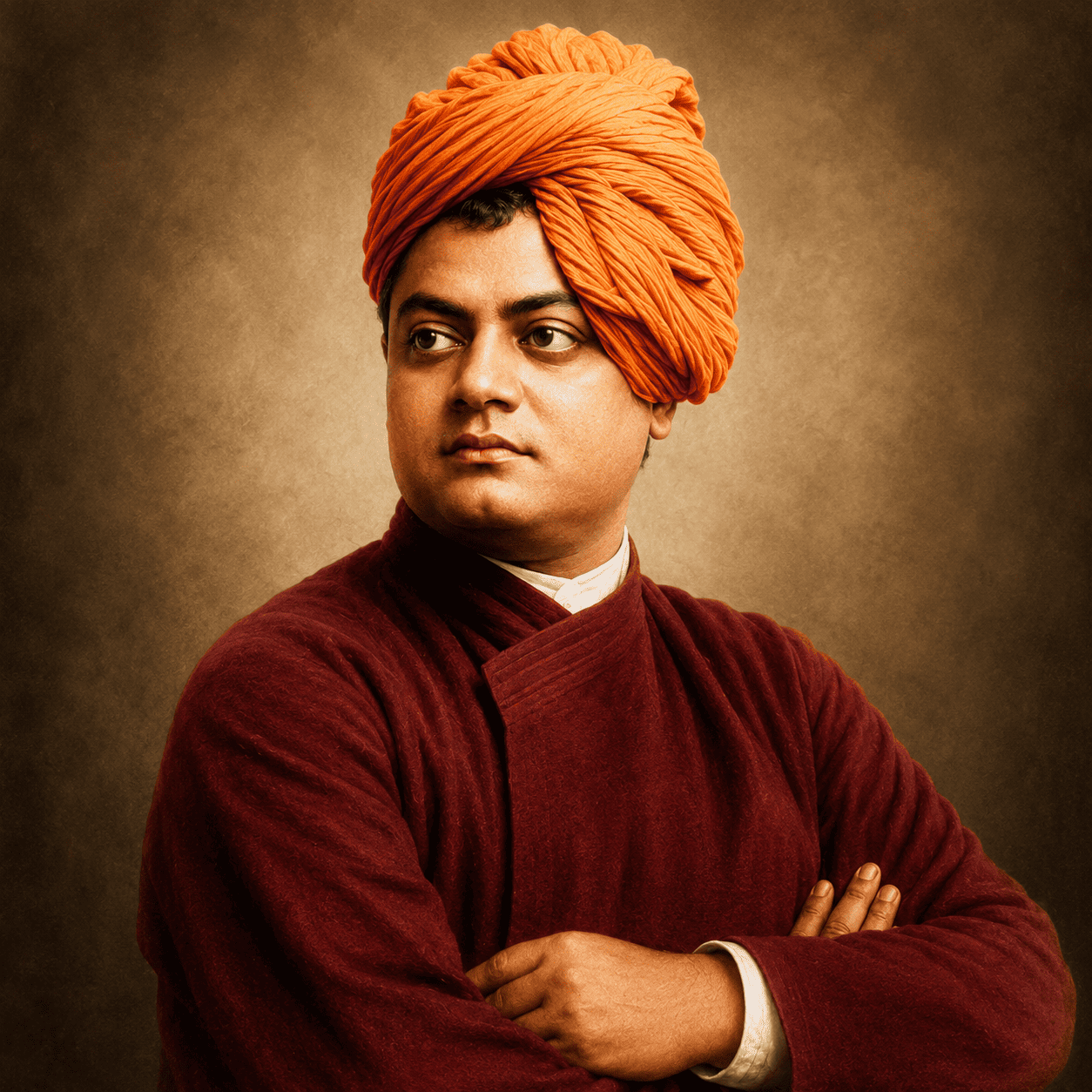
Who was Swami Vivekananda?
Swami Vivekananda was one of modern India’s greatest spiritual leaders, philosophers, educationists, social reformers, and nation-builders. A disciple of Sri Ramakrishna Paramahamsa, he played a pivotal role in introducing Vedanta and Yoga to the modern world while simultaneously awakening India’s civilizational confidence during the colonial era.
Born as Narendranath Datta on 12 January 1863 in Calcutta (now Kolkata), Vivekananda possessed an exceptional intellect and was deeply influenced by Western philosophy, Indian scriptures, science, and rational inquiry. His spiritual quest culminated in his meeting with Sri Ramakrishna, whose teachings transformed him from a brilliant seeker into one of the most influential spiritual teachers of modern times.
Following his guru’s passing, Vivekananda travelled extensively across India as a wandering monk. These journeys exposed him to the immense poverty, social inequalities, and cultural resilience of the Indian people. He came to believe that India’s regeneration required not merely political freedom but the awakening of human character, education, self-confidence, social service, and spiritual strength.
In 1893, Vivekananda represented Hinduism at the World’s Parliament of Religions in Chicago. His opening words, “Sisters and Brothers of America,” received a standing ovation and introduced the world to the universal vision of Vedanta. Through his lectures across America and Europe, he presented Indian philosophy as a rational, universal, and experiential tradition rather than merely a system of religious beliefs.
Returning to India, Vivekananda founded the Ramakrishna Math and the Ramakrishna Mission in 1897, institutions dedicated to combining spiritual realization with organized social service. He believed that service to humanity was itself a form of worship, encapsulated in his teaching:
“Shiva Jnane Jiva Seva” — Serve every human being as God Himself.
Unlike many religious leaders, Vivekananda addressed virtually every dimension of national life—education, women, science, economics, religion, social harmony, youth, labour, and civilization. His philosophy of Practical Vedanta sought to bring the highest spiritual ideals into everyday life, arguing that spirituality should strengthen society rather than withdraw from it.
Although he lived only 39 years, Vivekananda profoundly shaped modern India’s intellectual and spiritual landscape. Leaders such as Mahatma Gandhi, Sri Aurobindo, Rabindranath Tagore, Subhas Chandra Bose, and countless others acknowledged his influence. Today he is widely regarded as one of the principal architects of India’s modern renaissance, whose ideas continue to inspire scholarship, nation-building, education, leadership, and civilizational thought.
Major Works
Swami Vivekananda’s writings and lectures cover philosophy, spirituality, education, society, nationalism, psychology, and practical ethics. His principal works include:
- Raja Yoga
- Jnana Yoga
- Karma Yoga
- Bhakti Yoga
- Practical Vedanta
- Lectures from Colombo to Almora
- Inspired Talks
- The East and the West
- My Master
- Addresses at the Parliament of Religions
- Complete Works of Swami Vivekananda (9 Volumes)
- Letters of Swami Vivekananda
Areas of Thought
- Practical Vedanta
- Education and Character Building
- Nation Building
- Human Development
- Social Service
- Youth Leadership
- Women’s Empowerment
- Science and Spirituality
- Universal Religion
- Civilizational Renewal
- Interfaith Harmony
- Fearlessness and Self-Confidence
- Ethics and Leadership
- Individual and Social Transformation
Selected Quotations
On Human Potential
“All power is within you; you can do anything and everything.”
On Education
“Education is the manifestation of the perfection already in man.”
One of the foundational principles of his educational philosophy.
On Courage
“Strength is life; weakness is death.”
On Action
“Arise, awake, and stop not till the goal is reached.”
Inspired by the Katha Upanishad, this became Vivekananda’s enduring call to purposeful action.
On Service
“They alone live who live for others; the rest are more dead than alive.”
On Fearlessness
“Be fearless.”
A recurring message throughout his lectures and letters.
On Self-Confidence
“You cannot believe in God until you believe in yourself.”
On Nation Building
“The main hope of a nation lies in the proper education of its youth.”
On Character
“We want that education by which character is formed, strength of mind is increased, the intellect is expanded, and by which one can stand on one’s own feet.”
On Religion
“Each soul is potentially divine.”
The central philosophical principle of Practical Vedanta.
On Universal Brotherhood
“We believe not only in universal toleration but we accept all religions as true.”
From his address at the World’s Parliament of Religions, Chicago, 1893.
On Responsibility
“Take up one idea. Make that one idea your life.”
On Leadership
“Purity, patience, and perseverance are the three essentials to success.”
On Society
“So long as millions live in hunger and ignorance, I hold every man a traitor who, having been educated, pays not the least heed to them.”
Legacy
Swami Vivekananda redefined the relationship between spirituality and society by demonstrating that the highest ideals of Vedanta could become the foundation for education, service, leadership, and national regeneration. He inspired generations to view India not merely as a political entity but as a living civilization with a universal mission rooted in spiritual wisdom and human dignity.
His philosophy of Practical Vedanta, man-making education, fearlessness, and service to humanity continues to influence scholars, educators, policymakers, spiritual leaders, and social reformers across the world. For contemporary civilizational studies, Vivekananda remains one of the most important thinkers for understanding the relationship between the individual, society, culture, and the future of humanity.
