
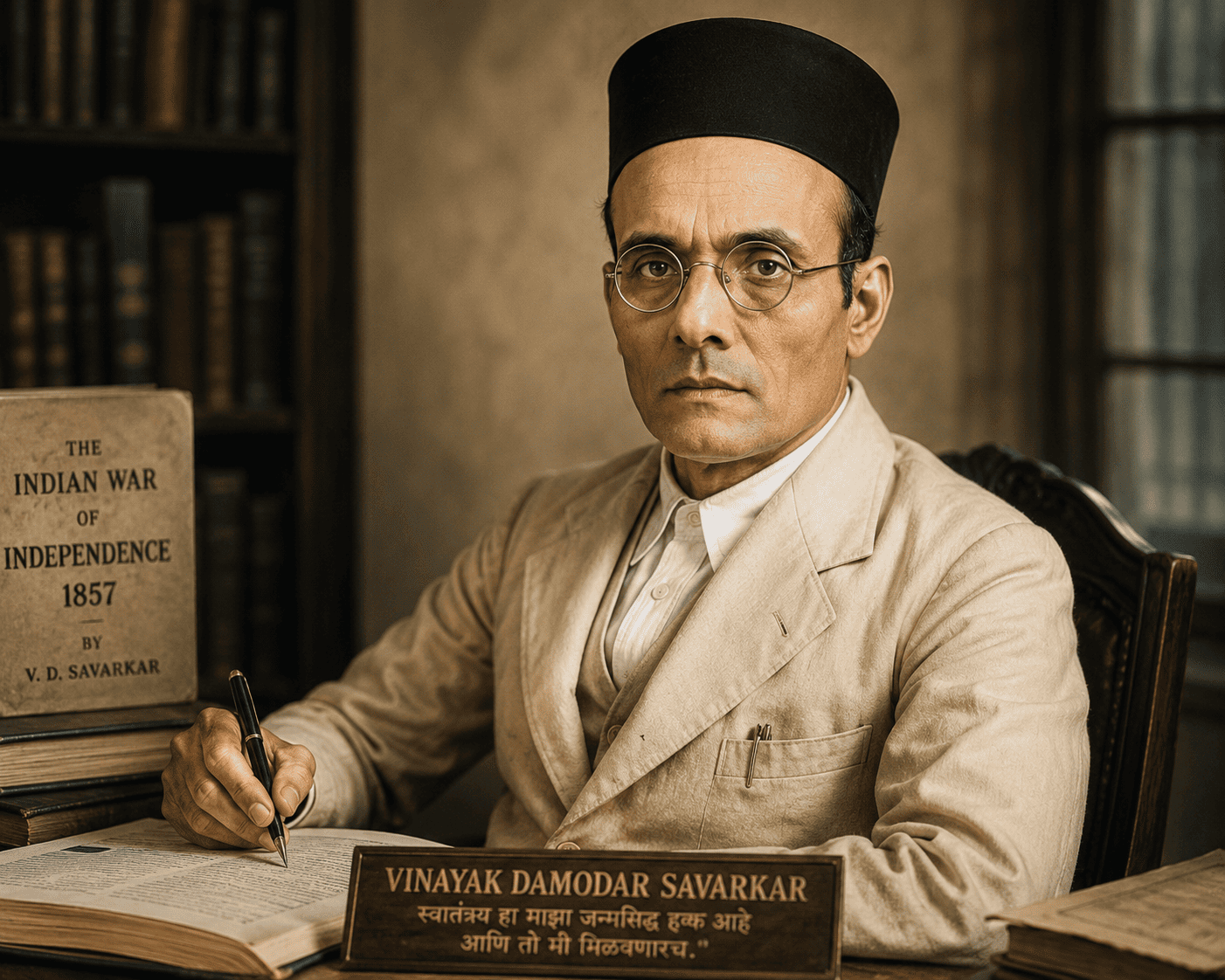
Who was Veer Savarkar?
Vinayak Damodar Savarkar, popularly known as Veer Savarkar, was an Indian revolutionary, political thinker, historian, poet, social reformer, and one of the most influential intellectuals of twentieth-century India. Born on 28 May 1883 in Bhagur near Nashik, Maharashtra, Savarkar emerged as a leading revolutionary during the early struggle against British colonial rule. While studying in London, he organized revolutionary networks at India House, inspired nationalist movements across Europe, and authored The Indian War of Independence 1857, one of the earliest works to interpret the uprising of 1857 as a national war for freedom rather than merely a sepoy mutiny.
Arrested in 1910, he was sentenced to two life imprisonments (50 years) and transported to the Cellular Jail in the Andaman Islands. During and after his imprisonment, Savarkar produced an extensive body of literature on history, political philosophy, social reform, nationalism, language, military preparedness, and cultural identity.
He was also a prolific Marathi poet, playwright, and essayist. His writings continue to influence debates on nationalism, Hindutva, Indian history, social reform, and civilizational identity. At the same time, many of his ideas remain the subject of significant scholarly and political debate, making him one of modern India’s most discussed and contested thinkers.
Major Works
Some of Savarkar’s principal writings include:
- The Indian War of Independence 1857 (1909)
- Essentials of Hindutva (Hindutva: Who is a Hindu?) (1923)
- Six Glorious Epochs of Indian History
- Hindu Pad-Padshahi
- My Transportation for Life (Majhi Janmathep)
- Letters from Andamans
- Historic Statements
- Hindu Rashtra Darshan
- Kamala (epic poem)
- Sanyasta Khadga (play)
- Ushap
- Numerous collections of speeches, essays, poems, and political writings.
Selected Quotations
On History
“A nation that has no consciousness of its past has no future. Equally true it is that a nation must develop its capacity not only of claiming a past but also of knowing how to use it for the furtherance of its future.”
Source: The Indian War of Independence 1857 (Introduction).
On Freedom
“Liberty is not begged for; it is won.”
Source: Theme repeatedly expressed in Savarkar’s revolutionary writings and speeches; reflected in Historic Statements.
On Humanity
One of Savarkar’s most remarkable—and often overlooked—passages reads:
“After all there is throughout this world, so far as man is concerned, but a single race—the human race, kept alive by one common blood, the human blood.”
Source: Hindutva: Who is a Hindu?, p. 90 (1923 edition).
On National Identity
“A Hindu means a person who regards this land of Bharatvarsha, from the Indus to the Seas, as his Fatherland (Pitribhumi) and Holy Land (Punyabhumi).”
Source: Hindutva: Who is a Hindu?
On National Language
“Sanskrit shall be our Deva Bhasha… and Sanskrit-nishtha Hindi our Rashtra Bhasha.”
Source: Hindutva.
On Strength
“The sword of revolution is sharpened on the whetting stone of ideas.”
Source: Attributed to Savarkar in his revolutionary writings and speeches; frequently associated with his political philosophy.
On Social Reform
Savarkar consistently argued that social divisions weakened national unity:
“Untouchability is a sin against humanity.”
Source: Reflected throughout his speeches and campaigns against caste discrimination during the Ratnagiri years.
On Scientific Temper
Savarkar repeatedly advocated a rational outlook and criticized superstition. One of his recurring ideas may be summarized as:
“Religion must never stand in the way of scientific progress.”
Source: Themes developed in his essays on rationalism and social reform, including Historic Statements.
On Organization
“Organization is strength.”
Savarkar repeatedly emphasized that national freedom depended upon disciplined social organization rather than sentiment alone.
Source: Historic Statements.
On National Defence
“A nation that neglects military preparedness invites slavery.”
This idea appears throughout his speeches advocating national security and military training.
Source: Historic Statements.
On Duty
“Sacrifice is meaningful only when it strengthens the nation.”
Source: Speeches collected in Historic Statements.
On Civilization
Savarkar viewed civilization as something to be continuously defended and renewed through cultural confidence, historical memory, and collective effort—a theme developed across Six Glorious Epochs of Indian History and Hindu Pad-Padshahi.
