Must Society Be Destroyed Before It Can Be Improved?
Few ideas have shaped modern political imagination as deeply as the idea of revolution. For more than two centuries, societies across the world have repeatedly been told that the existing order is fundamentally illegitimate and that genuine change requires a decisive break with the past. Monarchies had to be overthrown, old classes eliminated, institutions dismantled and social relations reconstructed. The promise was not merely reform but the creation of a new society, and often a new human being.
This idea continues to possess extraordinary emotional power. The language changes with time, but the aspiration remains familiar: the Long March, the total revolution, the struggle for azadi, the liberation of the oppressed and the promise of a final transformation. The underlying assumption is that the existing social order is so deeply broken that correction is insufficient. Society must therefore be dismantled and rebuilt according to a new ideological design.
But does society actually work like a machine that can be disassembled, redesigned and reconstructed? Or is society closer to a living system whose continuity, memory and relationships are themselves necessary conditions for change?
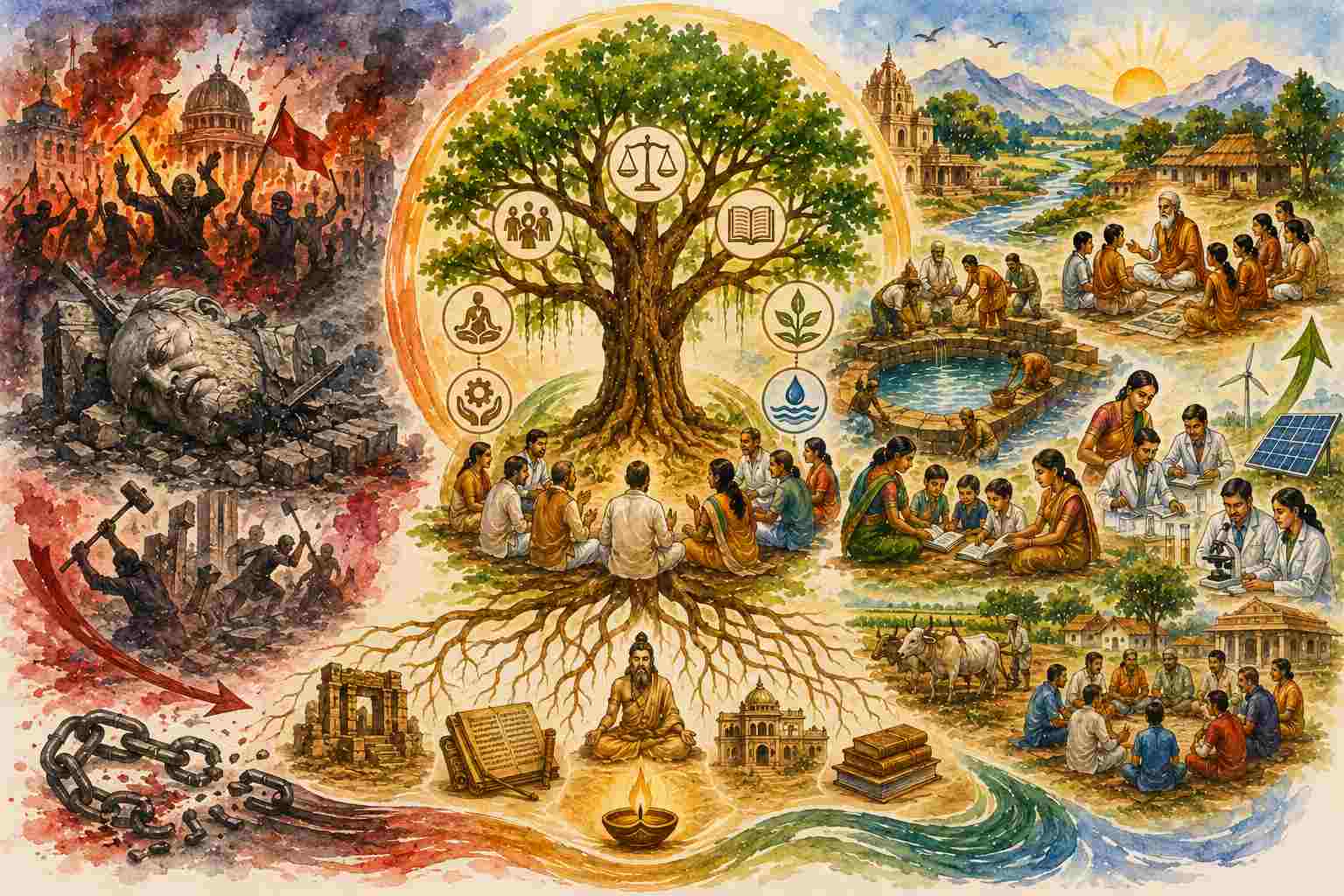
This question forms the foundation of the Indic framework of Holistic Transformation. It does not deny injustice, suffering or the need for radical social change. Its argument is more fundamental: the transformation of society need not always require the destruction of its civilizational foundations. A society may require deep change, but the method, direction and pace of change cannot be separated from the complex nature of society itself.
The Revolutionary Imagination and the Promise of a New World
Modern revolutionary thought emerged from particular historical experiences. The French Revolution challenged hereditary monarchy and aristocratic privilege. The Industrial Revolution created new forms of wealth alongside unprecedented urban poverty and class conflict. Marxism interpreted these developments through the conflict between classes and argued that capitalism would eventually give way to a fundamentally different social order. Revolutionary movements across the twentieth century subsequently attempted to transform economic structures, political institutions, cultural practices and even human consciousness.
Different ideologies proposed different destinations, but many shared a similar structure of thought. History was understood as moving toward a decisive transformation, and the existing order was often treated as something that had to be overcome rather than gradually reformed. The old world represented oppression, while the new world represented liberation.
The problem was not the desire for change. Every civilization requires change. The deeper problem emerged when a theoretical blueprint became more important than the society upon which it was imposed. Human beings were treated as material that could be reorganized according to an ideological design, while institutions carrying accumulated social knowledge were sometimes dismissed simply because they belonged to the past.
The twentieth century demonstrated the dangers of this assumption. Revolutions promised equality, freedom and human emancipation, but revolutionary states also produced coercion, political repression and the concentration of power in the hands of those who claimed to represent the future. The attempt to destroy one hierarchy often produced another. The promise of liberation could lead to the creation of institutions more intrusive than those they replaced.
The central lesson is not that every revolution fails or that every inherited institution deserves preservation. Rather, it is that societies are more complex than ideological blueprints. They contain relationships, memories, identities, informal institutions and forms of knowledge that cannot simply be removed without consequences.
The Indic Starting Point: Society as a Living Order
The Indic civilizational approach begins from a different understanding of social reality. Society is not simply a contract created at one moment in history, nor merely an economic structure determined by relations of production. It is a layered order extending across generations.
The individual exists within a family, the family within a community, the community within institutions and the institutions within a wider civilizational order. Each level influences the others. A disturbance at one level can eventually affect the entire system.
This does not mean that the existing order is automatically dharmic. It means that the correction of one part must consider its relationship with the whole. A society cannot be transformed by examining only class, only economics, only law or only politics. Human life involves dharma, artha, kāma and mokṣa; therefore, a framework that seeks to transform society through a single variable will inevitably leave other dimensions unaddressed.
This is where the distinction between revolutionary replacement and holistic transformation becomes important. The revolutionary imagination often asks: what must be destroyed so that a new society can emerge? The Indic framework begins with a different question: what has become distorted, what must be corrected, what must be preserved and what new capacity must be created?
These are not conservative questions in the narrow political sense. They may produce profound change. But they reject the assumption that destruction is itself evidence of progress.
Dharma and the Idea of Continuous Correction
Dharma is often misunderstood as a rigid collection of inherited rules. Such an understanding cannot explain the enormous diversity of practices, schools and institutions within Bharatiya civilization. At a deeper level, Dharma provides a framework for examining whether relationships, actions and institutions are sustaining an appropriate order.
A living order does not remain healthy by remaining permanently unchanged. It requires continuous correction. Families change. Institutions become rigid. Customs may become detached from their original purpose. Social practices may produce injustice. Political arrangements may become exploitative. Economic systems may create concentration and exclusion. A society that refuses correction will eventually damage itself.
The Indic response, therefore, is not blind preservation of everything inherited from the past. Tradition is not valuable simply because it is old. A practice must also be examined in relation to Dharma.
This introduces an important distinction. Continuity does not mean permanence, and transformation does not require rupture. A society can remain connected to its civilizational memory while changing its social institutions. The form may change while deeper principles continue to guide the transformation.
This is why Dharma cannot be understood as a utopian blueprint. It does not promise a final perfect society. Human desires remain diverse, circumstances change and new imbalances continuously emerge. The purpose of social life is therefore not the creation of a permanent earthly paradise but the continuous restoration of balance in changing conditions.
From Utopia to Renewal
The desire to create a perfect society has repeatedly produced a particular danger in modern politics. Once an ideal future is imagined as historically inevitable, those who oppose it can easily be portrayed as obstacles to progress. The future becomes morally pure, while the present becomes expendable.
The Indic civilizational imagination generally shows greater skepticism toward the idea of a final political destination. Human life itself is understood through multiple purushārthas, and no single goal can permanently absorb the others. The pursuit of artha without Dharma can become destructive, but a social order that suppresses material life cannot endure either. Individual aspiration matters, but social relationships also matter. Spiritual goals may be central to some individuals, but society cannot be organized as though every person possesses the same aspiration.
This plural understanding produces a different model of transformation. Social harmony is not a final state achieved once and for all. It is something that requires continual adjustment.
A river remains a river because water flows, not because it remains frozen. Similarly, a civilization preserves continuity not by preventing change but by developing mechanisms through which change can occur without destroying its entire social memory.
This is the deeper meaning of holistic transformation. It is not slow change merely for the sake of gradualism. Some circumstances may require rapid intervention. The question is whether the transformation strengthens the long-term capacity of society to renew itself or whether it destroys existing capacities in the hope that a new order will somehow emerge from the ruins.
Transformation from Within
The philosophical idea of Satkāryavāda provides a useful conceptual parallel. In the Sāṅkhya tradition, the effect is understood as emerging from causes in which it exists in a latent form. Transformation is therefore not creation out of absolute nothingness but the manifestation of potential already present within a process.
This idea can be carefully extended to society. Social transformation becomes more durable when it develops from capacities that already exist within society. A community may possess moral resources, institutional structures, historical memories and intellectual traditions that can be mobilized for reform. Change need not always be imported as a complete blueprint from outside.
This does not mean that every solution must be ancient or indigenous. Societies can learn from one another. Bharat has always absorbed external ideas, technologies and institutions. The issue is whether an idea is mechanically imposed or creatively adapted to the social reality in which it operates.
A transformation that emerges through dialogue with society has a greater possibility of becoming socially embedded. A transformation imposed entirely through coercion may survive while coercive power remains strong but become fragile when that power weakens.
Reform as a Civilizational Process
Bharatiya history offers numerous examples of major social and intellectual transformations occurring without requiring the destruction of the entire civilization. Buddhism emerged through a powerful critique of existing assumptions while developing an entirely new institutional and philosophical order. Jain thought presented its own understanding of ethics, metaphysics and human responsibility. The Bhakti movements transformed religious and social expression by bringing new languages, communities and devotional forms into the public sphere.
These developments were not always peaceful, and historical realities must not be romanticized. Yet Bharat repeatedly demonstrated the capacity to produce new intellectual and social movements without requiring one tradition to erase every other tradition from the civilizational landscape.
The nineteenth and twentieth centuries produced another phase of transformation. Swami Vivekananda called for social and spiritual regeneration while drawing upon Vedāntic resources. Mahatma Gandhi challenged colonialism, untouchability, economic exploitation and political centralization without arguing that Bharat had to erase its civilizational inheritance. Vinoba Bhave attempted to address land inequality through the voluntary Bhoodan movement, seeking transformation of social relationships rather than the violent seizure of property. Sri Aurobindo combined political liberation with the idea of an evolutionary transformation of human consciousness.
Their methods differed, and they should not be artificially merged into one school. Yet they shared an important departure from revolutionary nihilism: the transformation of society required the transformation of the human being and the renewal of social institutions, not merely the replacement of one ruling structure by another.
Why Holistic Transformation Matters Today
The contemporary relevance of this framework is significant. Modern societies are increasingly divided between those who defend inherited institutions regardless of their failures and those who demand their complete destruction. Both positions underestimate the complexity of social transformation.
A family cannot be transformed only through legislation. An economy cannot be transformed only through moral appeals. Environmental problems cannot be solved only through technology. Caste discrimination cannot be addressed merely by changing political leadership. Educational reform cannot succeed by altering textbooks alone.
Social problems are interconnected, and therefore transformation must also be interconnected.
An Indic framework of holistic transformation examines change at multiple levels simultaneously: the individual, family, community, institution, economy, ecology and state. It recognizes that a transformation at one level may fail if the supporting conditions at another level remain unchanged.
For example, economic self-reliance cannot be studied separately from skills, family structures, community institutions, ecological conditions and local resources. Environmental sustainability cannot be separated from patterns of consumption, cultural attitudes toward nature, local resource governance and technological capacity. Social equality cannot be reduced to formal legal rights when everyday relationships, educational opportunities and institutional practices continue to reproduce exclusion.
Holistic transformation therefore does not reject political reform. It asks political reform to recognize its limits. The state is important, but it cannot transform society alone. Civil society matters, but communities cannot address every structural injustice independently. Individual moral change matters, but structural conditions also shape human behaviour.
No single institution possesses the complete solution.
Transformation Without Civilizational Amnesia
The central principle of this framework is that a civilization should be capable of changing without forgetting itself. The past should not be worshipped blindly, but neither should it be treated as an obstacle that must be erased before progress can begin.
Every civilization carries accumulated knowledge. Some of it remains valuable; some requires reinterpretation; some may need to be abandoned. The challenge of social transformation is therefore one of discrimination and judgment. What should be preserved? What should be reformed? What should be discarded? What new institutions are required?
This requires a more difficult intellectual approach than either reactionary preservation or revolutionary destruction. Both extremes provide simple answers. One says that what existed should continue because it is inherited. The other says that what exists should disappear because it is imperfect.
Holistic transformation accepts neither simplicity. It recognizes that societies are living systems carrying both wisdom and distortion, resilience and injustice, continuity and decay.
The Holistic Transformation Framework
The framework of Holistic Transformation over Violent Revolution therefore rests upon several connected principles. Society must be understood as a living and interconnected system rather than as a machine that can be redesigned through a single ideological blueprint. Transformation must examine multiple levels of social life rather than focusing exclusively on political power or economic structure. Dharma provides a principle of continuous correction rather than a promise of final perfection. Reform should remain capable of preserving valuable social and civilizational capacities while addressing injustice and dysfunction. Finally, lasting change requires not only the transformation of institutions but also the participation and renewal of the communities and individuals who sustain them.
The framework is not an argument against deep transformation. It is an argument against the belief that destruction is the only proof of transformation. Some of the deepest changes in human history have occurred through long processes of intellectual challenge, institutional adaptation, moral reform and social reorganization.
Bharat’s civilizational experience suggests that endurance and transformation need not be opposites. A society may survive because it changes, while its ability to change may depend upon the resources preserved from its past.
The objective, therefore, is neither to protect the existing society from every challenge nor to destroy society in pursuit of an imagined utopia. It is to develop the capacity for continuous self-correction. A civilization remains alive when it can recognize imbalance, confront injustice, reform institutions and generate new possibilities without severing itself from every source of its accumulated memory.
This is the central proposition of the Indic framework of Holistic Transformation: a healthy society does not have to choose between stagnation and destruction. It must learn how to renew itself.
