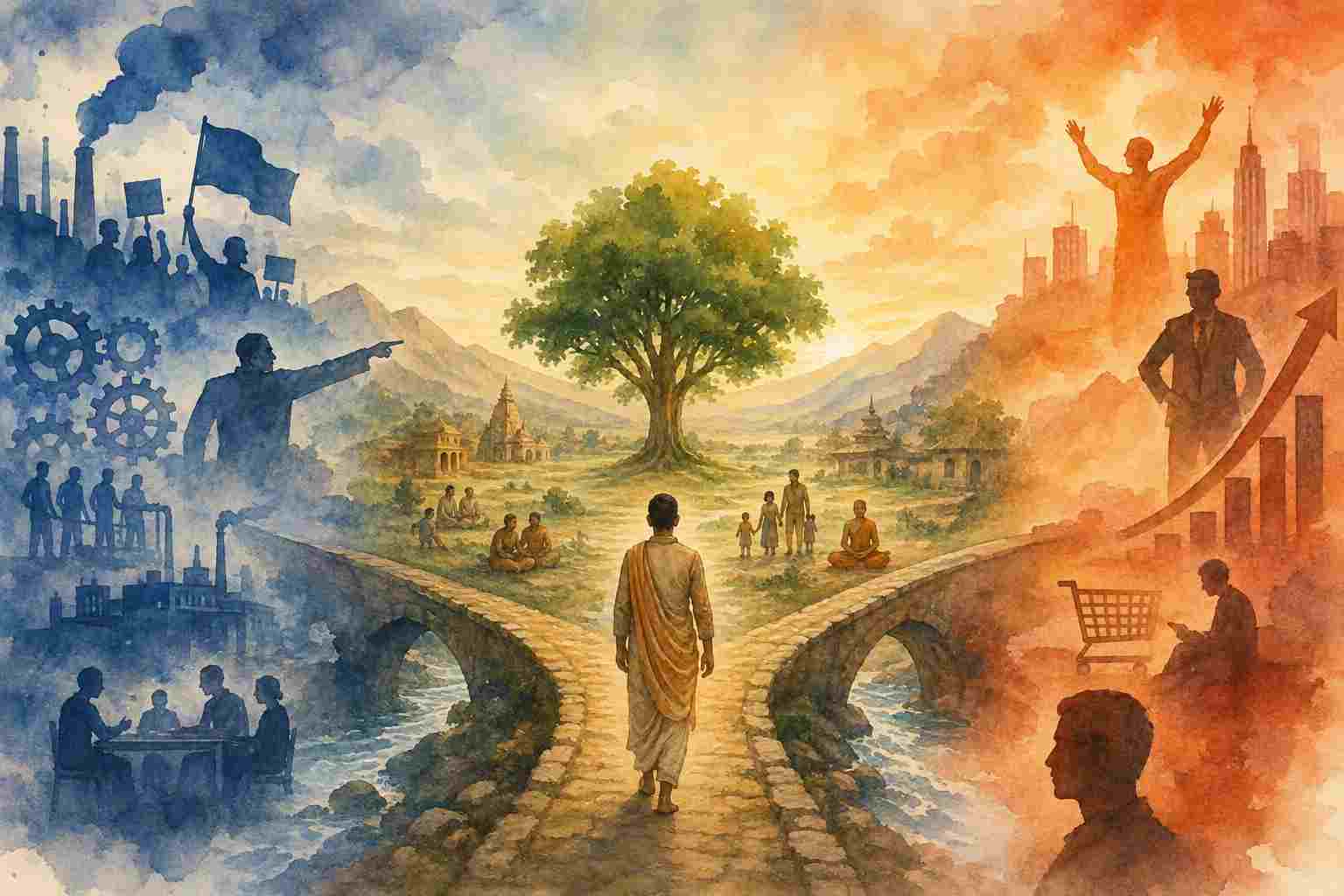
Must Bharat Always Choose?
Modern political thought often presents society as a choice between two extremes.
Left or Right? Market or State? Individual or Collective? Rights or Duties? Capitalism or Socialism? Conservatism or Progressivism?
These binaries are now so familiar that they appear universal. But are they? Even the political language of “Left” and “Right” emerged from a specific European historical experience. Liberalism, socialism, communism and modern conservatism developed in response to particular conditions: industrialization, class conflict, political revolution, the rise of the nation-state and the transformation of European society.
These traditions have produced powerful intellectual insights. The question is not whether they should be rejected. The real question is simpler: Are they sufficient to understand every civilization? Must Bharat locate itself somewhere on a spectrum created elsewhere? The Third Way Model begins with this question.
The Problem of Binary Thinking
Every ideology tends to identify one central problem and then organize society around its solution. Liberalism places the individual at the centre and asks how freedom can be protected from excessive social and political control. Marxism places material relations and class conflict at the centre and asks how economic inequality can be overcome. Capitalism emphasizes markets and individual initiative. Socialism emphasizes collective ownership and state intervention. Each identifies something real. Human freedom matters. Economic inequality matters. Social responsibility matters. Political authority matters. The difficulty begins when one dimension becomes the explanation for everything.
Can human beings be understood only as autonomous individuals? Can all social relations be reduced to class conflict? Can markets alone sustain society? Can the state successfully organize every dimension of life?
A civilization is more complicated. Bharatiya thought historically approached this problem differently. It rarely began by declaring one human goal to be absolute. Instead, it asked how multiple and often competing dimensions of life could be accommodated.
This is the foundation of the Third Way.
Madhyama Mārga: Not Weak Compromise
The Indic idea of the Madhyama Mārga, or middle path, is often misunderstood as compromise. It is not simply standing halfway between two positions. If one person walks toward a cliff from the left and another from the right, standing exactly between them is hardly wisdom. The middle path is not mathematical moderation. It is the search for the appropriate relationship between competing forces. Bharatiya thought repeatedly confronted such tensions:
- Artha and Dharma
- freedom and responsibility
- individual aspiration and social obligation
- diversity and unity
- continuity and change
- material prosperity and higher human purpose
The question was not: Which one should permanently defeat the other? The question was: How can imbalance be prevented without destroying legitimate human aspirations? This is fundamentally different from an ideological system that seeks the permanent victory of one principle.
The Individual and Society
The central divide between modern ideologies often concerns the individual. Individualist traditions fear the domination of society over the person. Collectivist traditions fear the fragmentation of society through excessive individualism.
The Indic framework begins from a different observation: the individual is neither completely independent nor merely a cell within a collective body. The individual is born within relationships.
One enters Kutumb, participates in community, inherits language and culture, learns through teachers, and gradually becomes connected to larger social and civilizational circles. Yet these relationships do not necessarily eliminate individuality. Rather, they provide the social environment through which individuality itself develops.
The relationship can therefore be represented differently:
| Binary Model | Third Way Model |
|---|---|
| Individual vs Society | Individual within society |
| Rights vs Duties | Rights and duties |
| Market vs State | Society as an independent sphere |
| Uniformity vs fragmentation | Unity with diversity |
| Revolution vs stagnation | Regeneration and reform |
The Third Way is therefore not merely a political position between capitalism and socialism. It is a different way of understanding the relationship between individual, society and authority.
Society Is Not Empty Space
Modern political models frequently imagine society through two dominant actors: the individual and the state. But what exists between them? This question is crucial for understanding Bharat.
The space between individual and state has historically been occupied by numerous social institutions: Kutumb, Jāti, Śreṇi, Sampradāya, Gram, temple institutions, educational traditions and local communities. These institutions performed functions that modern systems often transfer either to markets or the state. They generated social obligations, economic cooperation, knowledge transmission and cultural continuity. This does not mean that every historical institution was perfect or should be reproduced unchanged. The point is analytical: society possesses its own institutional life and cannot be reduced either to individual contracts or state administration.
This intermediate civilizational space is central to the Third Way Model.
Dharma as a Regulating Principle
What prevents one sphere from becoming absolute? The Indic answer is Dharma. Dharma does not simply mean religion, nor is it equivalent to modern law. It provides a principle of relationship, obligation and appropriate order.
- Artha is legitimate, but wealth cannot become the only goal.
- Kāma is legitimate, but desire cannot become the only regulator.
- Mokṣa represents transcendence, but society cannot be organized as though every human being has withdrawn from worldly life.
The Purushartha framework is therefore important because it recognizes plural human goals.
| Extremity | Indic Question |
|---|---|
| Unlimited wealth | What is wealth for? |
| Total equality through control | What happens to freedom and diversity? |
| Absolute individual freedom | Who sustains social responsibility? |
| Total social control | Where does individual agency remain? |
| Revolution through destruction | What knowledge and institutions are lost? |
The Third Way does not assume that one answer fits every question. It requires balance according to context.
Yajña and the Principle of Reciprocity
The Third Way is also social. The concept of Yajña provides a powerful alternative to both isolated self-interest and permanent social conflict. It recognizes that human beings receive from systems larger than themselves and therefore also have obligations to contribute.
The individual receives from family, society, knowledge traditions, ecology and previous generations. The question follows naturally: What does the individual return? This is the principle of reciprocity.
A society cannot survive if every individual only maximizes personal gain. But neither can it flourish if individual aspiration is permanently suppressed for an abstract collective.
The Third Way therefore seeks neither radical individualism nor complete collectivization. It seeks a society in which freedom is connected with responsibility and receiving is connected with contribution.
Beyond Utopian Politics
The twentieth century demonstrated the dangers of absolute political certainty. States attempted to redesign economies, societies and even human behaviour around singular ideological visions. Some promised equality. Others promised unlimited freedom. Both often discovered that human societies resist simple designs.
The Indic civilizational approach historically showed less interest in discovering a final social arrangement and more interest in maintaining balance within a changing world. This is why the Third Way is not a utopian blueprint.
It does not ask: What is the perfect society? It asks: What prevents society from falling into destructive imbalance?
This makes the model adaptive rather than doctrinaire.
A Third Way, Not a Halfway Point
The Third Way Model should therefore not be misunderstood as a compromise between Left and Right.
It is not: 50% capitalism + 50% socialism = an Indic model.
It begins from a different set of questions.
- How are individual and social interests connected?
- What institutions exist between family and state?
- How can economic activity remain socially embedded?
- How can diversity exist without civilizational fragmentation?
- How can change occur without destroying continuity?
- How can rights and duties reinforce rather than negate one another?
These questions move the discussion beyond imported ideological coordinates.
The Third Way as a Civilizational Framework
Bharat need not choose between intellectual extremes simply because modern political language demands a choice. The challenge is not to reject Left or Right. Both contain important insights and must be engaged through Purvapaksha. The challenge is to recognize their historical limits and ask whether Bharatiya categories can generate additional possibilities.
The Third Way Model therefore begins with Madhyama Mārga: not the comfort of compromise, but the discipline of balance. It studies society through relationships rather than binaries, through intermediate institutions rather than only individual and state, and through Dharma rather than ideological absolutism.
Its fundamental question is not: Should Bharat be Left or Right?
It is: Why must Bharat begin by accepting that these are the only two directions?
Perhaps the most important civilizational task is not choosing between inherited extremes. Perhaps it is learning how to see the space that lies beyond them.
