Can a society survive for millennia without remaining politically unified?
History presents us with an interesting puzzle. Empires rise and fall, kingdoms emerge and disappear, political boundaries change and institutions are replaced. Yet civilizations do not necessarily disappear when the political systems that once governed them collapse. Bharat is perhaps one of the most striking examples of this phenomenon. Across centuries of political fragmentation, the rise and fall of kingdoms, foreign invasions, colonial rule and the transformation of social institutions, a recognizable civilizational continuity persisted.
How do we explain this?
Modern social sciences usually direct us towards institutions, States, classes, markets and individuals. These categories help us understand important aspects of society, but they may not be sufficient to explain a civilization whose continuity survived repeated changes in political authority. The State changed, but society continued. Dynasties disappeared, yet cultural memories remained. Centres of learning were destroyed, but knowledge continued to survive through teachers, texts, households and communities.
The question, therefore, is not simply how political institutions survive. It is how a society continues to reproduce itself when particular institutions disappear.
This is where the Sanātana Model of Society begins.
The Puzzle of Civilizational Continuity
Much of modern political thought assumes, consciously or unconsciously, that society requires a stable political structure to maintain continuity. The modern nation-State, in particular, has become the primary framework through which we understand collective identity, citizenship, territory and political belonging. Yet the history of Bharat does not fit comfortably into this assumption.
For long periods, the subcontinent was not governed by a single political authority. Kingdoms, empires and local powers emerged simultaneously. Political boundaries changed frequently. Yet people across distant regions remained connected through pilgrimage, sacred geography, philosophical traditions, networks of learning, trade and cultural practices. Political sovereignty was often divided, but civilizational relationships continued across political boundaries.
This does not mean that Bharat was historically united in every sense or that political divisions did not matter. Political power deeply shaped social life. Wars produced destruction, and political changes transformed institutions. However, the civilization itself was not entirely dependent upon the survival of one political structure. When one kingdom disappeared, the society did not have to begin again from zero.
Why? Because civilizational memory was not stored in one place.
It existed in families and communities, in teachers and students, in sacred places and pilgrimage routes, in languages and texts, and in institutions that often operated across political boundaries. Society possessed multiple mechanisms through which its knowledge, practices and relationships could continue from one generation to another.
The Sanātana Model attempts to understand this distributed continuity.
Society as a Continuum of Relationships
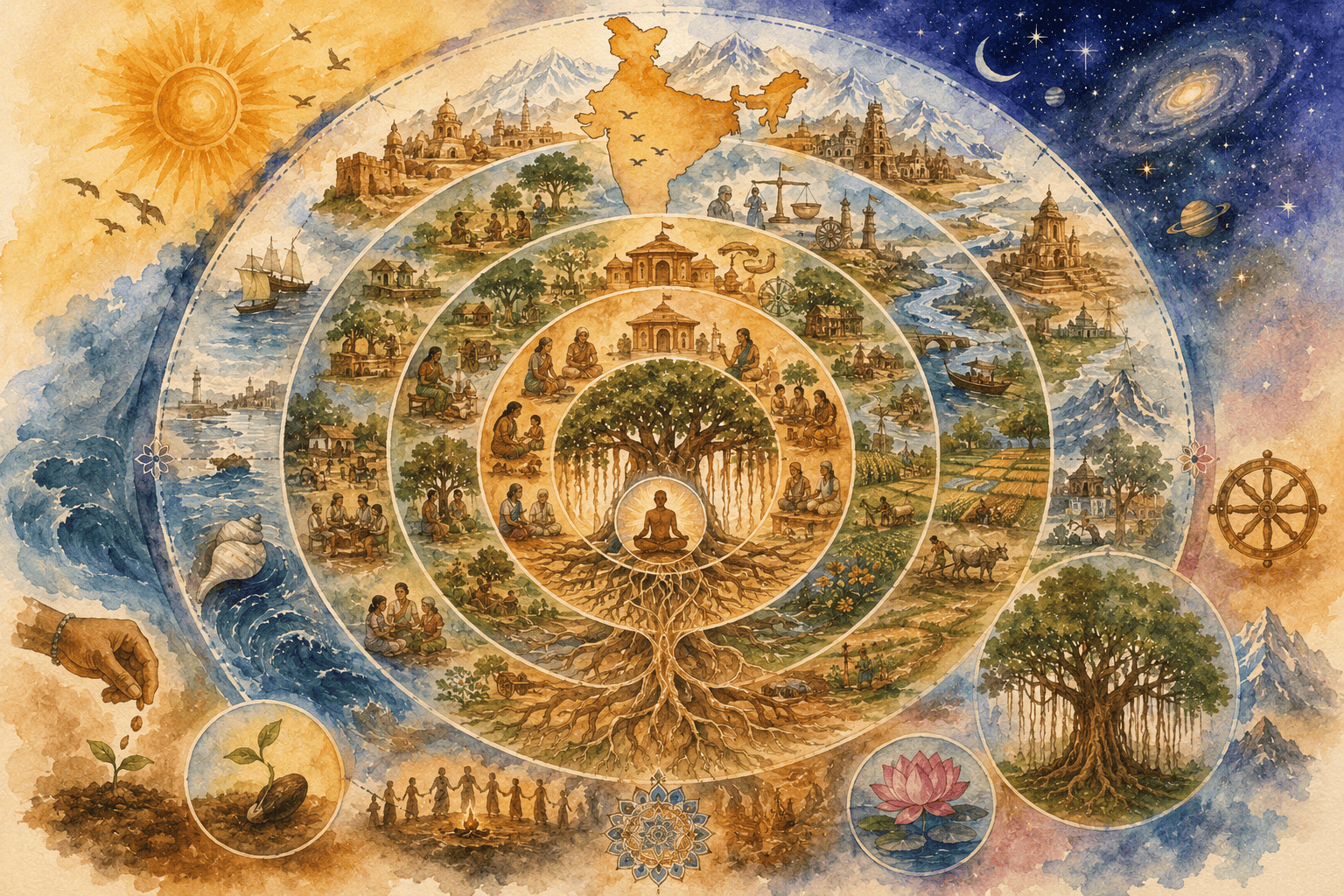
The Sanātana Model begins with the idea that society is not merely a collection of individuals brought together by contracts, interests or laws. Nor is it simply a population governed by the State. The individual exists within a continuum of relationships that gradually expands into larger spheres of social and civilizational life.
We may broadly understand this movement as: Vyakti → Kutumba → Samaja → Janapada → Rashtra → Jagat
However, these should not be understood as rigid steps in a hierarchy. The individual does not leave one sphere behind to enter another. Each level remains connected with the others. A person exists within the family, but the family also participates in the wider society. Communities create institutions and relationships that extend beyond particular households. Regions develop their own distinctive forms while participating in wider civilizational networks. Political and civilizational belonging emerges through these expanding relationships.
The Kutumba, for example, is not simply a private household. It is often a site of intergenerational transmission. Language, stories, practices, memory and ethical habits can pass through the family even when political institutions change. A community similarly does more than gather families together. It develops networks of cooperation, collective responsibility and social institutions. The transmission of knowledge may occur through formal institutions, but also through the Guru–Shishya parampara, occupations, families and local traditions.
Society, in this understanding, is created not simply by adding individuals together, but by sustaining relationships between them.
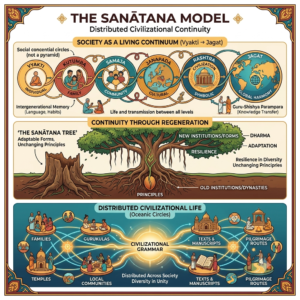 This gives us a different way of understanding social continuity. A family does not merely reproduce individuals; it also carries memory into the next generation. A teacher does not merely transfer information; a parampara can transmit an intellectual tradition. A pilgrimage does not merely move people geographically; it can connect distant communities to a shared sacred geography.
Civilizational continuity is therefore produced through countless acts of transmission occurring simultaneously across society.
Sanātana: Continuity Through Regeneration
The term Sanātana is usually translated as “eternal.” But if eternity is understood as permanent sameness, we immediately encounter a difficulty. Nothing in human society remains completely unchanged. Languages evolve, political systems disappear, institutions are replaced and social practices transform.
Bharat itself has changed continuously.
Therefore, the continuity of a civilization cannot mean that every historical form remains permanently frozen. A more useful way of understanding Sanātana is through continuity of principles and the capacity to regenerate them through changing forms.
A simple analogy may help. A seed does not resemble the tree that eventually grows from it. Yet the tree contains the same generative possibility that allows new seeds and future trees to emerge. Continuity exists, but it does not exist through sameness.
Something similar may be observed in social life.
A particular institution may disappear, but the relationship or principle that sustained it may continue elsewhere. The form of the Gurukula may change, yet the importance of the teacher–student relationship and parampara can continue in new educational environments. A political kingdom may disappear, but the wider understanding of Dharma and social responsibility can continue among the people who outlive the kingdom. A centre of learning may be destroyed, yet knowledge can survive through texts, memory and other networks of transmission.
The Sanātana Model therefore does not describe a civilization that remains static. It describes a civilization capable of continuity through regeneration.
This distinction is important because it helps us move beyond two simplistic positions. One imagines tradition as something permanently fixed. The other assumes that change necessarily means a complete break with the past. The history of societies is usually more complex. Continuity and transformation can occur simultaneously. Forms change, but some deeper principles, memories and relationships can continue to shape the forms that replace them.
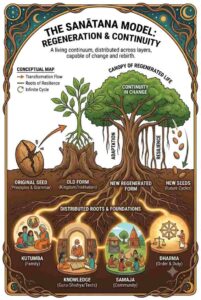 This may explain why the destruction of one institution does not necessarily mean the destruction of an entire civilization. Civilizational life is distributed across multiple social layers. When one layer weakens, another may preserve some part of the larger memory. This does not make society indestructible; history contains many examples of genuine loss. But it creates a capacity for resilience.
Oceanic Circles and the Distributed Life of Civilization
Gandhi’s idea of Oceanic Circles offers a modern expression of an important Indic intuition. He rejected the imagination of society as a pyramid in which the individual stands at the bottom while power accumulates towards the top. Instead, he imagined expanding circles in which the larger does not simply crush or absorb the smaller.
The Sanātana Model of Society follows a similar understanding of social life. The individual, family, community, region and larger political order are interconnected, but one does not necessarily eliminate the significance of another. The movement from Vyakti to Jagat is an expansion of relationships and responsibilities rather than a simple concentration of power.
This is particularly important in understanding Bharat’s diversity. A civilizational order does not require every region, community or language to become identical. Bharat historically contained enormous diversity in social practices, languages, philosophical traditions and political arrangements. Yet these different forms could participate in wider networks of sacred geography, intellectual exchange, pilgrimage and cultural memory.
Unity, therefore, need not always mean uniformity.
The same civilizational world can contain multiple forms of expression.
This distributed character may also help explain civilizational resilience. A civilization stored only in a centralized political structure becomes deeply vulnerable when that structure collapses. A civilization distributed across families, communities, teachers, institutions, texts, sacred spaces and social practices possesses multiple locations of continuity.
Where, then, is civilization stored? Perhaps this is the wrong question if we are looking for one location. A civilization may live in relationships.
A story transmitted by a grandmother, a ritual maintained by a household, a pilgrimage undertaken by generations, a knowledge tradition preserved by a teacher—none of these, individually, represents the whole civilization. Yet together they participate in the larger process through which a civilization remembers itself.
A Living Civilizational Continuum
The Sanātana Model of Society is therefore an attempt to understand Bharat not as a civilization that somehow remained unchanged through history, but as a living continuum capable of change, disruption, adaptation and regeneration.
Its first proposition is simple: civilizational continuity does not depend only upon the permanence of political institutions. It also depends upon the ability of society to reproduce its knowledge, memory, relationships and ways of life across generations.
This reproduction happens through interconnected layers of existence. The Vyakti participates in the Kutumba. The family participates in Samaja. Society creates and sustains regional and political relationships. These, in turn, exist within a wider civilizational order that ultimately places human life within a relationship with the larger Jagat.
This framework also places Dharma at the centre of the larger social imagination. Dharma, in this context, is not merely a religious label. It concerns the sustaining of relationships, responsibilities and order. A society cannot survive through rights and power alone; it also requires relationships of responsibility that connect its different parts.
The Sanātana Model, therefore, offers a different starting point for studying society. Instead of beginning only with the State, market or individual, it asks us to examine the continuum through which social and civilizational life is reproduced.
Bharat did not remain unchanged for millennia. No living civilization does.
The more important question is this: how did Bharat continue to regenerate itself despite change?
The answer may lie in the fact that civilizational life was never confined to one capital, one dynasty or one institution. It was carried through an interconnected continuum of individuals, families, communities, knowledge traditions, sacred geographies and social institutions.
The Sanātana Model begins with this possibility: Bharat’s continuity was not the absence of change, but the ability to carry a civilizational grammar through change and regenerate it in new forms.
This is the first of the ten Indic frameworks. The articles that follow will explore the larger continuum of social life and examine how different Indic categories can help us understand Bharat beyond the limitations of conventional frameworks alone.
